People create more than 3 billion images a week with OpenAI’s tools, about 430 million a day (OpenAI, 2026, daily rate calculated), up from 78 million a day in ChatGPT at the 2025 launch (OpenAI, via TechCrunch, 2025). These AI image generation statistics cover volume, money, law and trust.
AI Image Generation Statistics 2026: 60 Data Points
 Written by Editorial Staff
Key Takeaways
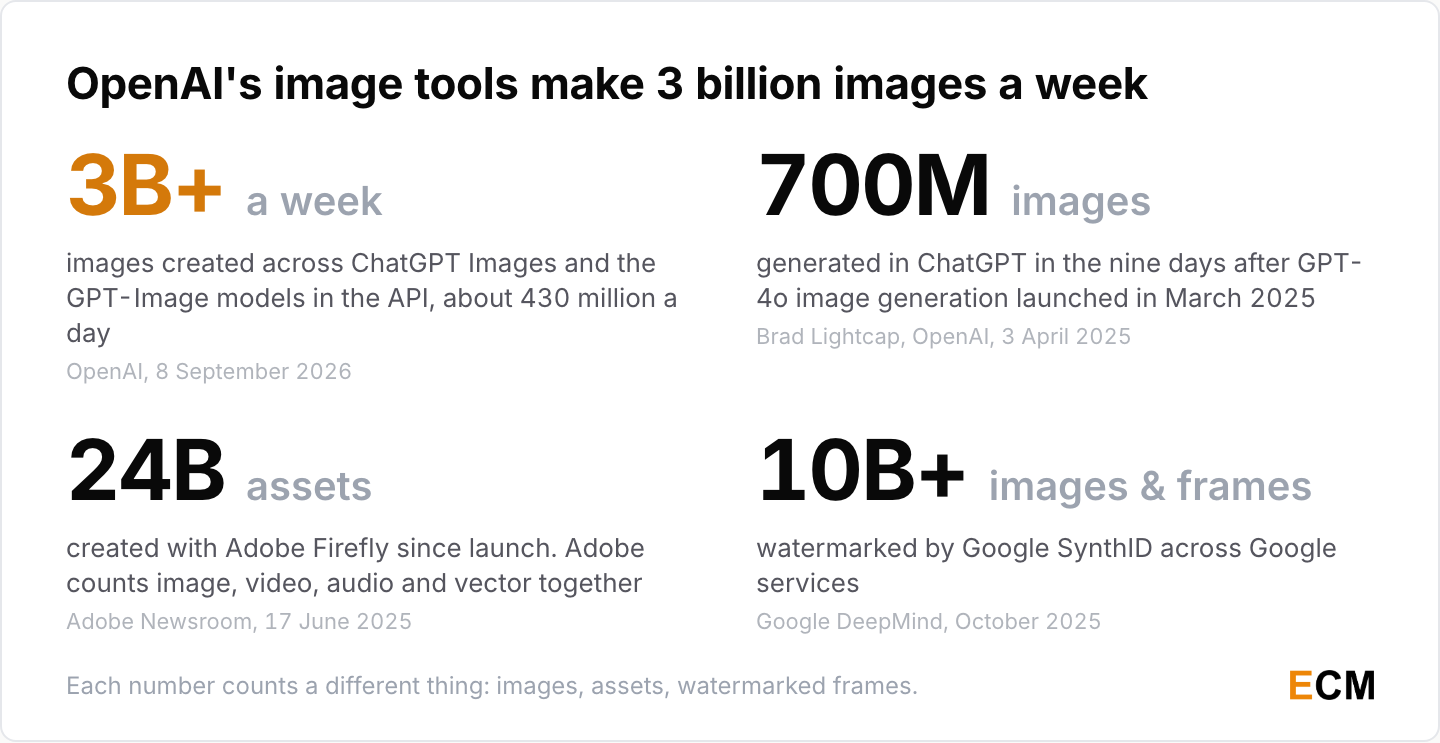
- One company now outruns the old industry estimate more than 12 times over. By September 2026 people were creating more than 3 billion images a week with OpenAI’s image tools, about 430 million a day (OpenAI, 2026, daily rate calculated). At launch, ChatGPT users made more than 700 million between 25 March and 3 April 2025, about 78 million a day (OpenAI, via TechCrunch, 2025), against the 34 million a day Everypixel estimated across the major text-to-image tools (Everypixel Journal, 2023).
- Adobe’s two big numbers count different things. Firefly passed 16 billion “generations” in December 2024 (Adobe Q4 FY2024, via Constellation Research, 2024) and 24 billion “assets” across image, video, audio and vector in June 2025 (Adobe Newsroom, 2025).
- Market estimates split on scope, not activity. Fortune Business Insights puts the image-only market at \$412.51 million for 2025 (Fortune Business Insights, 2026), while MarketsandMarkets reads \$8.7 billion for 2024 partly because it counts video too (MarketsandMarkets, 2024).
- The Getty and Shutterstock merger is dead. Getty terminated the agreement on 7 July 2026 after its board declined the divestiture the UK regulator required on 30 June 2026 (Getty Images 8-K exhibit, 2026).
- No US court has ruled that training on scraped images is fair use. In the UK, the High Court’s judgment in Getty v Stability AI on 4 November 2025 found Stable Diffusion’s weights are not an infringing copy (Getty Images v Stability AI, [2025] EWHC 2863 (Ch), 2025).
- Provenance exists and is barely deployed. The Content Authenticity Initiative had more than 6,000 members by January 2026 (Content Authenticity Initiative, 2026), yet fewer than 1% of news images or videos carry C2PA metadata (Reuters Institute, 2026).
How Many AI Images Are Generated Per Day
No one publishes a global count. What exists is one 2023 estimate and a few company disclosures, each measuring something different.
AI Images Generated Per Day by Platform
The company disclosures run well above the 2023 estimate for the major tools combined, and OpenAI’s own weekly figure now runs far above both.
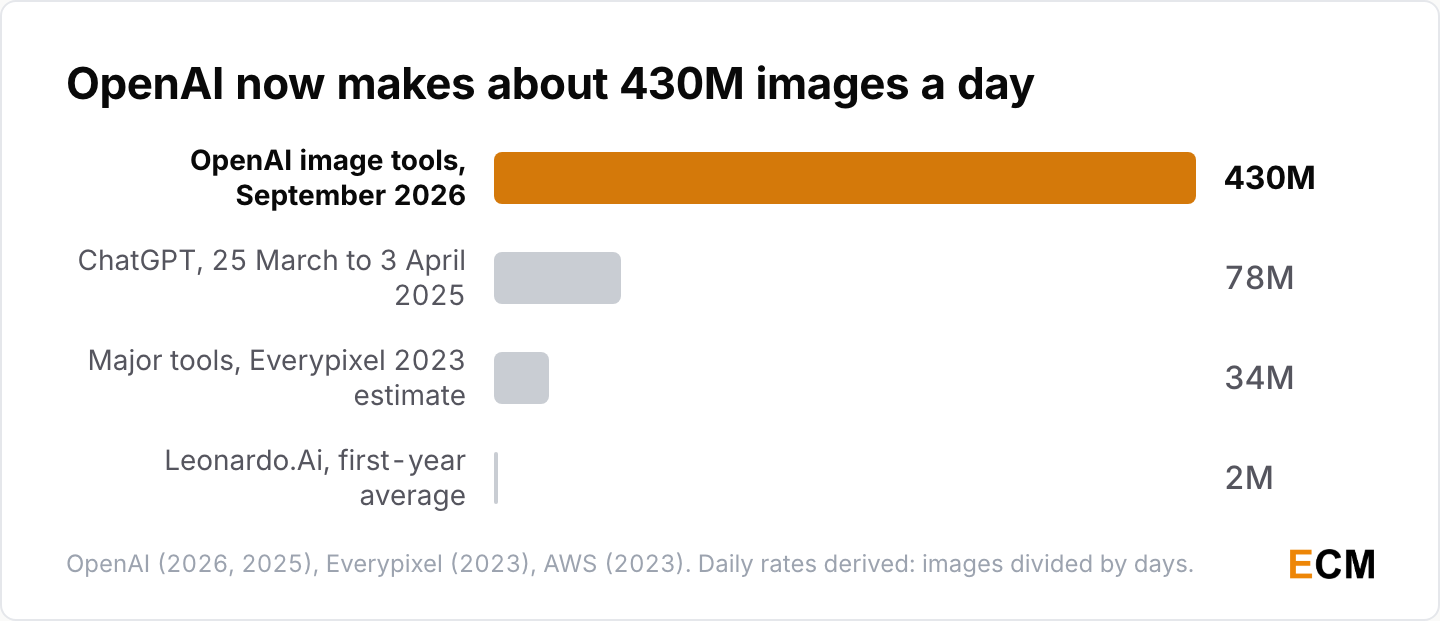
- By September 2026 people were creating more than 3 billion images a week across ChatGPT Images and OpenAI’s GPT-Image models in the API, about 430 million a day (OpenAI, 2026, daily rate calculated). That covers API customers as well as ChatGPT users.
- More than 130 million people generated over 700 million images in ChatGPT between the 25 March 2025 launch of GPT-4o image generation and 3 April 2025 (Brad Lightcap, OpenAI, via TechCrunch, 2025). That works out to about 78 million a day.
- Leonardo.Ai users generated more than 700 million images between its December 2022 launch and November 2023, which works out to about 2 million a day on average, and the platform was creating 4.5 million a day at the time of the release (AWS press release, 2023, daily average calculated). The headline number matches OpenAI’s 2025 launch figure, but over nearly a year rather than nine days.
- Ideogram’s 1.1 million users created more than 75 million images in the six months before its February 2024 funding round (Maginative, 2024).
Everypixel’s 15 Billion Image Estimate
The most-quoted figures on this topic come from one August 2023 blog estimate built from five per-platform components.
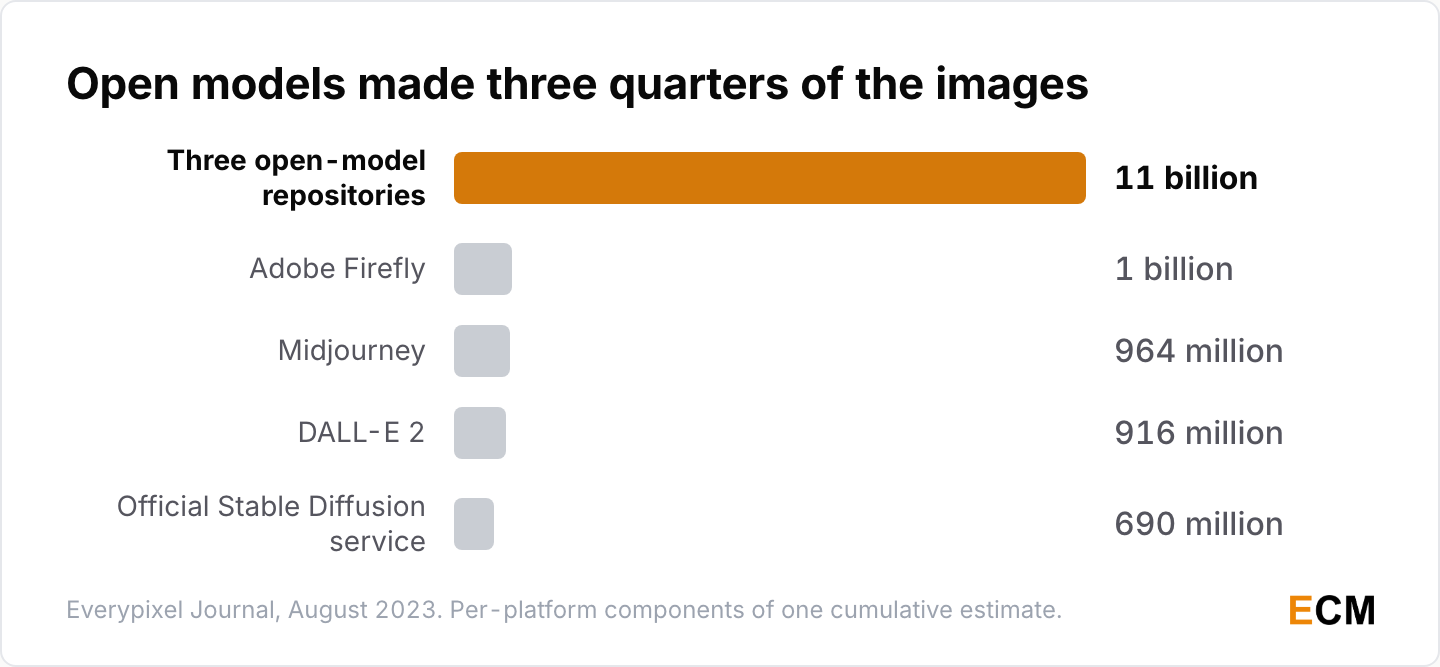
- More than 15 billion images had been created with text-to-image tools between 2022 and 2023, an average of 34 million a day since DALL-E 2 launched in April 2022 (Everypixel Journal, 2023).
- The total sums five estimates: roughly 11 billion made with models from three open-model repositories, about 1 billion for Adobe Firefly, 964 million for Midjourney, 916 million for DALL-E 2 and 690 million for the official Stable Diffusion service (Everypixel Journal, 2023).
- The 11 billion open-model slice is about 75% of the 14.57 billion the components add up to, and Everypixel extrapolated it from Midjourney’s growth trend applied to Stable Diffusion models on GitHub, Hugging Face and Civitai (Everypixel Journal, 2023, share calculated from the published components).
How AI Image Volume Has Grown Over Time
Adobe alone now reports more output than the 2023 estimate gave the whole industry, though every company counts a different unit.
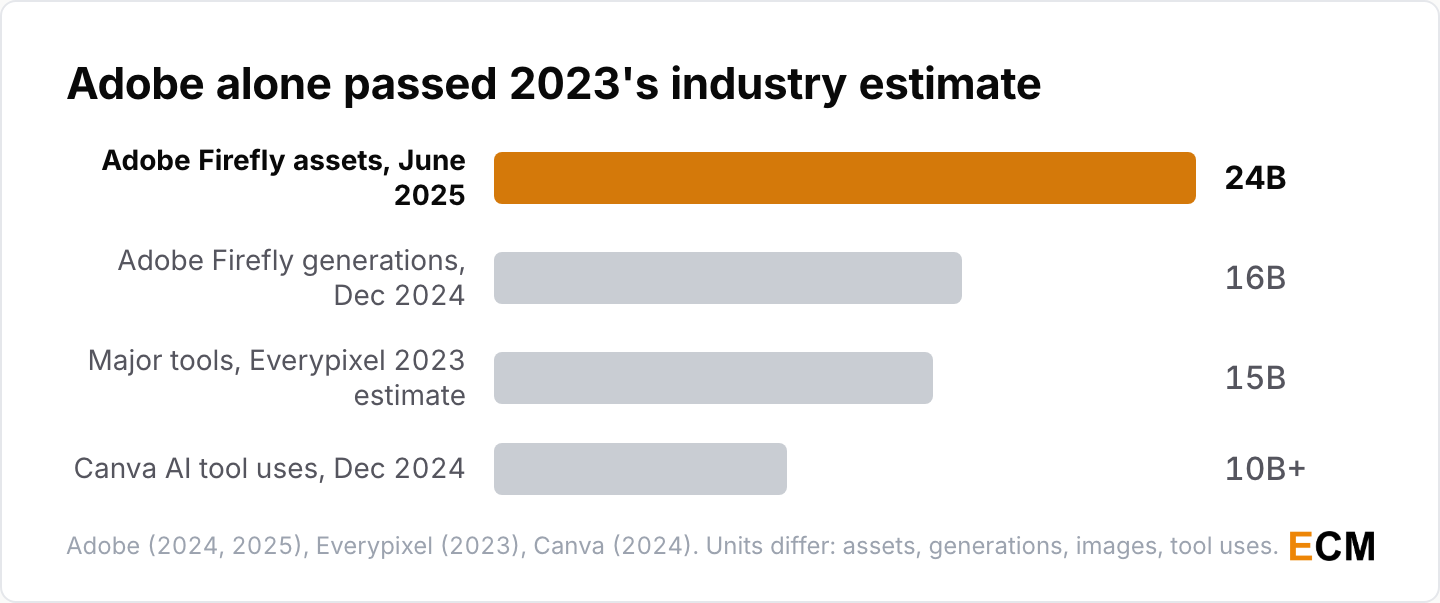
- Firefly generations across the Adobe platform topped 16 billion at Adobe’s Q4 FY2024 results in December 2024 (Adobe Q4 FY2024, reported by Constellation Research, 2024).
- By June 2025 Adobe said creatives had used Firefly “to create more than 24 billion assets”, with Firefly now spanning image, video, audio and vector (Adobe Newsroom, 17 June 2025, 2025). The noun changed, so I read the two as separate snapshots, not one running total.
- Canva’s AI tools had been used more than 10 billion times by December 2024, a count of AI tool uses rather than images (Canva newsroom, 2024).
AI Image Generation Market Size and Investment
Three analyst houses publish a figure you can read without paying. The spread between them comes from where each draws the market boundary.
AI Image Generator Market Size Forecasts
Two houses count image output only and land close together. The third counts video inside the same market name.

- Fortune Business Insights values the global AI image generator market at \$412.51 million for 2025 and \$484.29 million for 2026, rising to \$1,747.63 million by 2034 at a 17.40% compound annual growth rate (Fortune Business Insights, 2026).
- Verified Market Reports sizes its text-to-image generator market at \$0.48 billion for 2025 and \$3.07 billion by 2034, a 20.4% compound annual growth rate over 2026 to 2034 (Verified Market Reports, 2026).
- MarketsandMarkets sizes its AI image generator market at \$8.7 billion for 2024, rising to \$60.8 billion by 2030 at a 38.2% compound annual growth rate (MarketsandMarkets, 2024).
Why Market Size Estimates Differ
Read the scope wording and the twentyfold gap explains itself. Adobe’s revenue shows how much AI image money sits outside any “market” line.
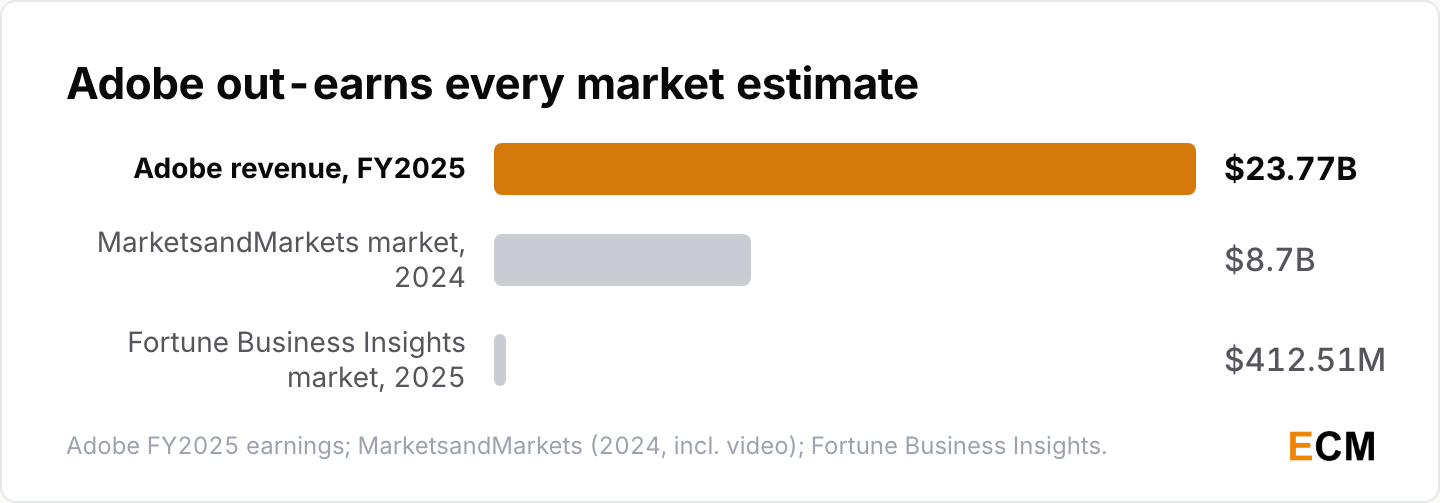
- MarketsandMarkets includes “Image Generation, Image Captioning, Image Manipulation, Video Generation, Video Synthesis, Video Editing” in scope, which is most of why its 2024 figure runs about 18 to 21 times the other two houses’ 2025 figures (MarketsandMarkets, 2024).
- Fortune Business Insights scopes the market to AI that produces “images, artworks, or visual content without direct human intervention”, and Verified Market Reports narrows it to text-prompted generation, so the two land within \$100 million of each other on 2025 (Verified Market Reports, 2026).
- Adobe’s FY2025 revenue was \$23.77 billion, about 58 times Fortune Business Insights’ \$412.51 million estimate for the entire global market in 2025 (Adobe Q4 FY2025 earnings call, Investing.com transcript, 2025). Adobe books AI use as ordinary subscription revenue, so none of it shows up as “AI image” revenue.
AI Image Model Funding Rounds
The open-weights challengers disclose funding rather than usage, so their scale shows up on the cap table.

- Black Forest Labs raised a \$300 million Series B at a \$3.25 billion post-money valuation, led by AMP and Salesforce Ventures, taking total funding past \$450 million (Black Forest Labs, 2025). It names Adobe, Canva, Meta and Microsoft as partners building on its models (Black Forest Labs, 2025).
- Its \$31 million Series Seed, led by Andreessen Horowitz, launched alongside FLUX.1 in pro, dev and schnell variants (Black Forest Labs, 2024).
- Ideogram closed an \$80 million Series A led by Andreessen Horowitz in February 2024 (BetaKit, 2024).
AI Image Generator Usage and Adoption Statistics
Usage is the best-documented part of this topic and the most misquoted, because each company reports a different kind of reach.
Most Popular AI Image Generators by Reach
The biggest tools report people reached, not images made, so none of these is a generation count.
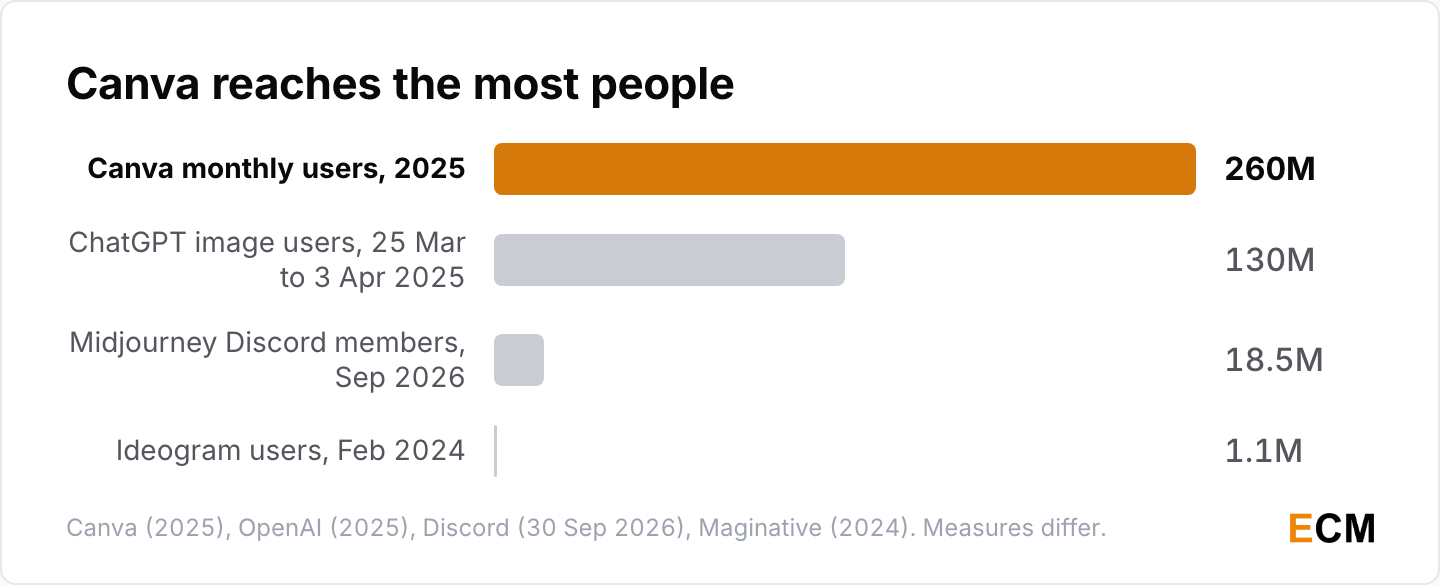
- 260 million people were using Canva every month in 2025 (Canva newsroom, 2025), up from more than 220 million people in 190-plus countries in December 2024 (Canva newsroom, 2024). My Canva AI review covers the image side.
- More than 130 million people used ChatGPT image generation between its 25 March 2025 launch and 3 April 2025 (OpenAI, via TechCrunch, 2025).
- Midjourney’s Discord server listed 18,614,981 members on 9 September 2026 and 18,549,810 members, about 18.5 million, with 555,136 online on 30 September 2026 (Discord public invite endpoint, 2026). Membership is not usage. My Midjourney review covers what it is like to work in.
Adobe Firefly Usage and Revenue Statistics
Adobe ties AI use to its earnings reporting, even if the AI line is its own definition.
- “Total new AI-influenced ARR now exceeds one-third of our overall book of business”, and generative credit consumption “increased 3x quarter over quarter” in Q4 FY2025 (Adobe Q4 FY2025 earnings call, Investing.com transcript, 2025). AI-influenced ARR is Adobe’s own category, so it does not compare across companies.
- Digital Media revenue was \$17.65 billion in FY2025, up 11%, with ending Digital Media ARR of \$19.2 billion, up 11.5% (Adobe Q4 FY2025 earnings call, Investing.com transcript, 2025).
- Adobe has “over 25 leading partner models, including Google, OpenAI, Black Forest Labs, Luma, Runway, Topaz Labs, and ElevenLabs” inside Firefly, Express and Creative Cloud (Adobe Q4 FY2025 earnings call, Investing.com transcript, 2025). My Adobe Firefly review goes through what that means in practice.
How Marketers Use AI for Images
Media creation sits second behind text, and no public survey separates images from video.

- 86.4% of marketing teams use AI in at least a few marketing areas (HubSpot State of Marketing, n=1,500+, 2026).
- 75% of marketers use AI for media production (HubSpot, 2026).
- Media creation is the second most common extensive use of AI at 37.2%, behind content creation at 42.5% and ahead of administrative task automation at 35.6% (HubSpot State of Marketing, n=1,500+, 2026).
- Coca-Cola’s 2025 “Holidays Are Coming” campaign used around 100 people, five of them AI specialists, who generated and refined more than 70,000 clips (ContentGrip, 2025).
AI Adoption Stages in Marketing Teams
People say they have embedded AI far more often than their organizations have.

- 26% of nearly 1,900 marketing and business leaders placed themselves in the Integration stage of AI adoption (Marketing AI Institute, 2025 State of Marketing AI Report, 2025).
- Across 2,100-plus professionals in all functions, 53% of individuals placed themselves in the Integration or Transformation phases, while 47% of organizations were still Piloting, 28% at Understanding and only 25% at Scaling (SmarterX, 2026 State of AI for Business Report, 2026).
AI Readiness Gaps and Search Impact
Most people call AI important and few organizations have a plan for it.
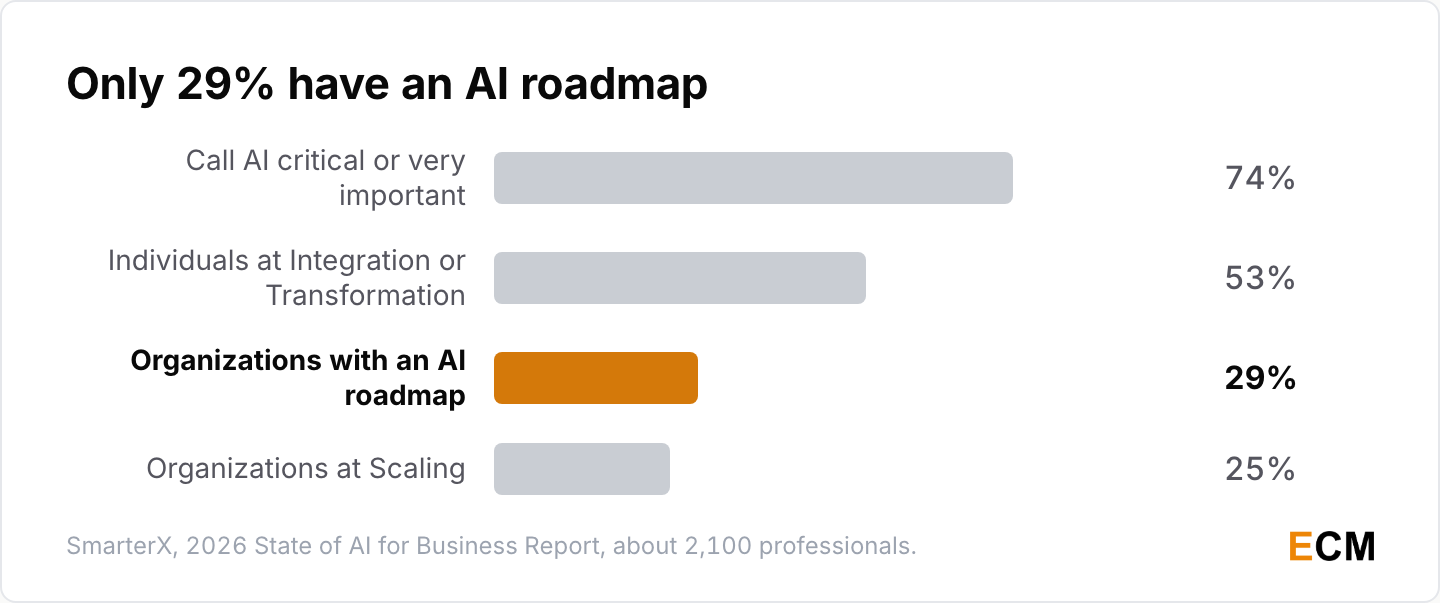
- 74% of respondents said AI is critically or very important to their success in the next 12 months, but only 29% had an AI roadmap (SmarterX, 2026).
- In May 2023, 51% of marketers were already using generative AI, 76% of them for content creation (Salesforce, n=1,029, 2023). That is the start of the trend line, not a current figure.
- 61% of marketers say AI is causing marketing’s biggest disruption in 20 years (HubSpot, 2026), and nearly 30% report lower search traffic as people turn to AI tools (HubSpot, 2026). I cover that shift in the content marketing statistics roundup.
AI Image Copyright and Stock Licensing Statistics
None of the US image-generator cases has reached a fair use ruling. Meanwhile, licensing images to model labs has become a disclosed revenue line.
Stock Photo Licensing and the Getty Merger
Stock libraries now sell their archives as training data, and the planned merger of the two biggest ended in July 2026.

- Shutterstock made \$104 million in 2023 from licensing deals with AI companies, and projected \$138 million for the whole business unit in 2024 and expects “this part of its business” to produce \$250 million in annual revenue by 2027 (Bloomberg, via PetaPixel, 2024).
- The Shutterstock and OpenAI agreement signed in July 2023 runs six years and covers image, video and music libraries plus metadata (Shutterstock, 2023).
- Shutterstock launched AI Services for model training and evaluation on 7 October 2025, citing more than 2 million creators across 150-plus countries and 10 production hubs (Shutterstock, 2025).
- Getty’s board resolved on 30 June 2026 not to sell Shutterstock’s editorial business as the UK Competition and Markets Authority required, and Getty terminated the merger agreement on 7 July 2026 (Getty Images 8-K exhibit, 2026).
Getty Images v Stability AI UK Judgment
Getty lost the copyright claim it took to judgment and won only narrow trade mark points, after dropping its training claim.
- The UK High Court handed down judgment in Getty Images v Stability AI on 4 November 2025, holding at paragraph 600 that “the model weights are not themselves an infringing copy and they do not store an infringing copy” ([2025] EWHC 2863 (Ch), 2025).
- Getty abandoned its training and database claims before closing submissions, accepting at paragraph 9 that “there is no evidence that the training and development of Stable Diffusion took place in the United Kingdom”, and the judgment records its January 2023 letter of claim as covering Getty content “said to be 12 million links” (paragraph 608, judgment, 2025).
- Getty’s section 10(3) trade mark claim failed at paragraph 538. Its section 10(1) claim succeeded only for iStock watermarks from v1.x models, and its 10(2) claim for iStock (v1.x) and Getty (v2.x) watermarks (judgment, 2025).
US AI Image Copyright Case Status
All three US cases were still short of a merits ruling at the end of September 2026.
- Andersen v Stability AI has no merits ruling. The August 2024 order only decided motions to dismiss, and a sanctions motion against DeviantArt filed on 1 September 2026 was resolved by stipulation on 19 October 2026, the day before its hearing (docket 3:23-cv-00201, N.D. Cal., 2026).
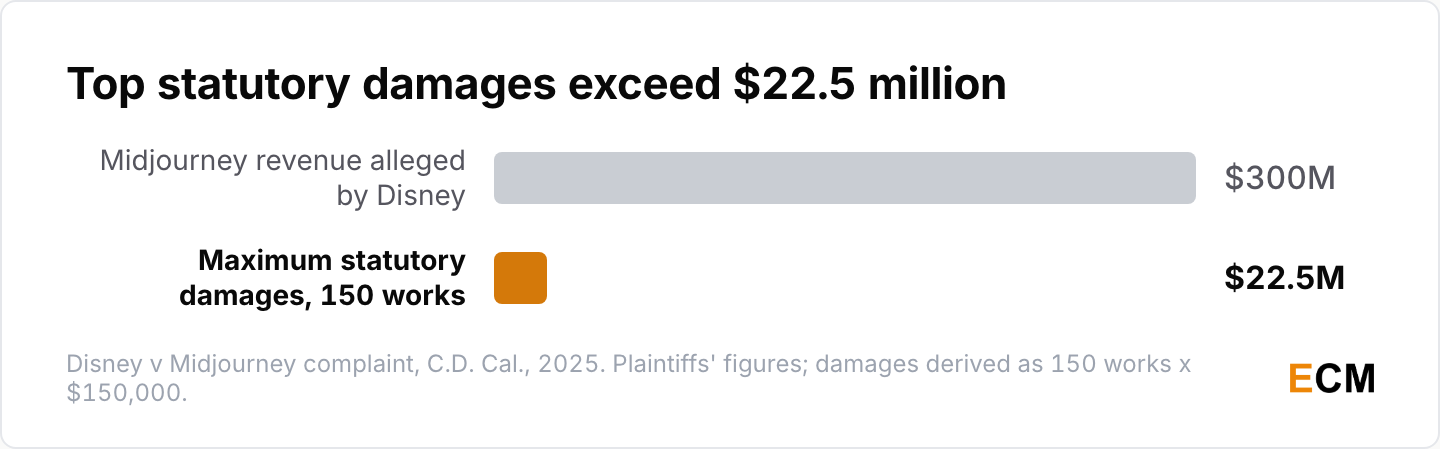
- Disney and NBCUniversal sued Midjourney on 11 June 2025, saying it “reportedly made \$300 million in revenue in 2024” and had nearly 21 million subscribers as of September 2024 (docket 2:25-cv-05275, C.D. Cal., 2025).
- The Disney plaintiffs seek statutory damages of up to \$150,000 per infringed work across more than 150 listed works, which puts nominal exposure above \$22.5 million plus an injunction (docket 2:25-cv-05275, 2025).
- Getty refiled its US case in the Northern District of California on 14 August 2025, where a motion to dismiss was granted in part on 23 April 2026 and a dispositive motion hearing is set for 31 August 2027 (docket 3:25-cv-06891, N.D. Cal., 2026).
AI Image Detection and Content Credentials Statistics
The provenance standard has broad backing and almost no presence in published media, and most detectors fail on new generators.
AI Image Detection Accuracy Rates
People do a little better than chance, and most automated detectors do far worse on recent generators.
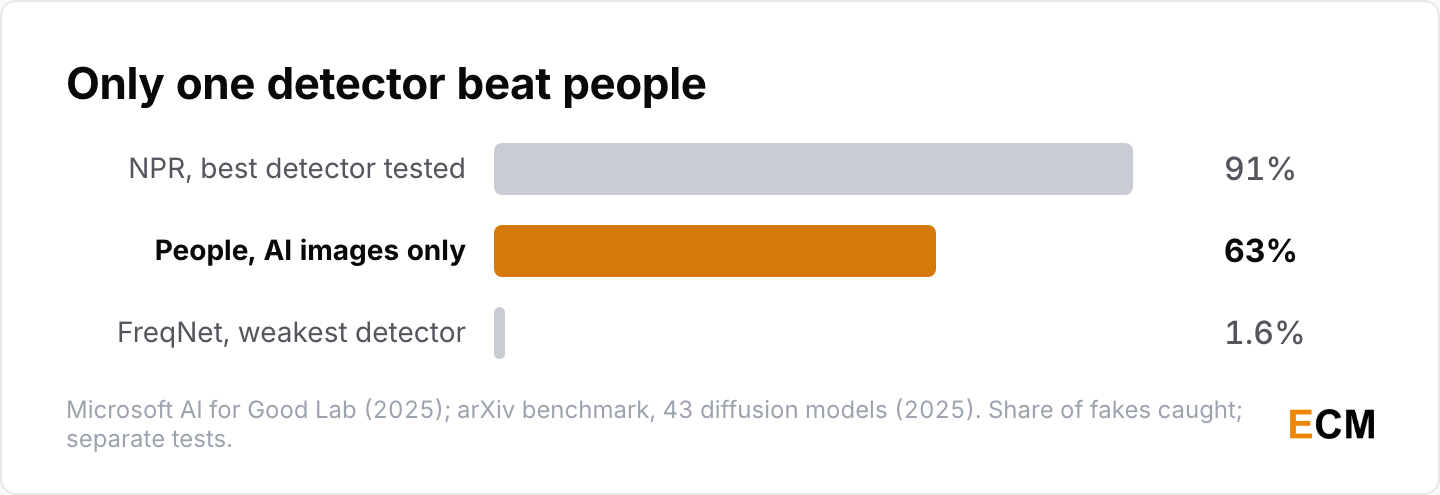
- People do only slightly better than chance: about 12,500 participants making roughly 287,000 image judgments got 62% right, and 63% on the AI-generated images alone (Microsoft AI for Good Lab, arXiv, 2025). They did best on human portraits and worst on landscapes.
- Tested against images from 43 recent diffusion models, seven of ten detectors caught under 13% of the fakes and only one, NPR, beat the 63% people managed on AI images, reaching 91% (AI-Generated Image Detection: An Empirical Study, 2025).
- One detector, FreqNet, dropped to 1.6% on that benchmark despite strong results on other benchmarks (arXiv, 2025). I go deeper in the AI content detection statistics roundup.
- Google’s SynthID has watermarked more than 10 billion images and video frames across Google’s services, and covers only what Google itself generates (Google, arXiv, 2025).
Content Credentials Adoption Statistics
Membership keeps growing while the metadata stays nearly invisible in published news.

- The Content Authenticity Initiative had more than 6,000 members by January 2026 (Content Authenticity Initiative, 2026), after its 5,000th in August 2025 and 4,000th in late 2024 (Content Authenticity Initiative, 2025).
- Cloudflare, whose services are used by about 20% of the web, became the first major content delivery network to support Content Credentials in February 2025, through an opt-in setting in Cloudflare Images (Content Authenticity Initiative, 2025).
- The Leica SL3-S shipped in January 2025 with hardware-signed Content Credentials (Content Authenticity Initiative, 2025), and Sony’s PXW-Z300, announced in July 2025, is the first camcorder to support C2PA for video (Sony, 2025).
- Google joined the C2PA steering committee in February 2024 (C2PA, 2024), OpenAI in May 2024 (C2PA, 2024), and Meta and Amazon followed in September 2024 (C2PA, Meta, 2024; C2PA, Amazon, 2024).
- Fewer than 1% of news images or videos published globally include C2PA metadata, an estimate that comes without a stated method (Reuters Institute, Trends and Predictions 2026, 2026).
Consumer Trust in AI Images Statistics
The Reuters Institute publishes samples, fielding windows and a consistent method every year, which makes it the cleanest independent source on how people feel about synthetic images.
Public Concern About Fake Images Online
Concern about what is real online is rising while trust in news falls.

- 62% of people say they are concerned about what is real and what is fake on the internet when it comes to online news, up from 58% a year earlier (Reuters Institute Digital News Report 2026, n=97,520, 2026; Digital News Report 2025, n=97,055, 2025). Concern rose by more than 5 points in 11 markets.
- Trust in news fell to 37%, “the lowest figure since we started measuring trust in 2015,” after holding at 40% for three years (Digital News Report 2026, 2026).
Generative AI Use and AI Labels
People use generative AI far more than a year ago, but how often they see an AI label on news depends heavily on where they live.
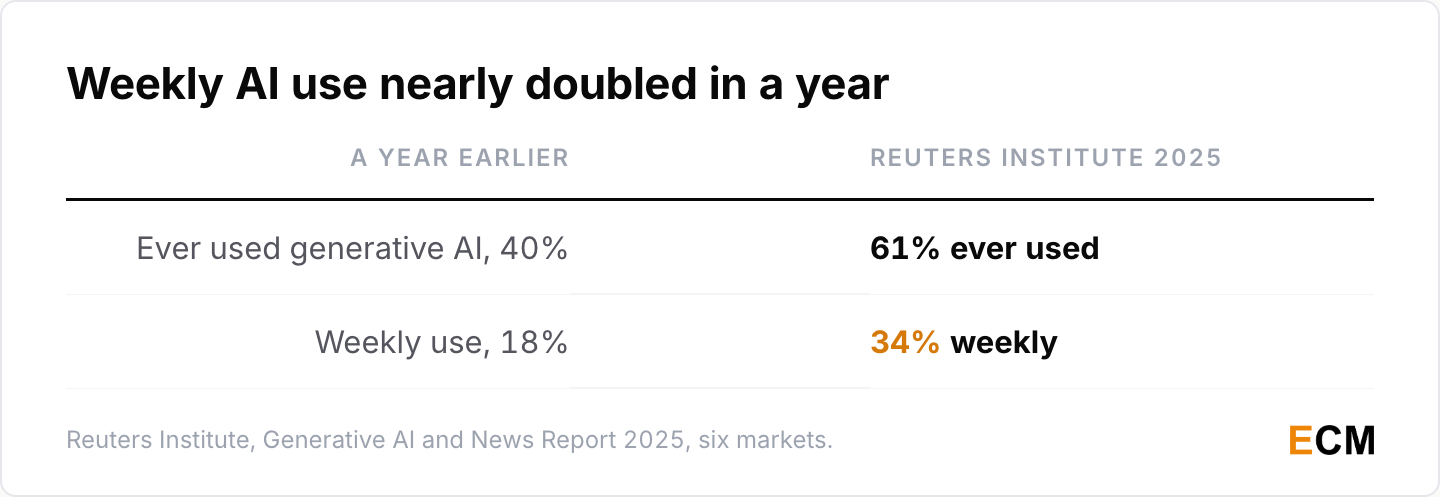

- Across six countries, having ever used a standalone generative AI tool rose from 40% to 61% in a year, and weekly use nearly doubled from 18% to 34% (Reuters Institute, Generative AI and News Report 2025, 2025).
- 6% of people in the UK say they see AI labels on news content daily, against a six-country average of 19%, 12% in Denmark, 16% in the United States and France, 32% in Argentina and 33% in Japan (Generative AI and News Report 2025, 2025).
Where People Check Suspicious News
Asked where they would check a news item they suspect is false, misleading or fake, people put AI chatbots last.
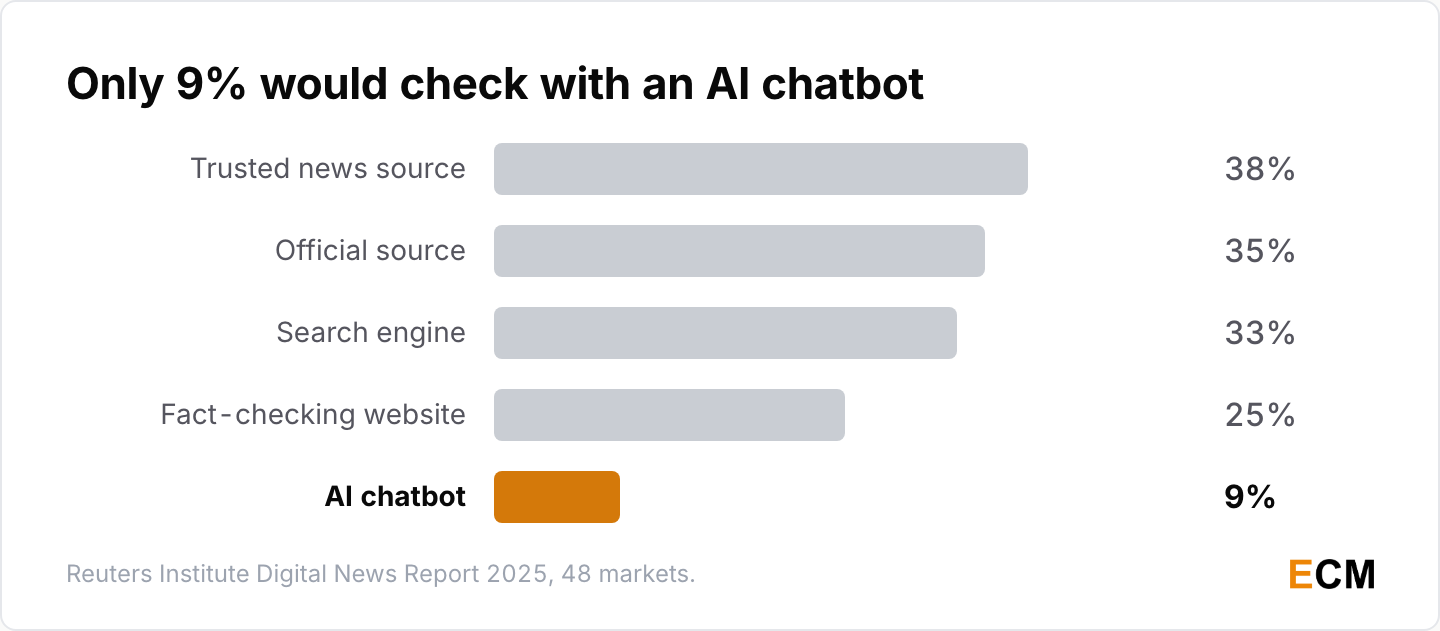
- In a multi-select question, a trusted news source came first at 38%, then an official source at 35%, a search engine at 33% and a fact-checking website at 25%, with an AI chatbot last at 9% (Reuters Institute Digital News Report 2025, 2025).
- Concern about misinformation is highest in Nigeria and Kenya, followed by the UK, Australia and Portugal (Digital News Report 2026, 2026).
Frequently Asked Questions
How Many AI Images Are Generated Per Day in 2026?
No one publishes a global total, but OpenAI now publishes a weekly rate: more than 3 billion images a week across ChatGPT Images and its GPT-Image API models, about 430 million a day (OpenAI, 2026, daily rate calculated). At the 2025 launch, ChatGPT users made more than 700 million images between 25 March and 3 April, about 78 million a day (OpenAI, via TechCrunch, 2025). The 34 million a day figure most pages quote is an August 2023 average across the major text-to-image tools (Everypixel Journal, 2023).
How Big Is the AI Image Generator Market?
It depends on the boundary. Counting image output only, Fortune Business Insights puts 2025 at \$412.51 million (Fortune Business Insights, 2026) and Verified Market Reports at \$0.48 billion (Verified Market Reports, 2026). MarketsandMarkets reads \$8.7 billion for 2024 because its scope includes video (MarketsandMarkets, 2024).
How Many People Use AI Image Generators?
260 million people used Canva every month in 2025 (Canva newsroom, 2025). In the nine days after GPT-4o image generation launched on 25 March 2025, more than 130 million people made images in ChatGPT (OpenAI, via TechCrunch, 2025). Among businesses, 75% of marketers use AI for media production (HubSpot, 2026).
What Are the Most Popular AI Image Generators?
By disclosed cumulative output, Adobe Firefly leads with more than 24 billion assets created by June 2025 (Adobe Newsroom, 2025). By rate, OpenAI’s image tools make more than 3 billion images a week (OpenAI, 2026). By reach, 260 million people used Canva every month in 2025 (Canva newsroom, 2025), and more than 130 million people used ChatGPT image generation between 25 March and 3 April 2025 (OpenAI, via TechCrunch, 2025).
What Do Marketers Use AI Image Generation For?
Surveys bundle images with video, so no public figure isolates images. Media creation is the second most common extensive use of AI among marketers at 37.2%, behind content creation at 42.5% (HubSpot State of Marketing, 2026).
How Is AI Image Generation Affecting Stock Photography?
Stock libraries now sell training data. Shutterstock made \$104 million from AI licensing deals in 2023 and expects “this part of its business” to produce \$250 million a year by 2027 (PetaPixel, 2024). The planned Getty and Shutterstock merger was terminated on 7 July 2026 (Getty Images 8-K exhibit, 2026).
Did Artists Win the AI Copyright Lawsuits?
Not yet. Andersen v Stability AI (docket, 2026), Disney v Midjourney (docket, 2026) and Getty’s refiled US case (docket, 2026) had no merits ruling in September 2026. The UK High Court’s judgment in Getty v Stability AI on 4 November 2025 held that Stable Diffusion’s weights are not an infringing copy, while Getty won narrowly on watermark trade marks ([2025] EWHC 2863 (Ch), 2025).
Can AI-Generated Images Be Detected Reliably?
Not reliably, by people or software. In a Microsoft AI for Good Lab study, about 12,500 participants identified images correctly 62% of the time (arXiv, 2025). A November 2025 benchmark found seven of ten detectors scoring under 13% accuracy on images from 43 recent diffusion models (arXiv, 2025). Provenance helps in principle, but fewer than 1% of news images and videos carry C2PA metadata (Reuters Institute, 2026).
Written by
Editorial Staff
The Editorial Staff represents the writers, editors, and content creators who have worked (or work) at Elite Content Marketer. The experimenter-in-chief behind the team is Chintan Zalani, who has close to a decade of experience trying to make sense of the content marketing industry. Started in 2019, Elite Content Marketer is on a mission to help creators build sustainable businesses.
Related Articles
Marketing Data
Influencer Marketing Statistics 2026: 60 Facts + $33B Market
60 influencer marketing statistics: a $32.55B industry in 2025, $10.5B US spend, budgets, ROI, platforms, consumer trust, creator pay and burnout.
Oct 25, 2026Read more →
Marketing Data
Creator Economy Statistics 2026: 60 Facts + $250B Market
60 creator economy statistics: a $250B market (2023), $37B projected US creator ad spend, 10.1M US independent creators, earnings, AI and burnout.
Oct 24, 2026Read more →
Marketing Data
Affiliate Marketing Statistics 2026: 60 Facts + $13.6B Spend
60 affiliate marketing statistics: $13.62B in US spend in 2024, 9.4% of US e-commerce sales, a 15X UK return and what affiliates really earn.
Oct 23, 2026Read more →