We frequently hear of companies encouraging employees to “work more and play less”, expecting them to go above and beyond. There is the underlying belief that the quantity of hours exerted determines the productivity and value of an employee in the corporate world.
28 Alarming Workplace Burnout Statistics You Should Know
 Written by Editorial Staff
However, many studies have shown that the unrelenting drive of companies to get employees to work longer hours is just leading to burnout among them, which is defined by the World Health Organization (WHO) as a syndrome resulting from chronic workplace stress that has not been successfully managed, marked by energy depletion or exhaustion, mental distance from the job and reduced professional efficacy.
If you are an employer who wants to understand the dire consequences of employee burnout, their causes, their costs, and how to improve the situation, we have collected some of the most important burnout stats for you.
Let’s begin by looking at some general workplace burnout statistics.
General Burnout Statistics By Industry
To get started, let’s look at what percentage of workers are experiencing workplace burnout, and what, if anything, employees report their organizations are doing about it, as well as other burnout trends.
1. 52% of American workers were feeling burnt out in 2021, according to the responses in an Indeed survey. (Indeed)
2. According to a Gallup study, 49%, or nearly half, of workers who were neither thriving nor engaged were feeling stressed the previous day, compared with 30% of thriving and engaged workers. (Gallup) 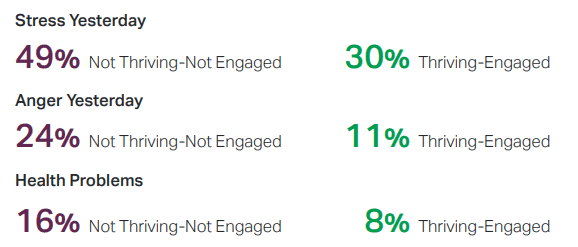
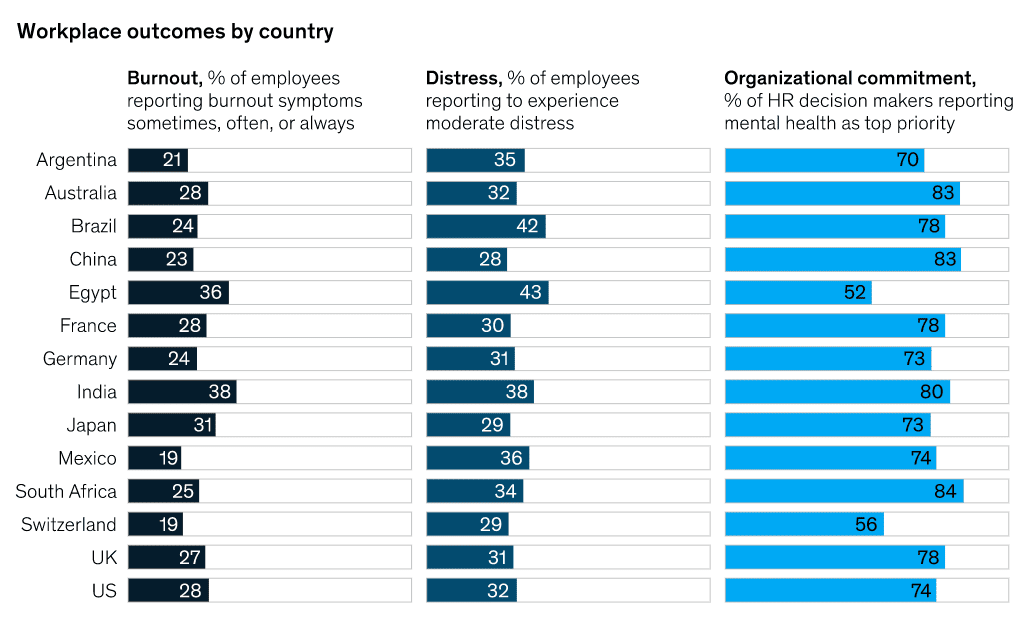
3. Employees report high rates of burnout and distress symptoms, despite an organizational commitment to mental health and well-being as a priority. (McKinsey)
4. Toxic workplace behavior is the biggest driver of negative workplace outcomes, such as burnout and intent to leave. (McKinsey) 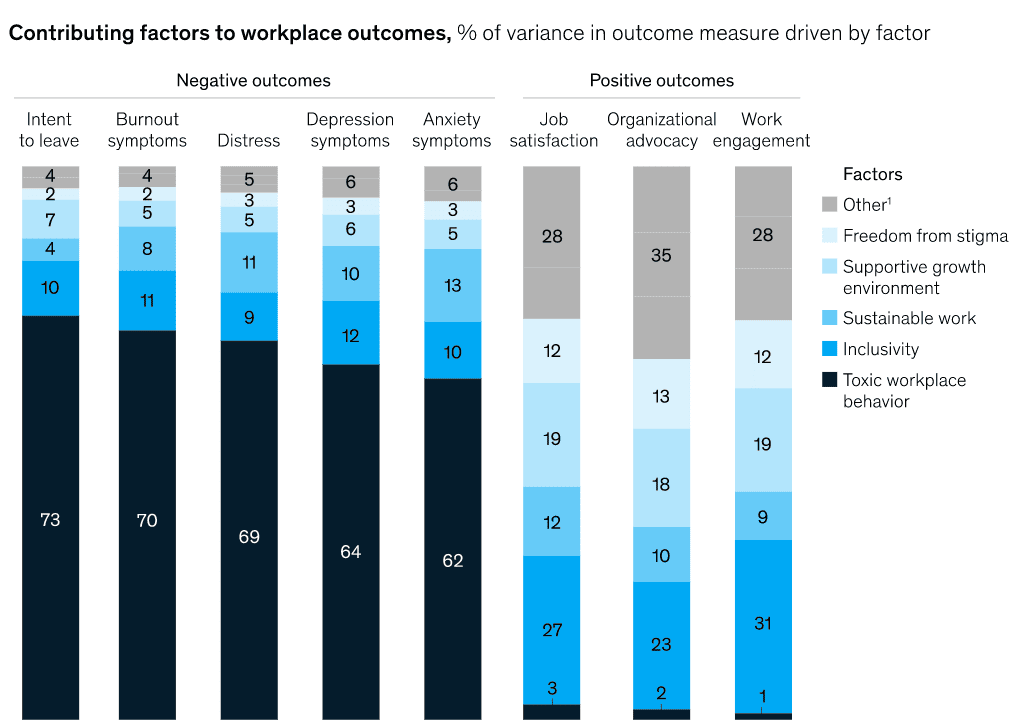
5. After the onslaught of the pandemic, 50% of employees reported feeling less connected with colleagues, and 36% reported feeling less positive about their careers. (Eagle Hill Consulting) 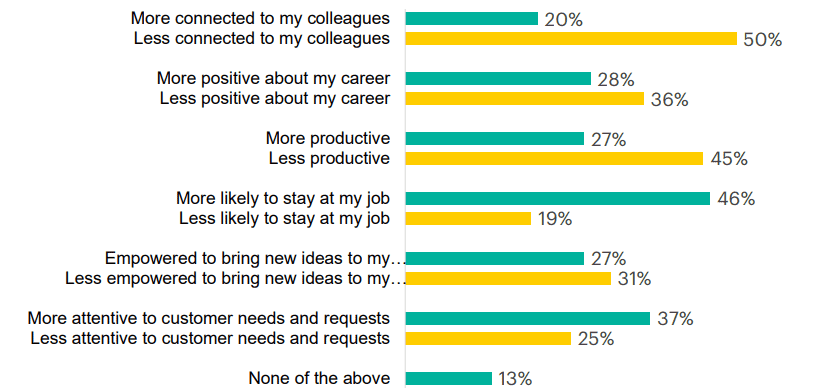
6. 36% of employees report that their organizations are not doing anything to help with employee burnout. (Eagle Hill Consulting)
7. Only 33% of workers in the United States and Canada were engaged in 2021. (Gallup)
8. It was found in a study by Visier that 91% of women experience burnout compared to 86% of men. (Visier) 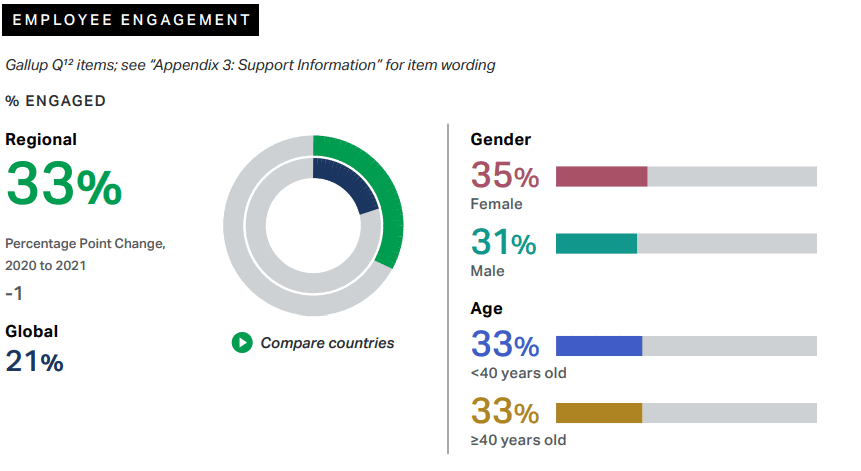
9. More than two-thirds (70%) of employees would consider leaving their current company for a different one that offered comprehensive resources, benefits, support, and/or policies intended to reduce burnout. (Visier)
Covid-19 Pandemic Burnout Statistics
The pandemic took a huge toll on mental health, so much so that stress levels were at an all-time high.
Moreover, with fears of an economy in regression, companies really pushed workers to their limits to ensure profitability.
All these lead to significantly high burnout rates, which we must explore because the work-from-home trends that started during the pandemic are likely to persist. Consequently, it would be essential to understand how to treat employees well in such circumstances.
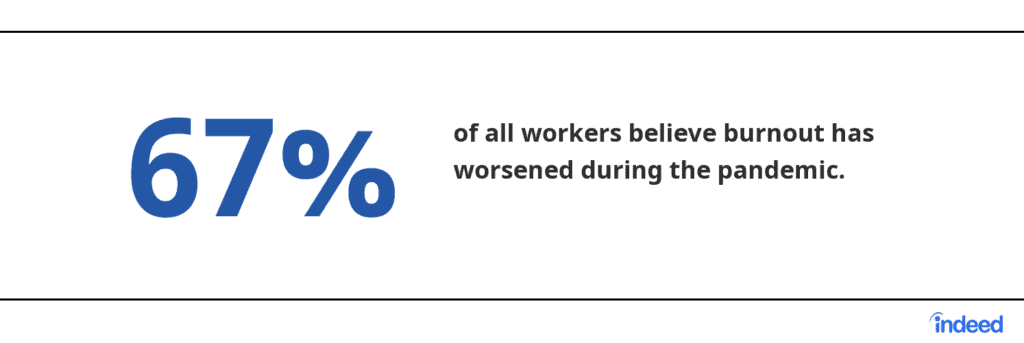
1. 67% of workers believe that the feeling of being burnt out has worsened over the course of the pandemic. (Indeed)
2. Employed workers are more than three times more likely to report poor mental health in July 2020 versus before the pandemic. (FlexJobs) 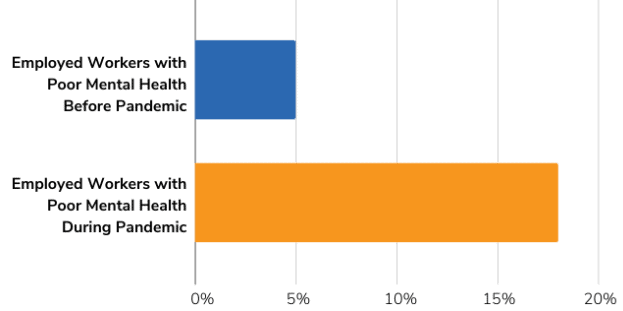
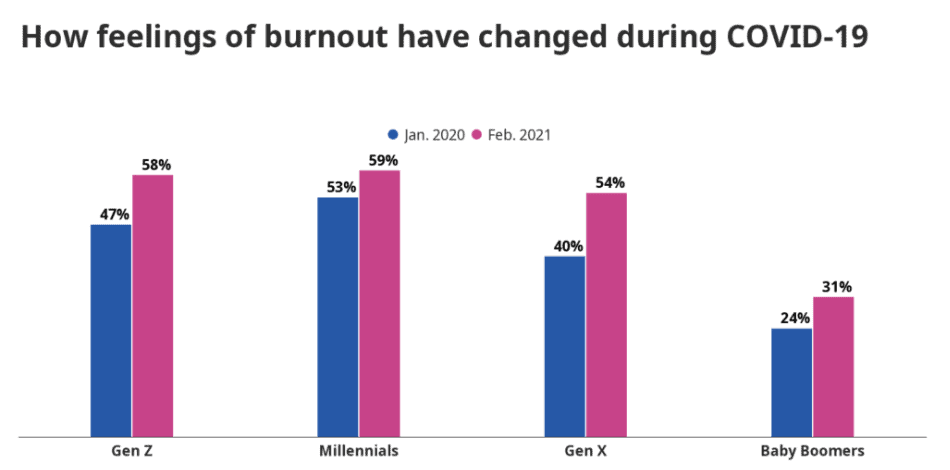
3. The younger generation remains the most affected by burnout post-COVID, with 58% of Gen Z and 59% of Millenials reporting burnout.
4. Gen X and Gen Z saw the biggest rise in post-COVID burnout symptoms, with a rise of 14 and 11 percentage points, respectively.
Work From Home Employee Burnout Stats
1. According to a 2021 Indeed survey, 38% of remote workers report their burnout has worsened over the course of the pandemic as compared to 28% of those working on site. (Indeed)
2. 53% of virtual or work-from-home employees are working more hours now than they were in the office, which is leading to significantly higher feelings of being burned out. (Indeed)
The Causes of Burnout
Having just looked at some of the data on employee burnout in the industry, we should try to understand in depth what exactly are the causes of burnout. If you are an employer, this will help you get a sense of employee burnout and its causes in your organization, so that you can take steps to mitigate the issues.
1. 16% of workers haven’t taken any time off during the pandemic, while 14% have taken less time off than they did before, which is increasingly leading to employees experiencing burnout. (Indeed)
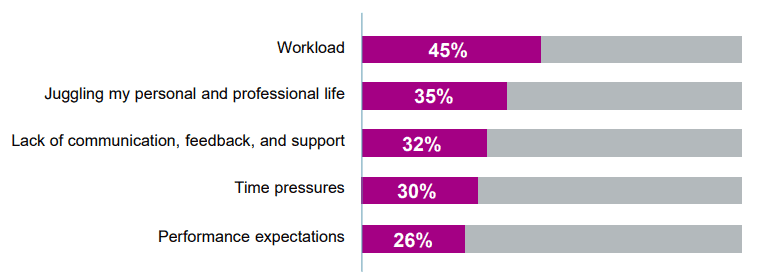
2. Workload, juggling personal life, and lack of communication and support are the top reasons employees are feeling burnout at work. (Eagle Hill Consulting)
3. According to a study by Visier, 44% of employees reported that being asked to take on more work was the No. 1 reason for them feeling burnt out. (Visier)
Costs of Employee Burnout: Statistics, Trends, & Facts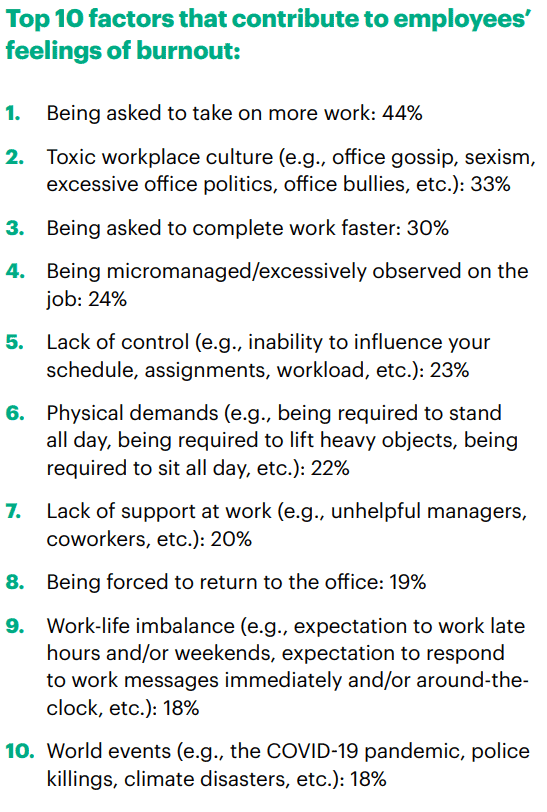
The causes of burnout are only half the story. Those causes eventually lead to burnout that costs companies millions in revenue and lost productivity every year.
To truly appreciate the serious consequences of burnout, here are some of the costs of having burned out employees in your company.
1. More than two in five intend to change jobs, up from one in three in 2019. (American Psychological Association)
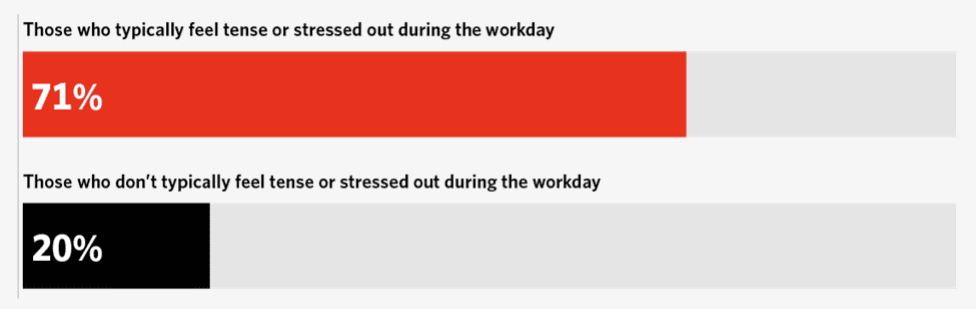
2. 71% of those who typically feel tense or stressed out during the workday say they intend to seek employment elsewhere, as compared to only 20% who say the same when they are not stressed. (American Psychological Association)
3. Employees who are not engaged cost their company the equivalent of 18% of their annual salary, according to a recent study. (Gallup)
4. In a company of 10,000 employees with an average salary of $50,000 each, the cost of disengaged employees is approximately $60.3 million annually, based on a study by Gallup. (Gallup)
5. Teams in the top quartile of employee engagement had 81% lower absenteeism than those in the bottom quartile, which can lead to a significant reduction in costs incurred by companies. (Gallup)
How to Take Care of Employee Mental Health: Tackling Workplace Stress
Having learned about the rates of burnout, its causes, as well as its costs, it is now essential to learn what a potential employer can do to help their employees feel less stressed and burned out.
Here are some of the solutions to bring about better work life balance and reduce burnout, as per employee consensus and workplace studies.
1. The most popular COVID-era perk is flex scheduling, with 90% of virtual and 77% of on-site workers taking advantage of the offering. (Indeed)
2. Employees say that more flexibility in scheduling and working remotely, or simply more PTO, could help to reduce burnout (36% each). (Indeed)
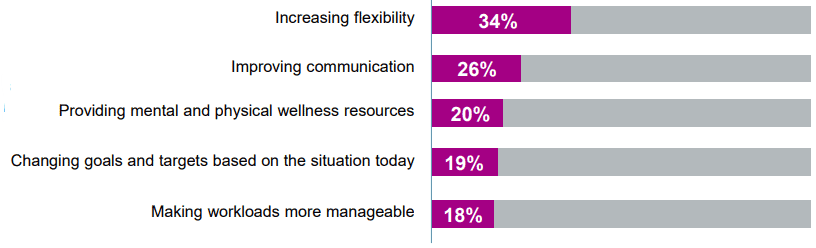
3. 34% of employees say their organizations are increasing workers’ flexibility to help with burnout. (Eagle Hill Consulting)
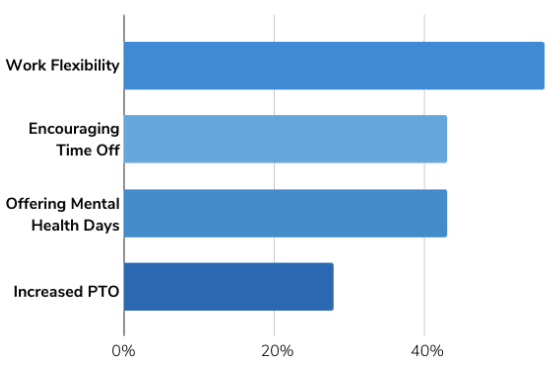
4. Encouraging time off and offering mental health days were reported to be beneficial for 43% of respondents, as per a 2020 survey. (FlexJobs)
5. Some of the recommended methods for employees to reduce stress and avoid the feeling of being burned out:
- Focus on Work only during work hours
- Ask for flexible scheduling
- Engage in more personal activities
- Turn off email and work notifications
- Develop boundaries between your work life and personal life. (FlexJobs)
Final Thoughts
It is clear from all the data we have discussed that a very large number of workers reported feeling burned out. No doubt, the COVID-19 pandemic has played a major own role in making the situation worse.
Fortunately, employers can mitigate the circumstances leading to employees experiencing burnout and prevent wasted efforts in a post-pandemic future by adopting plans that are good for both employees and the company.
If you’re an employer, we highly recommend you take steps to prevent burnout and ensure employee well-being.
Written by
Editorial Staff
The Editorial Staff represents the writers, editors, and content creators who have worked (or work) at Elite Content Marketer. The experimenter-in-chief behind the team is Chintan Zalani, who has close to a decade of experience trying to make sense of the content marketing industry. Started in 2019, Elite Content Marketer is on a mission to help creators build sustainable businesses.
Related Articles

Marketing Data
Career Change Statistics 2026: 59 Facts That Matter
59 career change statistics for 2026: how often people switch careers, why they do it, the average age, what it pays and what stops them.
Nov 9, 2026Read more →
Marketing Data
EdTech Market Statistics 2026: 60 Funding and AI Facts
60 edtech market statistics for 2026: market size, venture funding, Duolingo and Coursera results, school device use, AI adoption and cybersecurity data.
Nov 3, 2026Read more →
Marketing Data
Branding Statistics 2026: 60 Facts You Need to Know
60 branding statistics for 2026: brand value rankings, trust and authenticity, user-generated content, social media, loyalty and B2B branding data.
Nov 2, 2026Read more →