More than 1 billion users ask Google for translation help every month (Google, 2026). These AI translation statistics cover the market, adoption, accuracy, jobs, dubbing and the demand case for multilingual content.
57 AI Translation Statistics for 2026: 1B Monthly Users
 Written by Editorial Staff
Key Takeaways
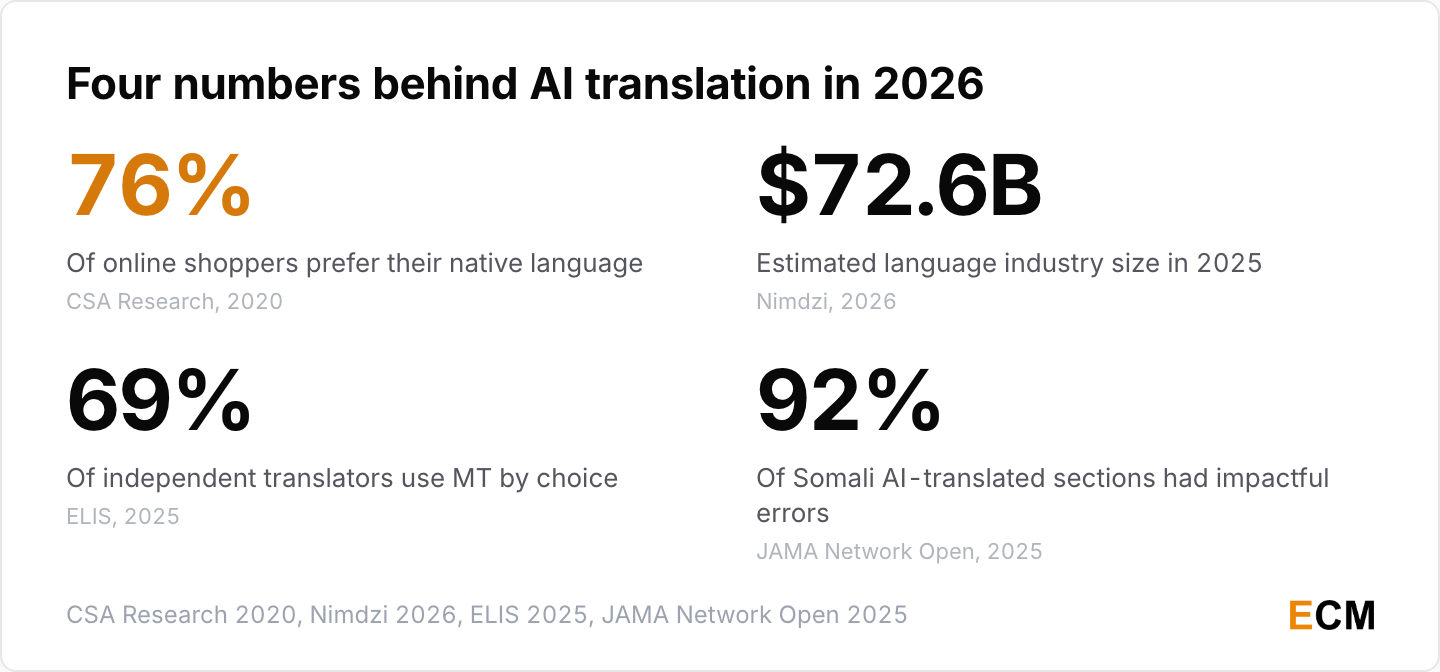
- 76% of online shoppers prefer to buy products with information in their native language, and 40% will never buy from websites in other languages (CSA Research, 2020).
- The language industry reached an estimated $72.6B in 2025 and is projected to reach $73.4B in 2026 (Nimdzi 100, 2026).
- 69% of independent language professionals in the European Language Industry Survey used machine translation on their own initiative, up from 58% a year earlier (ELIS 2025, 2025).
- At one US children’s hospital, AI-translated discharge instructions had clinically impactful errors in 92% of Somali sections, against 7% of Spanish sections (JAMA Network Open, 2025).
- YouTube averaged more than 6 million daily viewers watching at least 10 minutes of auto-dubbed content in December 2025 (YouTube, 2026).
- 36% of translators in the Society of Authors’ January 2024 survey had already lost work to generative AI (Society of Authors, 2024).
AI Translation Market Size and Industry Trends
The translation market has almost stopped growing, while the money inside it moves from human services to AI products and software.
How Big the Translation Market Is in 2026
Nimdzi puts the language industry at $72.6B and expects close to flat growth through 2030.
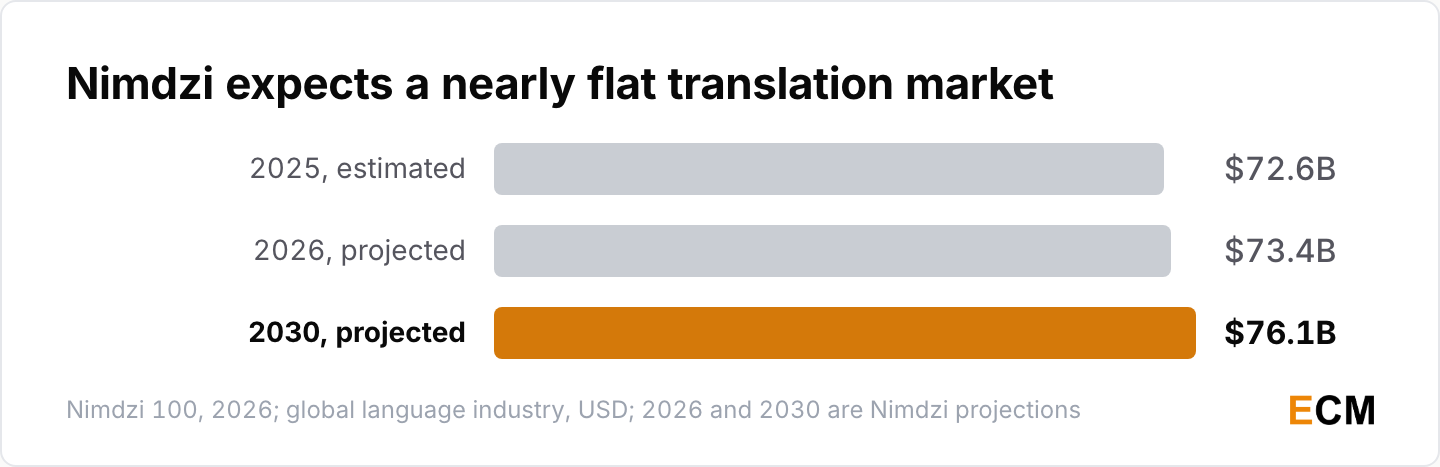
- The language industry reached an estimated $72.6B in 2025, is projected at $73.4B in 2026, and grows less than 1.0% a year afterwards to $76.1B by 2030 (Nimdzi 100, 2026).
- The 100 largest language providers made up 19.8% of total industry size in 2025, so the market is still highly fragmented (Nimdzi 100, 2026).
Where Translation Company Revenue Is Moving
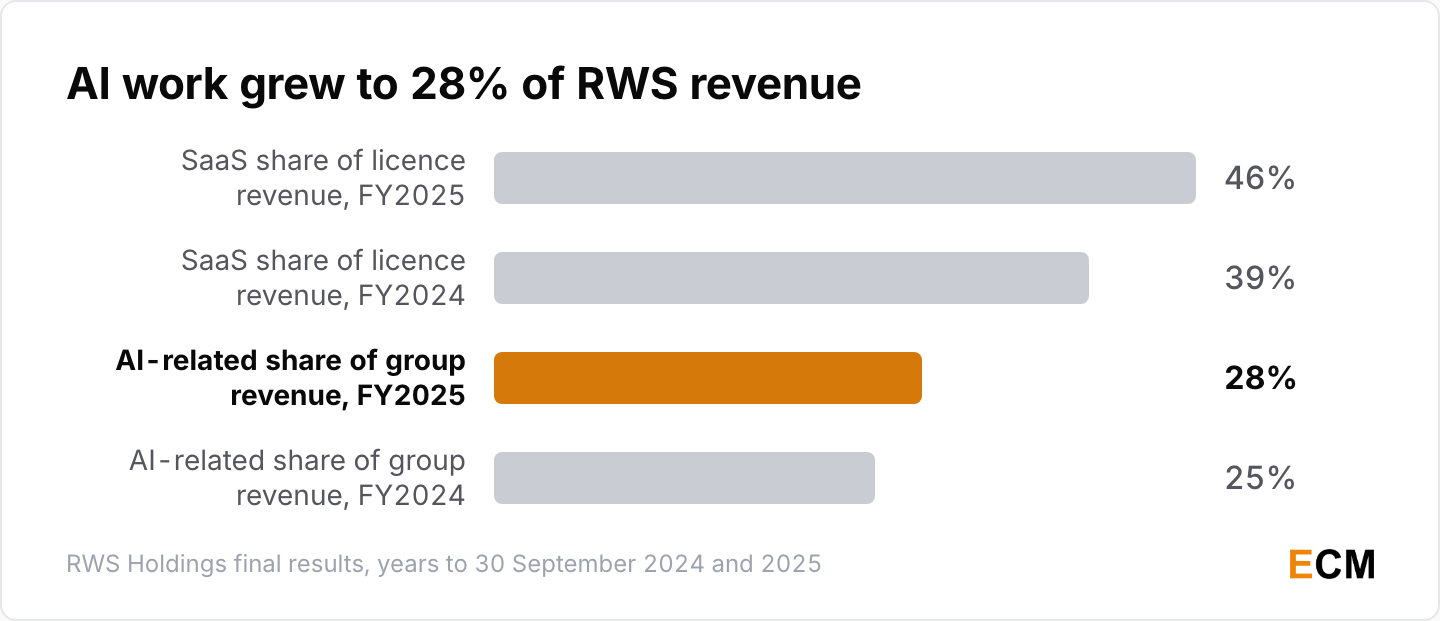
AI products are taking a bigger share of revenue, even at providers whose total sales fell.
- RWS Holdings reported revenue of £690.1m for the year to 30 September 2025, down 4% on the previous year (RWS Holdings, final results, 2025).
- RWS’s adjusted profit before tax fell 43% to £60.4m over the same year (RWS Holdings, final results, 2025).
- AI-related products and services made up 28% of RWS group revenue, up from 25%, and SaaS reached 46% of its licence revenue, up from 39% (RWS Holdings, final results, 2025).
- TransPerfect’s billed revenue rose 7% to $1.32B in 2025, its 33rd consecutive year of growth (TransPerfect, 2026).
- TransPerfect’s GlobalLink technology licensing revenue grew 18%, and its GlobalLink NOW AI translation portal passed 150,000 active client users (TransPerfect, 2026).
AI Voice and Translation Company Revenue
The fastest growth sits with AI voice and video companies, where dubbing is one product among several.
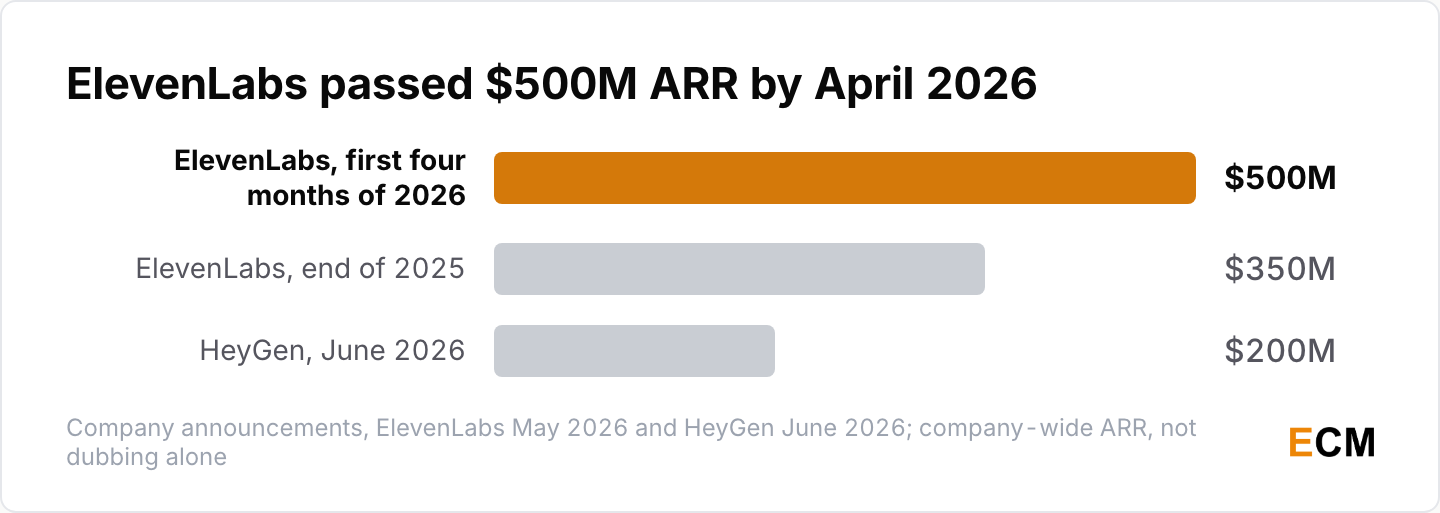
- ElevenLabs ended 2025 with $350M in annual recurring revenue and passed $500M in the first four months of 2026, across a business that also sells voice agents (ElevenLabs, 2026).
- HeyGen passed $200M in annual recurring revenue in June 2026, doubling in eight months, with more than 30 million users in 196 countries (HeyGen, 2026).
- DeepL raised $300M at a $2B valuation in May 2024 (DeepL, 2024) and had over 200,000 customers across 228 markets by November 2025 (DeepL, 2025).
Why AI Translation Got So Cheap
Translation now runs on general language models, and the price of running them collapsed in under two years.
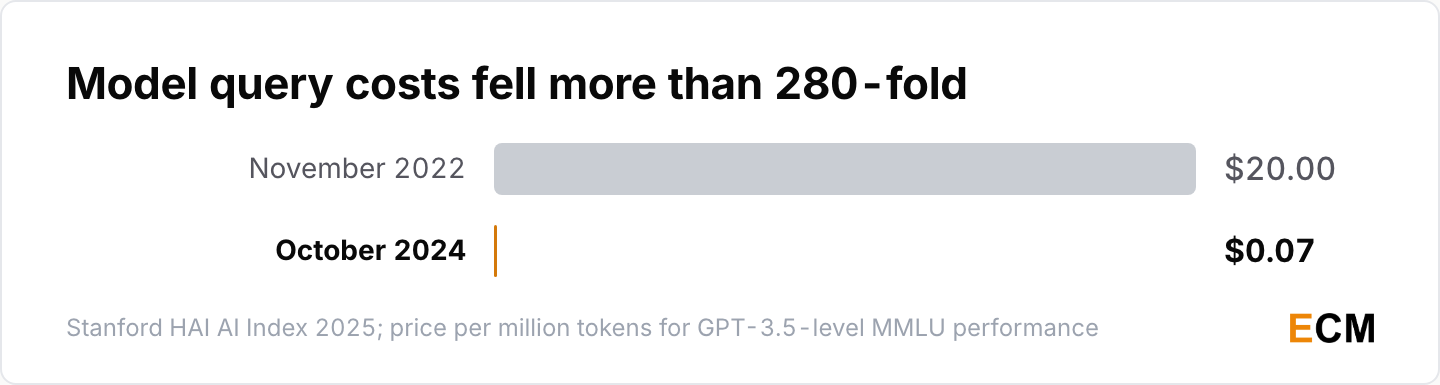
- The cost of querying a model that scores like GPT-3.5 on MMLU fell from $20.00 per million tokens in November 2022 to $0.07 by October 2024, a more than 280-fold drop (Stanford HAI, AI Index 2025, 2025).
- Depending on the task, LLM inference prices have fallen anywhere from 9 to 900 times per year (Stanford HAI, AI Index 2025, 2025).
How Businesses and Translators Use AI Translation
Machine translation is now a default tool for translators and a feature inside everyday Google products. Pricing and plans for DeepL, ElevenLabs and HeyGen are in their own reviews.
How Many People Use Google Translate
Translation has moved into search and the camera, which is why Google’s usage numbers are so large.
- More than 1 billion users ask Google for translation help each month, and people translate around 1 trillion words a month across Translate, Search, Lens and Circle to Search (Google, Translate at 20, 2026).
- Google Translate works for almost 250 languages and more than 60,000 potential language pairs, covering 95% of the world’s population (Google, Translate at 20, 2026).
Business Adoption of AI Translation Tools
Businesses treat AI translation as a growth tool, though the clearest survey here comes from a translation vendor.
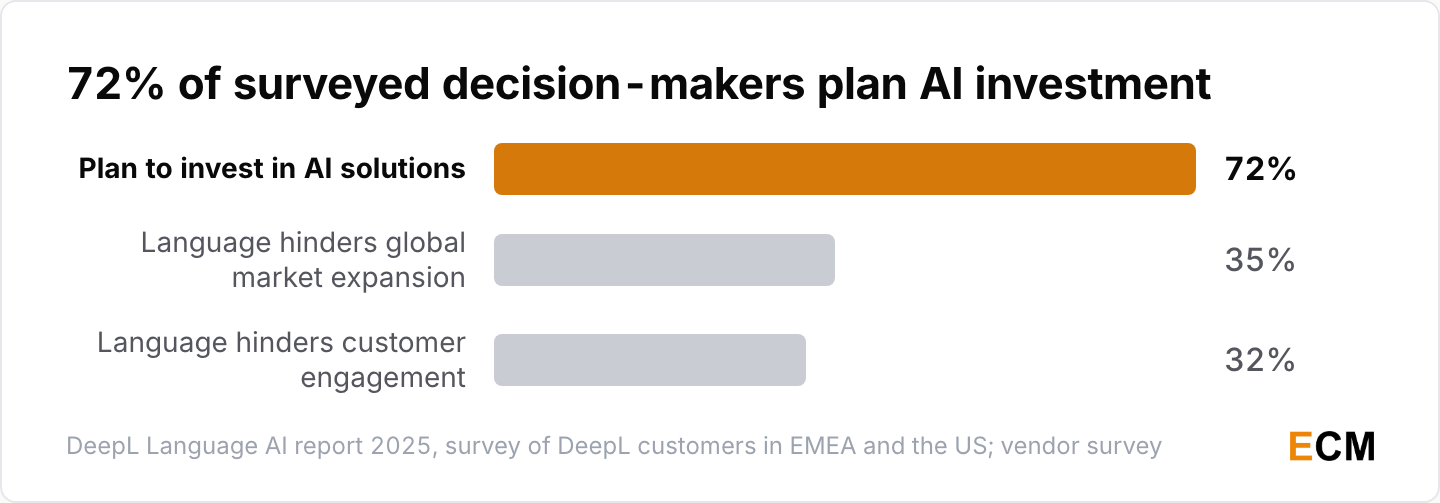
- In DeepL’s survey of customers across EMEA and the US, language barriers held back global market expansion for 35% of businesses and customer engagement for 32% (DeepL, Language AI report, 2025).
- 72% of business decision-makers in the same survey plan to invest in AI solutions, and over one-third of respondents see AI translation tools as essential for in-house translation (DeepL, Language AI report, 2025).
How Translators Use Machine Translation
Most European translators now choose machine translation themselves, whether or not a client pre-translated the file.
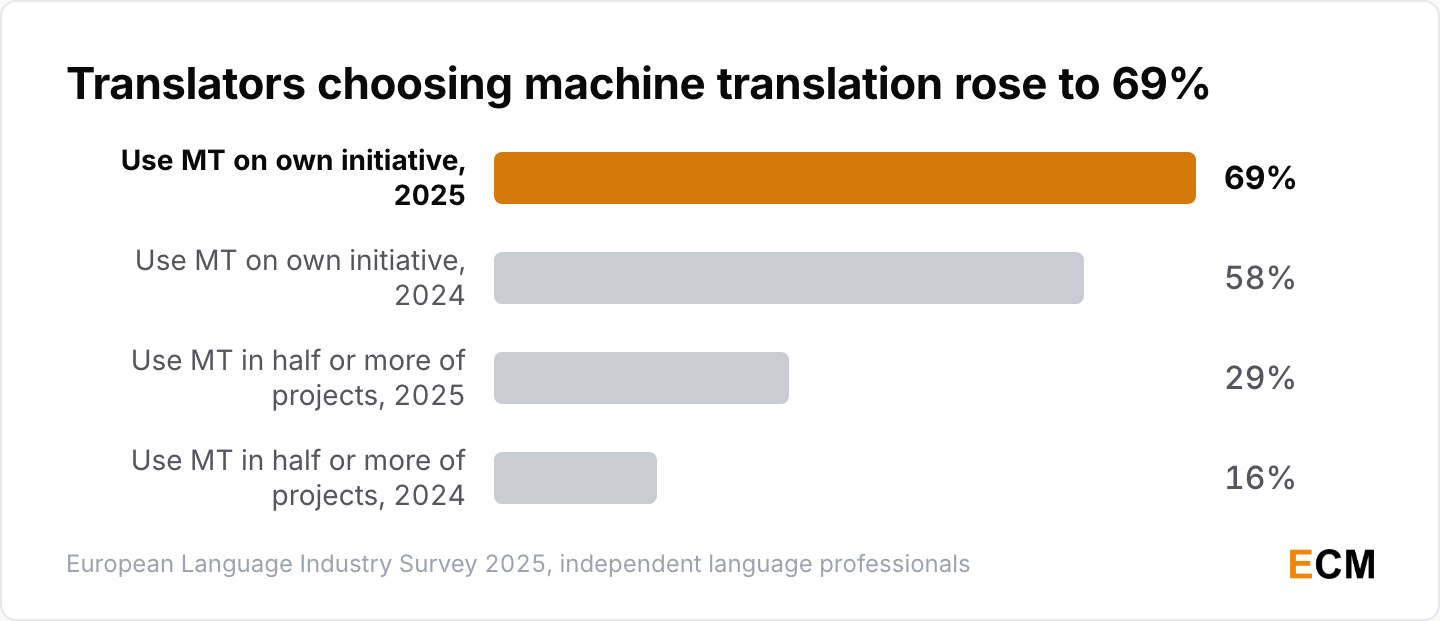
- 69% of independent language professionals in ELIS 2025 (654 of its 1,322 respondents) used machine translation on their own initiative, up from 58% in 2024 (ELIS 2025, 2025).
- 29% of those independent professionals used machine translation in half or more of their projects, up from 16% in 2024 (ELIS 2025, 2025).
- Language companies in the same survey reported machine translation in 50% of handled projects, with AI at 34% (ELIS 2025, 2025).
- ELIS 2026 put total use of automated translation among independent translators at 63%, split equally between post-editing client pre-translated content and MT or AI they apply on their own initiative (ELIS 2026, 2026).
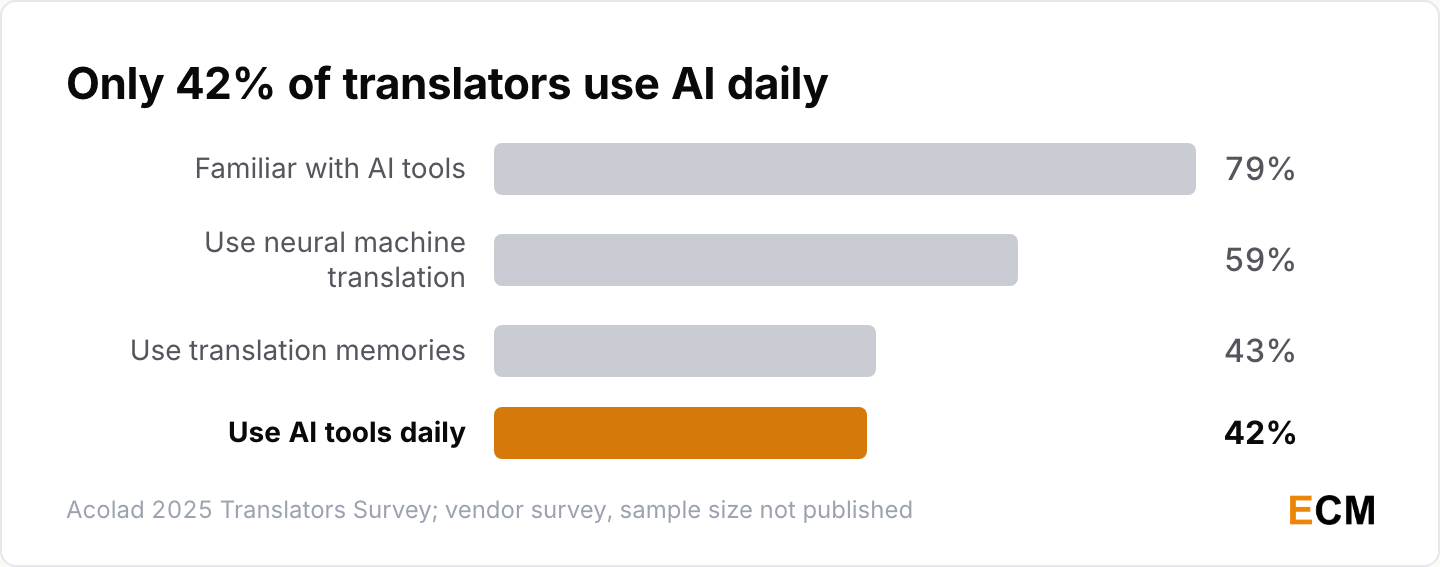
- 79% of translators in Acolad’s 2025 survey are familiar with AI tools, but only 42% use them daily, and neural machine translation (59%) is the most adopted AI tool ahead of translation memories (43%) (Acolad, Translators Survey, 2025).
AI Translation Accuracy and Quality Statistics
Translation quality depends far more on the language and the content than on which engine you pick.
How Effective Is AI Translation
On common business content in major languages, AI translation clears most quality bars, and the vendors measuring it say so loudly.
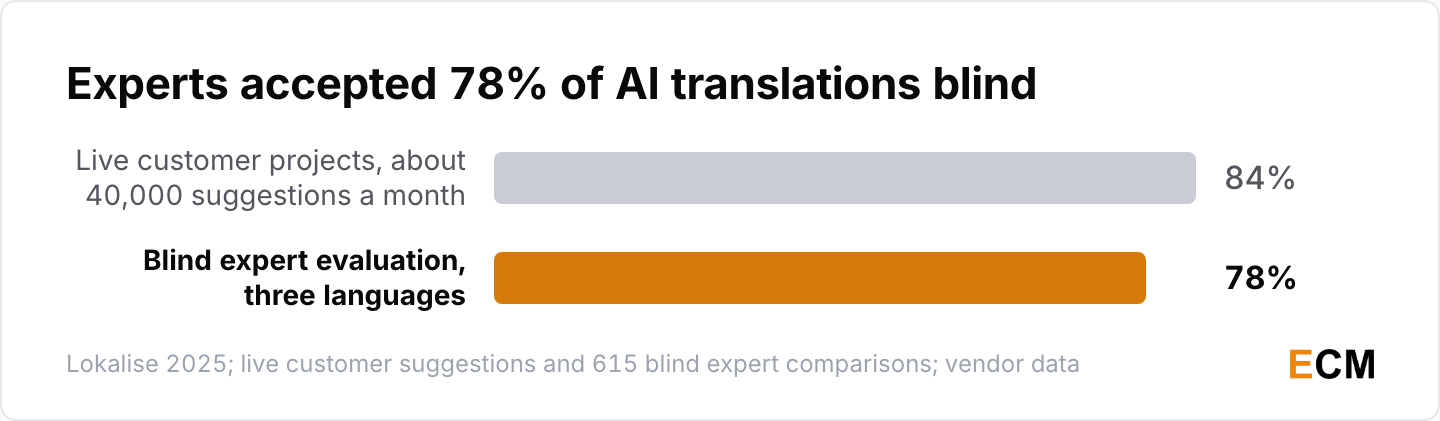
- Across roughly 40,000 monthly AI translation suggestions in live Lokalise customer projects, users accepted 84% (Lokalise, 2025).
- Seven expert reviewers ran 615 blind pairwise comparisons across three major languages for Lokalise and gave AI translations 78% acceptance (Lokalise, 2025).
- Intento’s 2025 report analyzed 46 machine translation engines and LLMs across 11 language pairs (Intento, State of Translation Automation, 2025).
- In Intento’s testing, baseline systems averaged 10 to 15 errors per text, and requirements-based setups cut that to 0 to 2, at least 80% fewer errors (Intento, State of Translation Automation, 2025).
Which AI Translation Service Is Most Accurate
No engine wins everywhere, and the research benchmark keeps getting harder to beat.
- WMT24 compared submitted systems with 8 large language models and 4 online translation providers across 11 language pairs, and titled its findings “The LLM Era Is Here but MT Is Not Solved Yet” (WMT24 findings, 2024).
- WMT25 widened the task to 30 language pairs, ran human evaluation on half of them, and evaluated 60 systems, 36 submitted by participants and 24 collected from LLMs and online translation providers (WMT25 findings, 2025).
Key Factors Influencing AI Translation Accuracy
Language matters more than the engine: Spanish holds up, lower-resource languages fall apart.
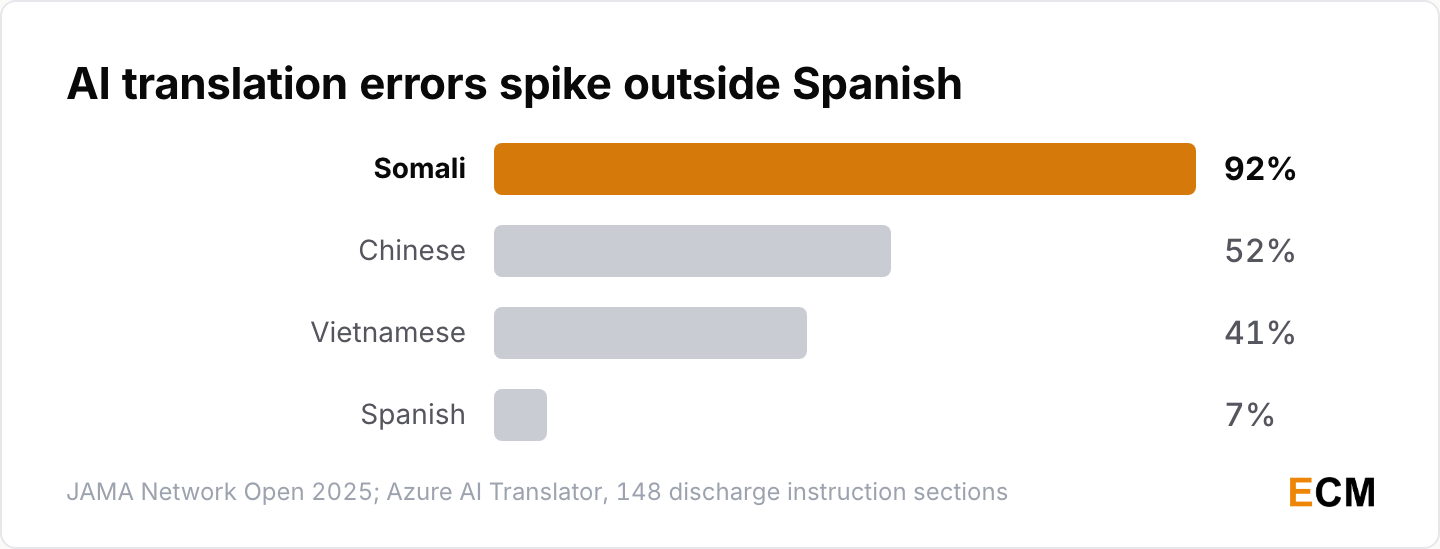
- In a 2025 study of 148 sections from 34 pediatric discharge instructions at a single US children’s hospital, Azure AI Translator had clinically impactful errors in 7% of Spanish sections, the same rate as professional translators (JAMA Network Open, 2025).
- The gap opened in other languages: AI against professional error rates were 52% versus 20% in Chinese and 41% versus 14% in Vietnamese (JAMA Network Open, 2025).
- Somali showed the widest gap, with clinically impactful errors in 92% of AI-translated sections against 13% of professionally translated ones (JAMA Network Open, 2025).
- An earlier study of 647 sentences from 100 emergency department instructions found Google Translate accurate for 92% of Spanish sentences and 81% of Chinese sentences (JAMA Internal Medicine, 2019).
- In that study, 2% of the Spanish translations and 8% of the Chinese translations carried potential for significant harm (JAMA Internal Medicine, 2019).
Translators Rate AI Quality Lower Than Before
Wider use is cooling the enthusiasm, and fewer professionals now rate machine output highly.
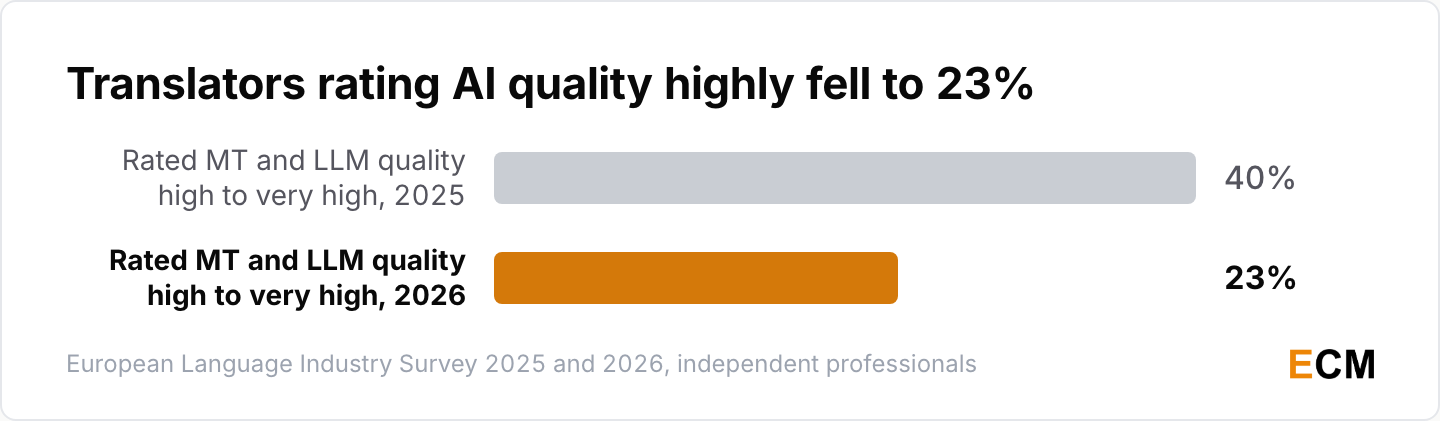
- Only 23% of independent professionals in ELIS 2026 rated the quality of MT engines and large language models high to very high, down from 40% in 2025 (ELIS 2026, 2026).
- Only 13% of independent language professionals in ELIS 2025 mentioned AI and MT as a positive development (ELIS 2025, 2025).
How AI Has Impacted Translation Jobs and Pay
Translators top Microsoft’s generative AI applicability ranking, and the first effects show up as slower hiring and lost freelance work.
Translator Employment and Pay in the US
US translator jobs haven’t collapsed, but their growth has nearly stalled.
- Interpreters and translators held about 73,900 US jobs in 2025, with a median annual wage of $60,170 in May 2025 (US Bureau of Labor Statistics, 2026).
- BLS projects employment of interpreters and translators to grow 2% from 2025 to 2035, slower than average, with about 6,000 openings a year (US Bureau of Labor Statistics, 2026).
- Microsoft Research put interpreters and translators at the top of its generative AI applicability ranking, with a score of 0.492; a high score means task overlap with AI, not job loss (Microsoft Research, Working with AI, 2025).
Machine Translation and Slower Translator Hiring
Where Google Translate use rose faster, translator hiring grew slower.
- Across 696 US local labour markets, each 1 percentage point rise in machine translation use cut translator employment growth by about 0.7 points, an estimated 28,000 new translator positions not created between 2010 and 2023 (CEPR VoxEU, Frey and Llanos-Paredes, 2025).
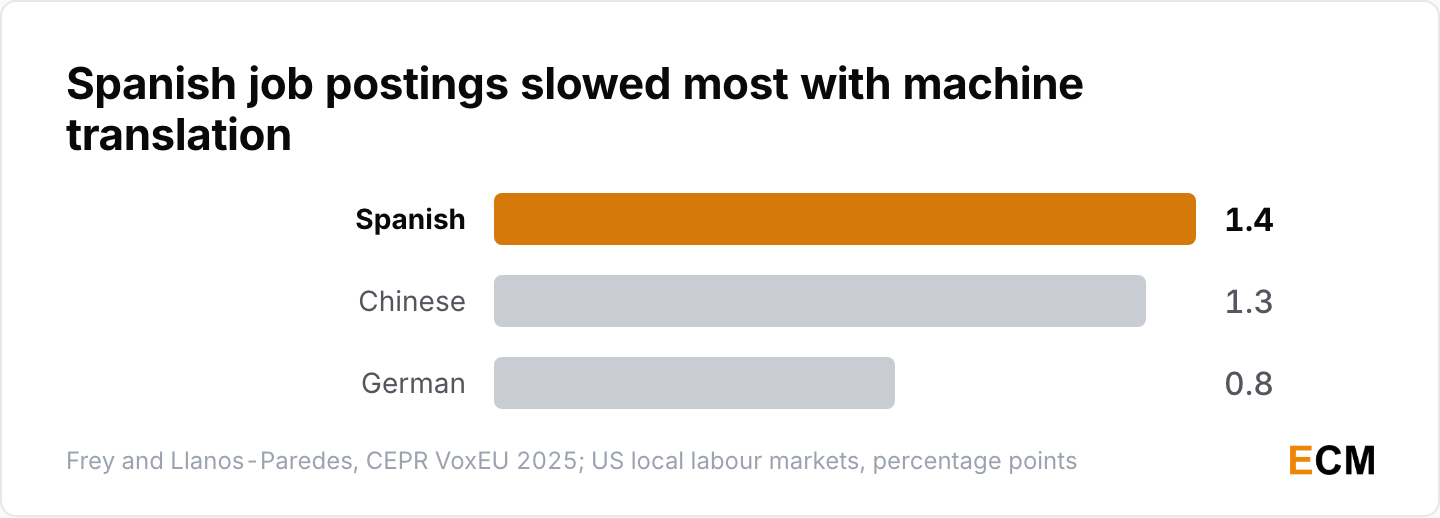
- In areas with heavy Google Translate use, job postings requiring Spanish grew about 1.4 percentage points less than elsewhere, with slowdowns of roughly 1.3 points for Chinese and 0.8 points for German (CEPR VoxEU, Frey and Llanos-Paredes, 2025).
Translators Losing Work to Generative AI
Translators report lost work and lower income, and most expect it to get worse.
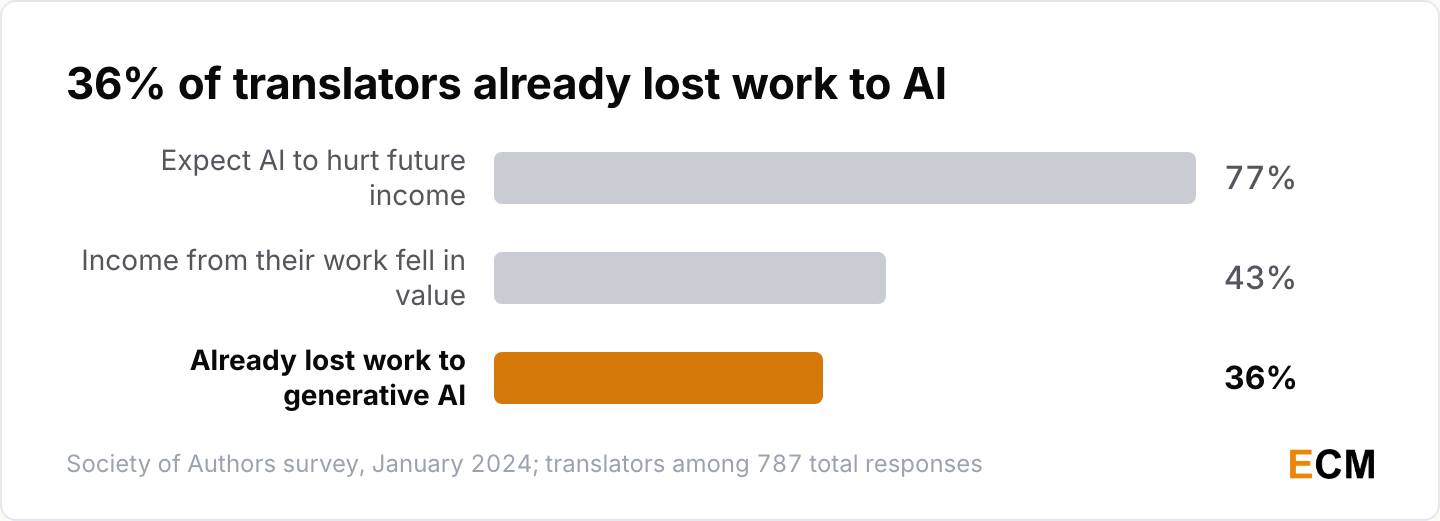
- 36% of translators who answered the Society of Authors’ January 2024 survey had already lost work to generative AI, and 43% said the income from their work had fallen in value (Society of Authors, 2024).
- 77% of translators in that survey expect generative AI to hurt their future income; the survey drew 787 responses across all its member groups, not translators alone (Society of Authors, 2024).
- 53% of linguists in Acolad’s 2025 survey are seriously concerned about AI’s impact on the profession, and 84% expect lower demand for human translation and more post-editing (Acolad, Translators Survey, 2025).
How Language Companies See AI’s Impact
Translation businesses turned sharply more negative on AI in a single year.
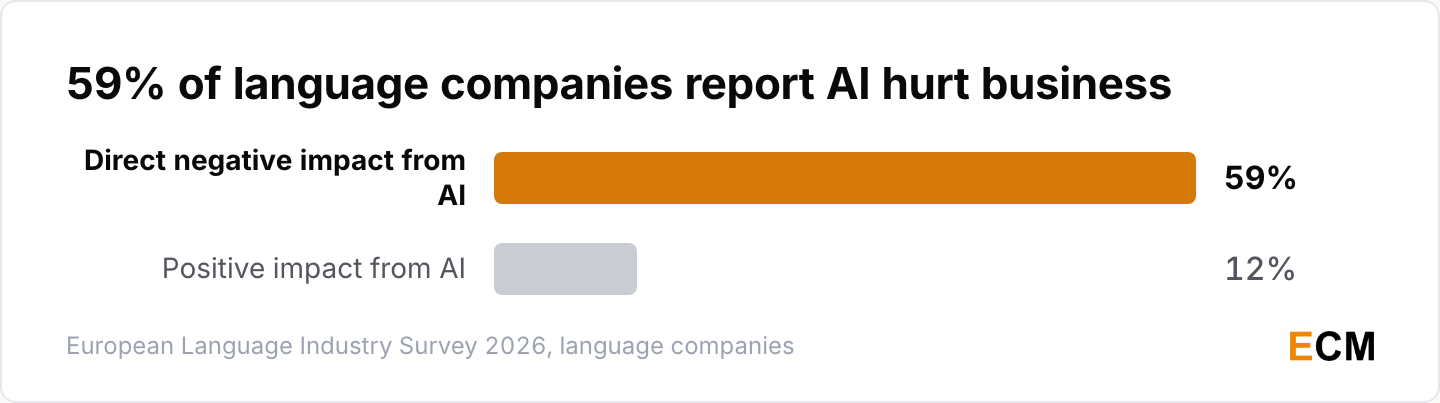
- 59% of language companies in ELIS 2026 reported a direct negative impact from AI, and only 12% a positive one (ELIS 2026, 2026).
- CSA Research found language service provider CEO optimism fell from +88% in 2021 to +10% in the first quarter of 2024 (CSA Research, 2025).
AI Dubbing and Video Translation Statistics
Video is where AI translation reaches marketers fastest, because the platforms now dub for you. The video marketing statistics and YouTube statistics roundups cover the wider channel picture.
YouTube Auto Dubbing and Multi-Language Audio
Auto dubbing is free inside the biggest video platforms, and the watch-time data says it works.
- YouTube auto dubbing is available to everyone in 27 languages, and YouTube averaged more than 6 million daily viewers watching at least 10 minutes of auto-dubbed content in December 2025 (YouTube, 2026).
- Creators uploading multi-language audio tracks saw over 25% of their watch time come from views in the video’s non-primary language (YouTube, 2025).
Languages Supported by AI Translation Tools
Language coverage varies widely between tools, so check your target markets before you pick one.
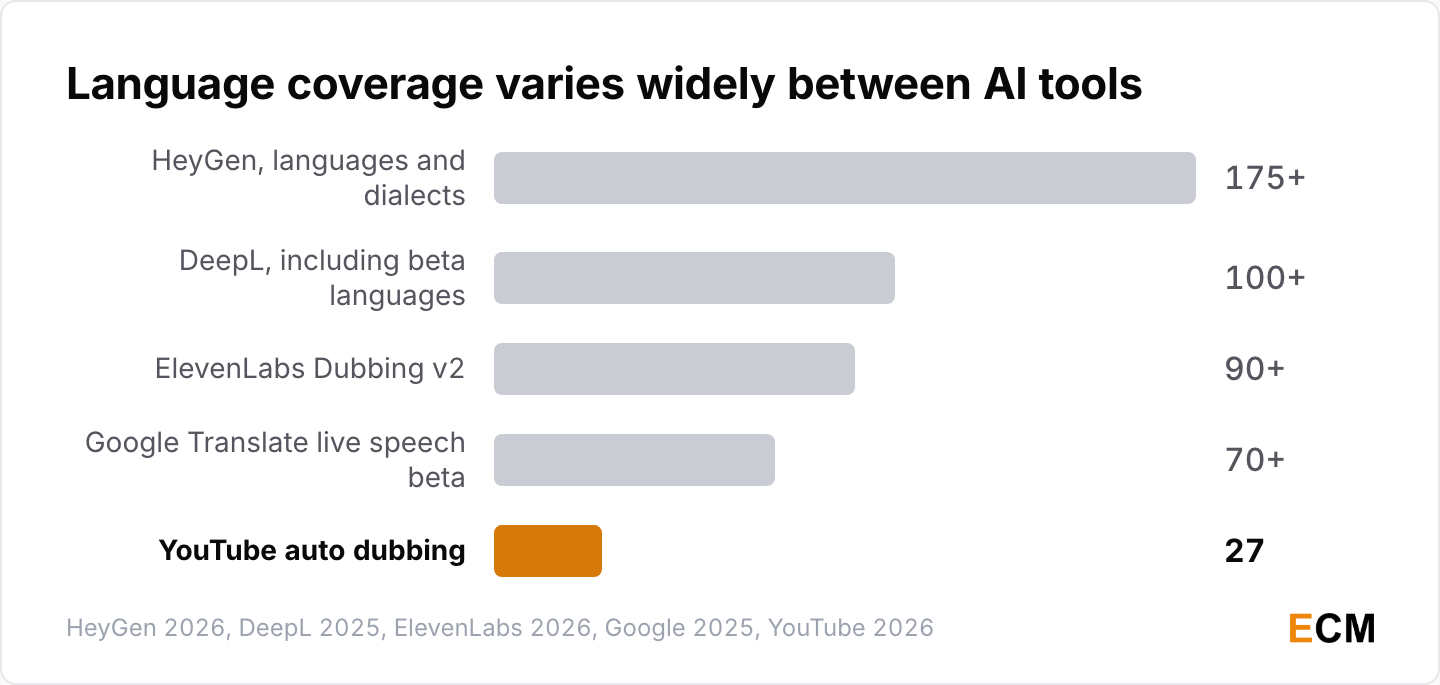
- HeyGen supports 175+ languages and dialects, and 85% of the Fortune 100 use it (HeyGen, 2026).
- DeepL grew to over 100 languages in November 2025 by adding around 70 in beta for enterprise customers (DeepL, 2025).
- ElevenLabs Dubbing v2 covers 90+ languages and accents, and its dubbing page says it is trusted by 1,000,000+ creators and leading enterprises (ElevenLabs, 2026).
- Google Translate’s live speech translation beta supports more than 70 languages (70+) and launched on Android in the US, Mexico and India in December 2025 (Google, 2025).
Why Multilingual Content Still Matters for Marketers
For a content team, this is the part that matters: buyers still want content in their own language, and most of the web isn’t in theirs. My content marketing statistics cover the rest of the channel mix.
Buyers Prefer Content in Their Own Language
Buyers reward local-language content even when the translation is rough, which is exactly where AI translation fits.
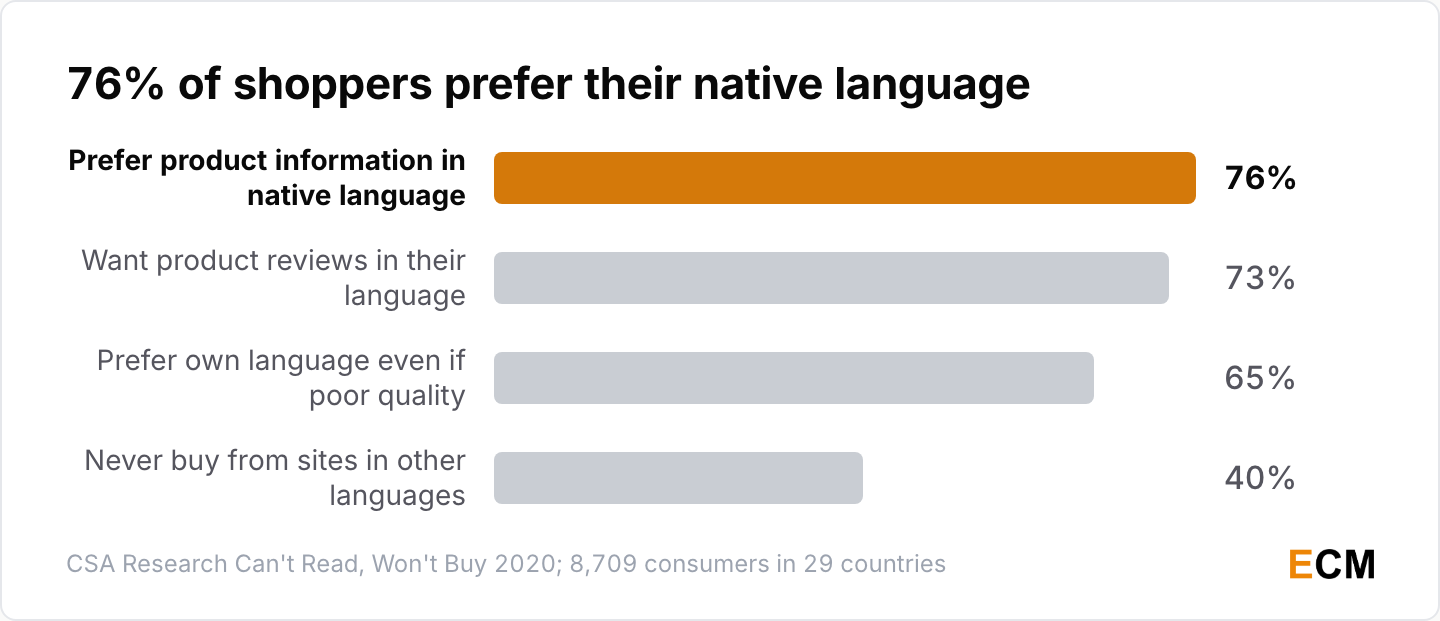
- 76% of online shoppers prefer to buy products with information in their native language, and 40% will never buy from websites in other languages (CSA Research, 2020).
- 65% prefer content in their language even if it’s poor quality, and 73% want product reviews in their language if nothing else (CSA Research, 2020).
- The survey covered 8,709 consumers in 29 countries, and 66% of them use online machine translation (CSA Research, 2020).
How Much of the Web Is in English
Half the web is in English, and no other language comes close.
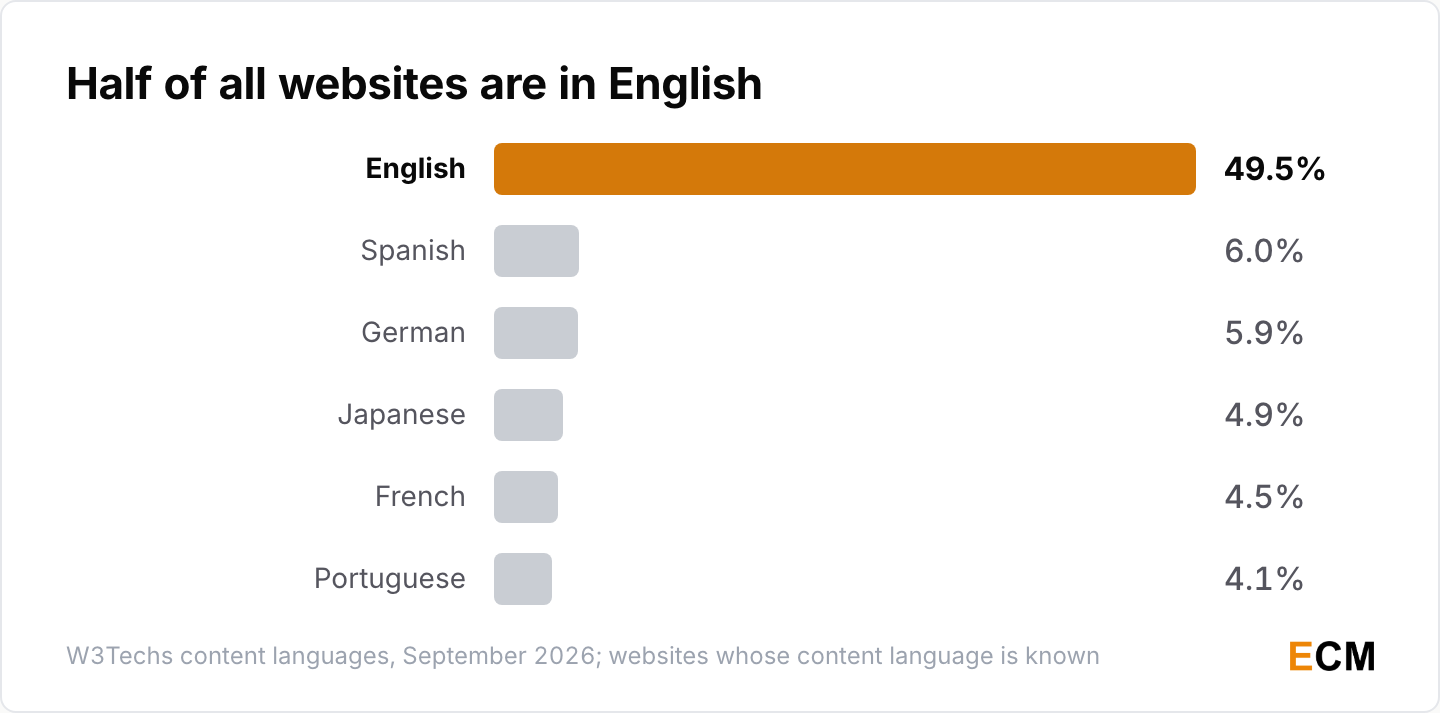
- English is the content language of 49.5% of websites whose language W3Techs can identify, followed by Spanish at 6.0%, German at 5.9% and Japanese at 4.9% (W3Techs, 2026).
- French holds 4.5% and Portuguese 4.1%, and English stood at 49.2% in April 2025 (W3Techs, 2026).
- 6.04 billion people used the internet at the start of October 2025, 73.2% of the world’s population (DataReportal, Digital 2026, 2025).
- CSA Research estimates that less than 0.000004% of global content gets translated today (CSA Research, 2025).
Frequently Asked Questions
How effective is AI translation?
Very effective in major languages, much less so elsewhere. Lokalise’s expert reviewers gave AI translations 78% acceptance in blind tests (Lokalise, 2025), and in a single-hospital pediatric study AI matched professionals on Spanish discharge instructions at 7% impactful errors, but hit 92% in Somali (JAMA Network Open, 2025). I’d use AI for first drafts in major languages and keep a human reviewer on anything regulated or customer-facing.
How has AI impacted the translation industry?
Revenue is moving to AI products while human work shrinks. AI-related work reached 28% of RWS group revenue (RWS Holdings, 2025), 36% of surveyed translators had lost work to generative AI (Society of Authors, 2024), and 59% of language companies reported a negative impact (ELIS 2026, 2026).
Which AI translation service is the most accurate?
No single engine wins every language pair. WMT25 evaluated 60 systems, including LLMs and online translation providers, on a task spanning 30 language pairs (WMT25 findings, 2025), and WMT24’s organizers concluded machine translation is not solved yet (WMT24 findings, 2024). Test two or three tools on your own content in your own target languages before you commit.
Is AI translation as good as human translation?
Only in narrow cases. Microsoft’s 2018 human parity claim covered Chinese-to-English news translation alone (Microsoft Research, Hassan et al., 2018). In the 2025 pediatric discharge instruction study, AI matched professional translators in Spanish but made clinically impactful errors in 52% of Chinese sections against 20% for professionals (JAMA Network Open, 2025).
How do human translators feel about AI translation tools?
Worried, but using them anyway. 53% of linguists in Acolad’s survey are seriously concerned and 84% expect lower demand for human translation (Acolad, 2025). Yet 69% of independent professionals in ELIS 2025 used machine translation by choice (ELIS 2025, 2025), so many translators have adapted rather than refused.
What is the future of AI in the translation industry?
Flat market growth, with more automation inside it. Nimdzi projects under 1.0% annual growth after 2026, reaching $76.1B by 2030 (Nimdzi 100, 2026), and BLS expects US interpreter and translator employment to grow just 2% from 2025 to 2035 (US Bureau of Labor Statistics, 2026).
Should content marketers use AI translation?
For reach, yes. 76% of online shoppers prefer product information in their native language (CSA Research, 2020), and creators who added multi-language audio got over 25% of watch time from non-primary-language views (YouTube, 2025). Start with your highest-traffic pages and videos, and have a native speaker check the result.
Written by
Editorial Staff
The Editorial Staff represents the writers, editors, and content creators who have worked (or work) at Elite Content Marketer. The experimenter-in-chief behind the team is Chintan Zalani, who has close to a decade of experience trying to make sense of the content marketing industry. Started in 2019, Elite Content Marketer is on a mission to help creators build sustainable businesses.
Related Articles
Marketing Data
58 B2B Content Marketing Statistics for 2026: 95% Use AI
58 B2B content marketing statistics for 2026: 95% of B2B marketers say their organization uses AI, and 61% say their content strategy improved.
Sep 13, 2026Read more →

Marketing Data
60 B2B Buyer Statistics for 2026: 94% Use AI
60 B2B buyer statistics for 2026: 94% of buyers use LLMs, first contact comes 61% into the journey, and 13 people join the average decision.
Sep 12, 2026Read more →
Marketing Data
60 Zero-Click Search Statistics for 2026: 68% No Click
60 zero-click search statistics for 2026: 68.01% of US Google searches end with no click, AI Overviews cut position 1 CTR 58%, publishers lost 33%.
Sep 12, 2026Read more →