69% of the input tokens reaching production language models are system prompts, not user questions (Datadog, State of AI Engineering 2026, Fact 4). These prompt engineering statistics come from the organizations that ran the surveys and the telemetry.
Prompt Engineering Statistics 2026: 57 Data Points
 Written by Editorial Staff
Key Takeaways
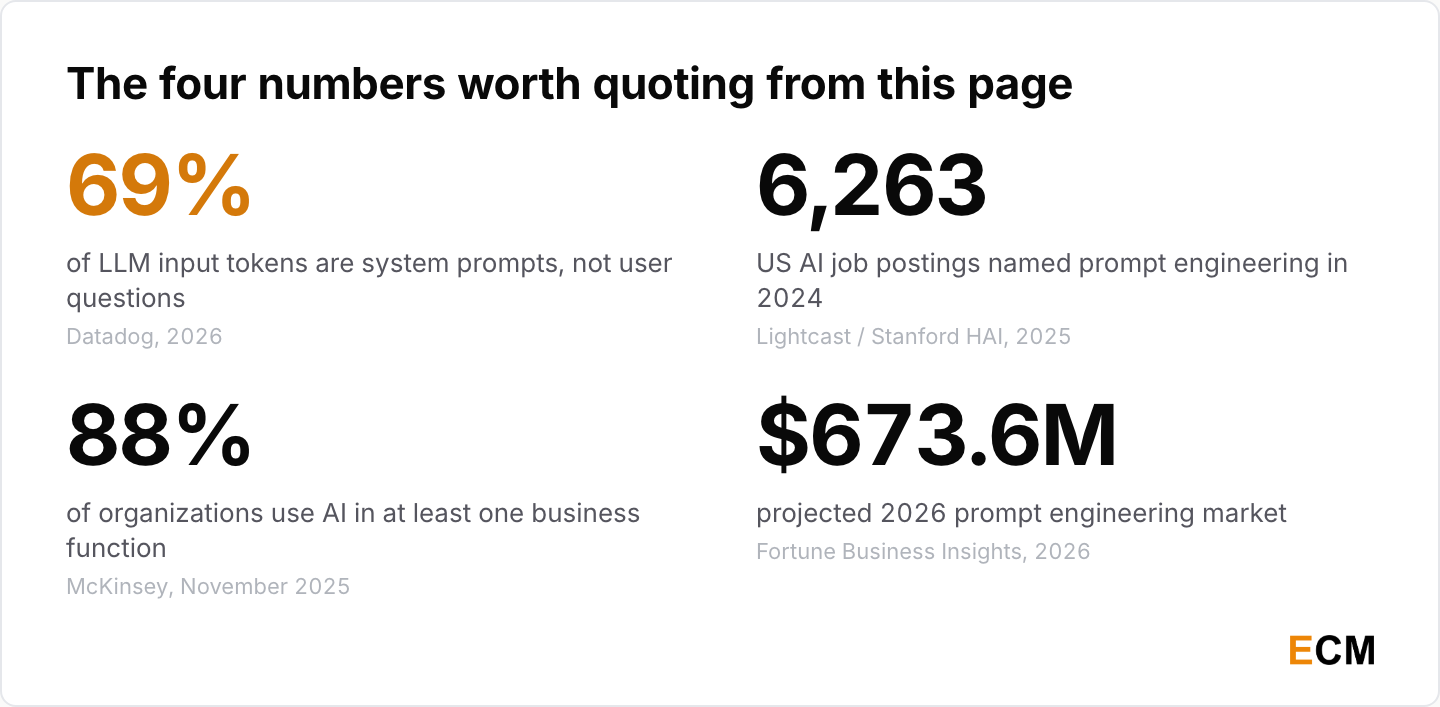
- Most of the prompt is written by the company, not the person asking. 69% of input tokens across instrumented production calls are system prompts, and among models that support prompt caching only 28% of calls read anything from the cache (Datadog, Fact 4).
- The market is small and the estimates disagree by more than tenfold. Fortune Business Insights puts 2026 at $673.6 million (Fortune Business Insights) and The Business Research Company at $1.49 billion (The Business Research Company), while Mordor’s wider category reads $6.95 billion for 2025 (Mordor Intelligence).
- Hiring for the exact phrase grew 350%. US AI job postings citing prompt engineering went from 1,393 in 2023 to 6,263 in 2024 (Lightcast data in the Stanford HAI AI Index Report 2025, Figure 4.2.5).
- Employers moved on to agentic AI. The agentic AI share of US postings grew from 0.06% to 0.23%, roughly 90,000 postings, while ChatGPT, Conversational AI and Chatbot clusters all declined (Lightcast).
- AI adoption is near-universal, workflow redesign is not. 88% of organizations reported regular AI use in at least one business function, while only 20% of companies outside the AI high-performer group have fundamentally redesigned a workflow (McKinsey, The State of AI, November 2025 wave).
- The same prompt does not give the same answer. Swapping “Please” for “I order” moved accuracy on individual questions by up to 60 percentage points in either direction, though the differences balanced out across the full dataset (Wharton Generative AI Labs, March 2025).
Prompt Engineering Market Size Statistics
Four named analyst houses size this market and their 2025 and 2026 figures span half a billion dollars to seven billion. The gap is about where each firm draws the category boundary, not about disagreement over demand.
Analyst Estimates Disagree by Tenfold
I quote a range with the scope attached. A single point estimate here is a guess wearing a decimal place.
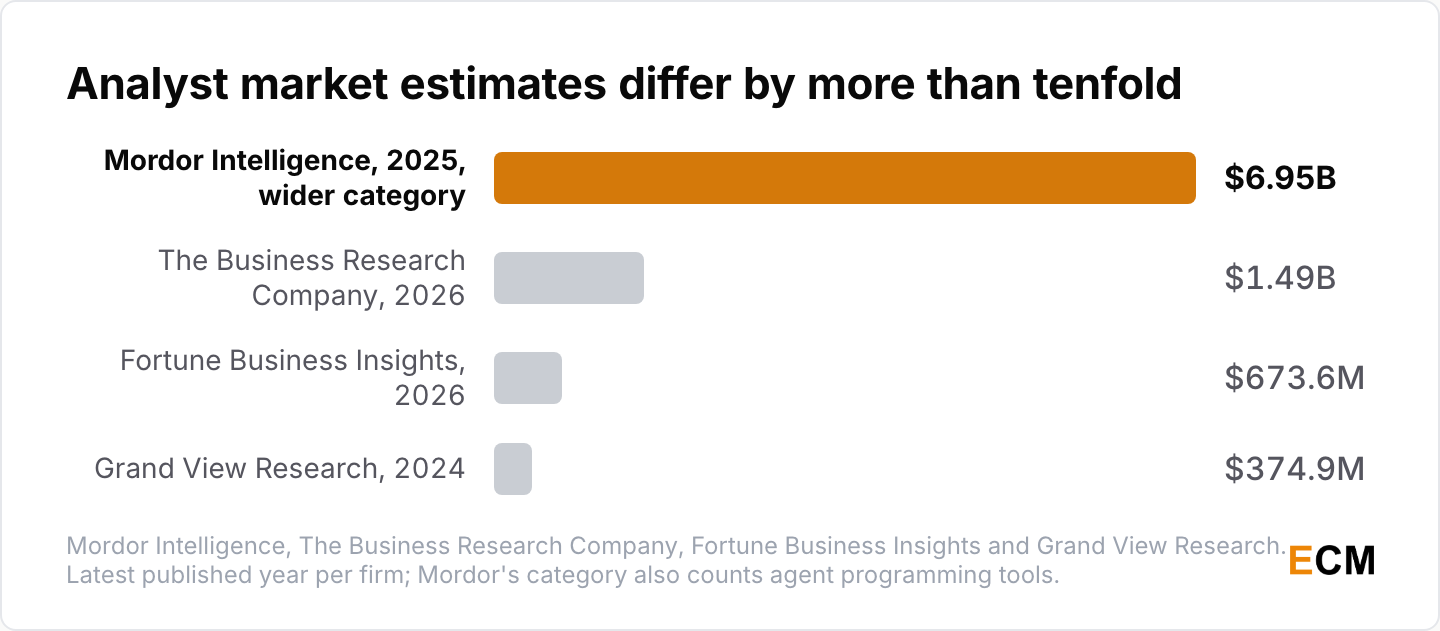
- Mordor Intelligence sizes a deliberately wider category, prompt engineering and agent programming tools together, at $6.95 billion in 2025, forecasts $40.87 billion by 2030 and states a 42.52% compound annual growth rate (Mordor Intelligence).
- The Business Research Company sizes the market at $1.13 billion in 2025 growing to $1.49 billion in 2026, and $4.51 billion by 2030 at a 31.9% rate thereafter (The Business Research Company).
- Fortune Business Insights sizes the same market at $505.43 million for 2025, $673.6 million for 2026 and $6,703.84 million by 2034, a 33.27% compound annual growth rate (Fortune Business Insights).
- Mordor’s 2025 figure is about fourteen times the Fortune Business Insights figure for the same year because Mordor counts LangChain, agent SDKs and the rest of the orchestration layer (Mordor Intelligence).
Grand View publishes the longest series in the category, and it is the one most people quote with a year it never printed.
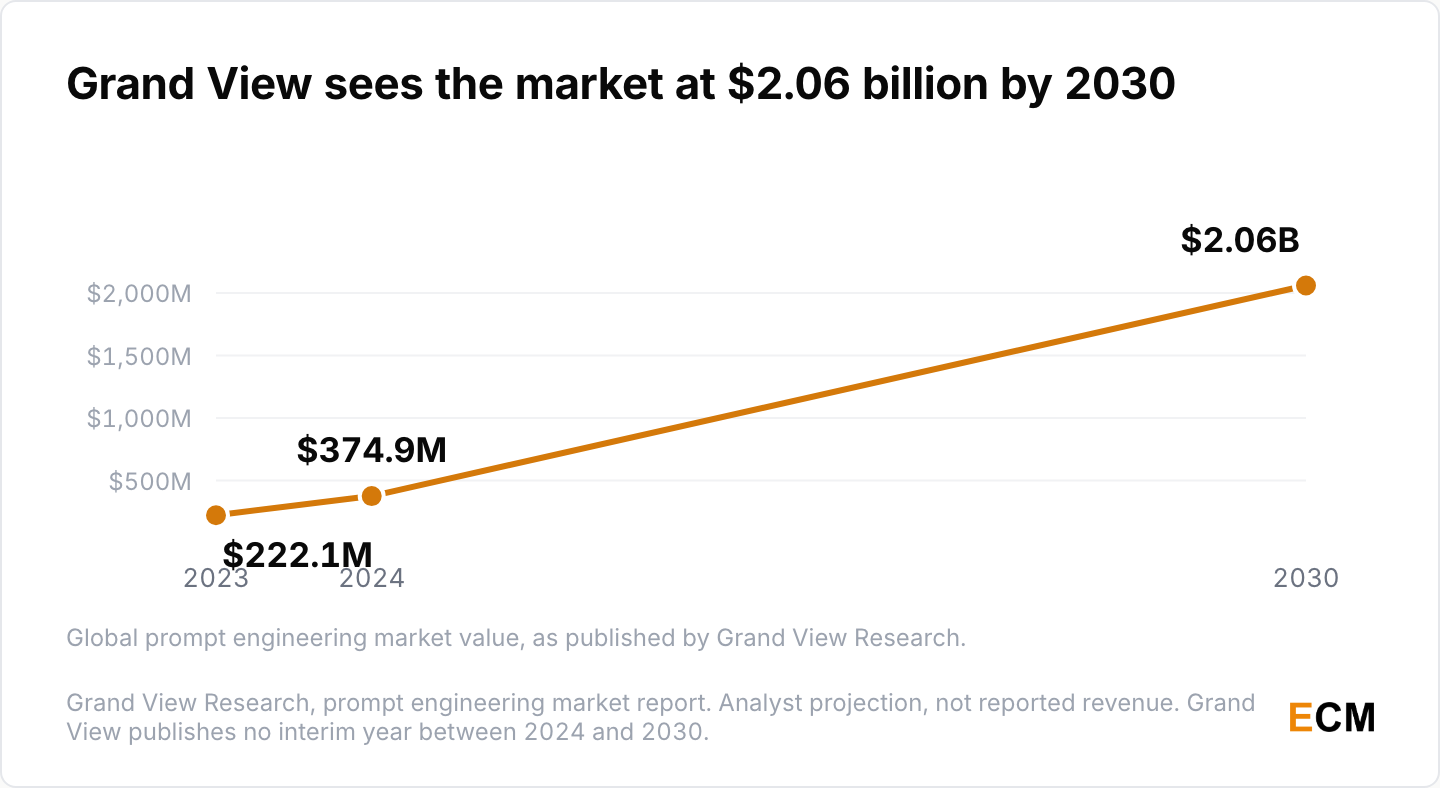
- Grand View Research valued the global prompt engineering market at $222.1 million in 2023 and $374.9 million in 2024, and projects $2.06 billion by 2030 at a 32.8% compound annual growth rate for 2024 to 2030 (Grand View Research).
- Those endpoints and that rate agree: $374.9 million compounding at 32.8% for six years lands on $2.06 billion (Grand View Research).
Grand View publishes no year between 2024 and 2030, so any Grand View figure attached to 2026 was interpolated by whoever quoted it.
If you need one anchor for a deck, quote a 2026 range of roughly $0.7 billion to $1.5 billion from the firms that do publish a 2026 number, and say out loud that every figure in it is an analyst model rather than revenue anyone reported.
Market Share by Component and Region
Each of these percentages splits the market a different way, so they describe four separate questions rather than one pie.
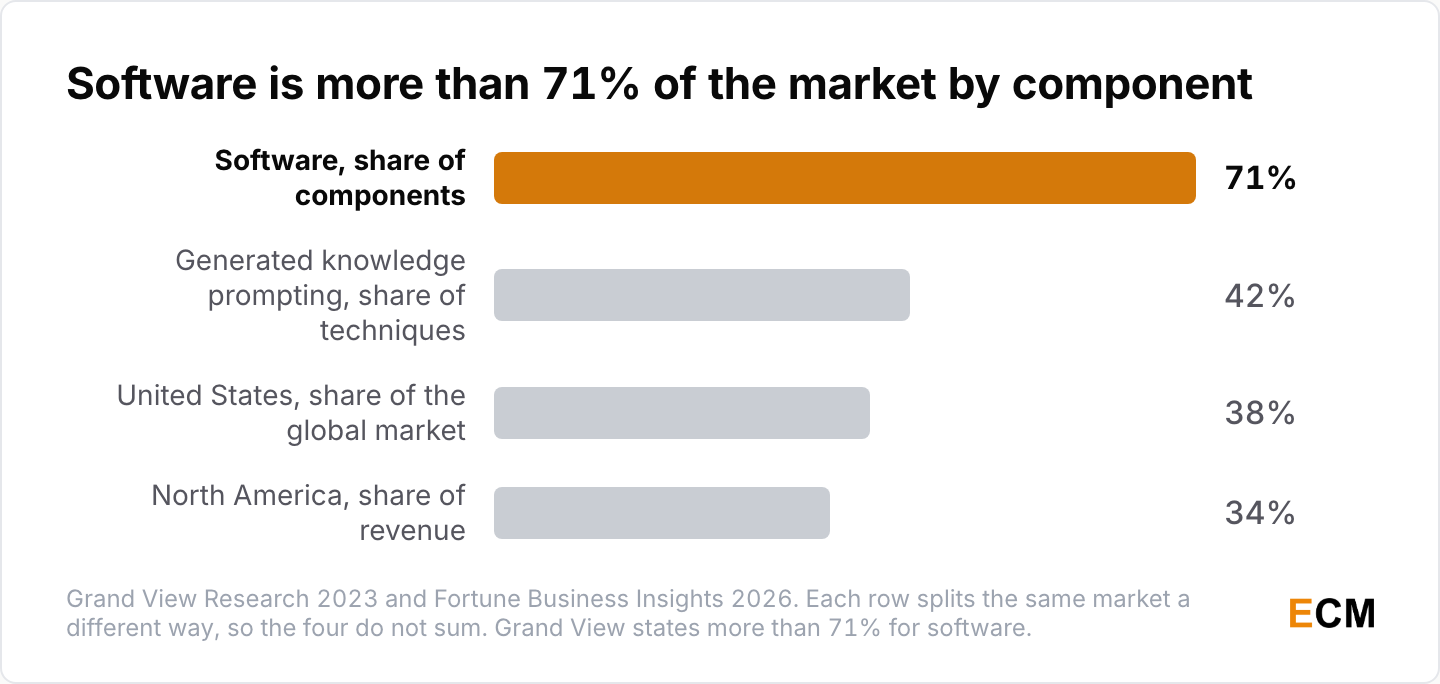
- Software took more than 71% of component share in 2023, and North America held 34.0% of revenue share the same year (Grand View Research).
- The United States accounts for approximately 38% of the global market, and generated knowledge prompting holds roughly 42% of technique share (Fortune Business Insights).
- The US market went from $61.4 million in 2023 to a projected $546.1 million by 2030. Grand View labels that series a 32.1% compound annual growth rate for 2024 to 2030, while the two endpoints imply 36.6% (Grand View Research).
Prompt Engineering Jobs And Salary Statistics
Job postings are the cleanest signal in this category, because Lightcast indexes online postings at scale and publishes its skill taxonomy. Read the denominator carefully, because it changes between the two subsections below.
AI Job Postings Naming Prompt Engineering
Prompt engineering grew faster than any other named AI skill in 2024, off the smallest base of the three.
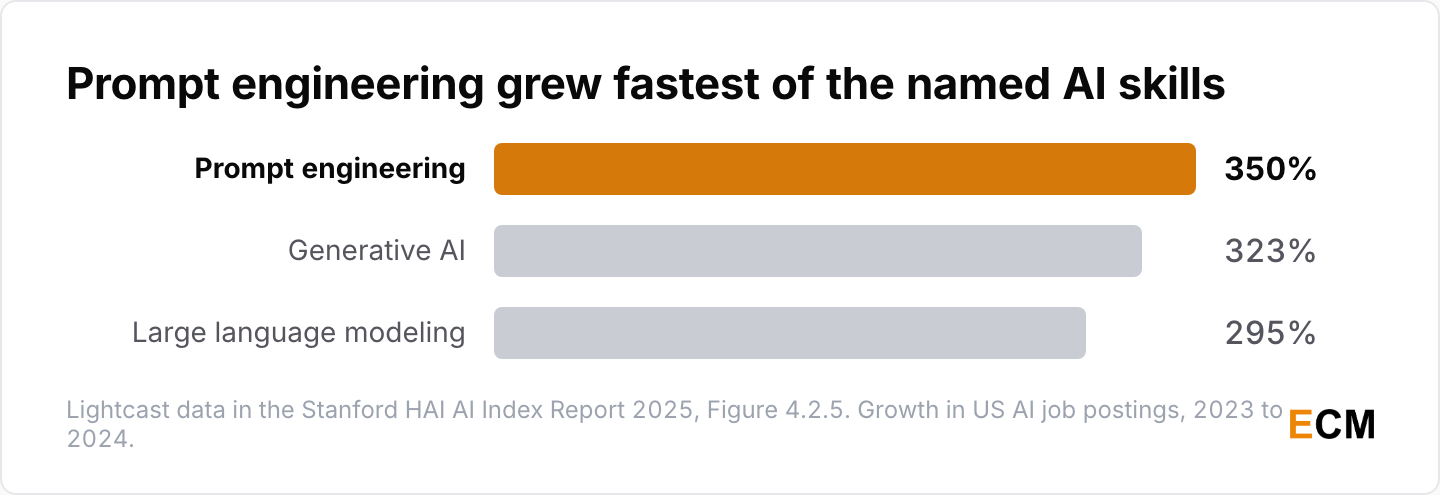
- US AI job postings citing prompt engineering went from 1,393 in 2023 to 6,263 in 2024, an increase of 350% (Stanford HAI AI Index Report 2025, Lightcast data, Figure 4.2.5).
- Over the same two years, US AI postings citing generative AI went from 15,741 to 66,635, up 323% (Stanford HAI AI Index Report 2025, Figure 4.2.5).
- Postings citing large language modeling went from 4,956 to 19,562 across the same period, up 295% (Stanford HAI AI Index Report 2025, Figure 4.2.5).
- Prompt engineering appeared in 5.68% of US AI job postings in 2024, up from 4.62% in 2023 (Stanford HAI AI Index Report 2025, Figure 4.2.6).
Those counts are drawn from US AI job postings, not from all US job postings. The next subsection switches denominators, which is where most misquotes of this data begin.
Agentic AI Hiring Demand
The vocabulary of the chat era is falling out of postings while demand for AI skills climbs.
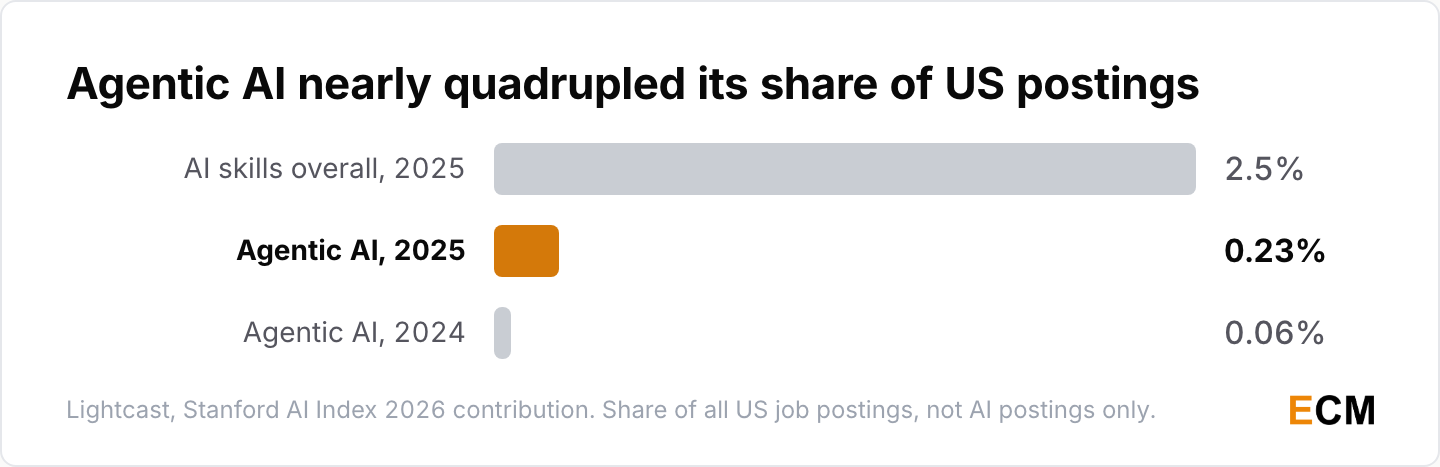
- Agentic AI skill mentions jumped from 0.06% of all US job postings in 2024 to 0.23% in 2025, a share increase of more than 280% year over year covering roughly 90,000 postings (Lightcast).
- AI skills appeared in 2.5% of all US job postings in 2025, a 55% increase from the prior year (Lightcast).
- ChatGPT, Conversational AI and Chatbot skill clusters all declined from 2024 to 2025 (Lightcast).
The skill has not died. It has been folded into roles that assume you can write a working system prompt, evaluate the output and iterate, without anyone writing “prompt engineer” on the requisition.
Prompt Engineer Salary Disclosures
There is no audited industry median for this role, and anyone quoting one is quoting a crowdsourced number without a disclosed sample.
- Anthropic’s Prompt Engineer and Librarian listing offered a base salary range of $175,000 to $335,000 in San Francisco (Fortune, March 9, 2023).
Treat that as one employer’s number for one unusual role in 2023, not as a market rate. Two higher figures circulate alongside it and neither traces to a named employer with a live listing.
Enterprise AI Adoption Statistics 2026
Nearly every organization now uses AI somewhere. Almost none of them have changed how the work is actually organized, and that gap is the whole story of the last two years.
Organizational AI Adoption Rates
Adoption climbed 33 percentage points in two years and is now close to its ceiling.
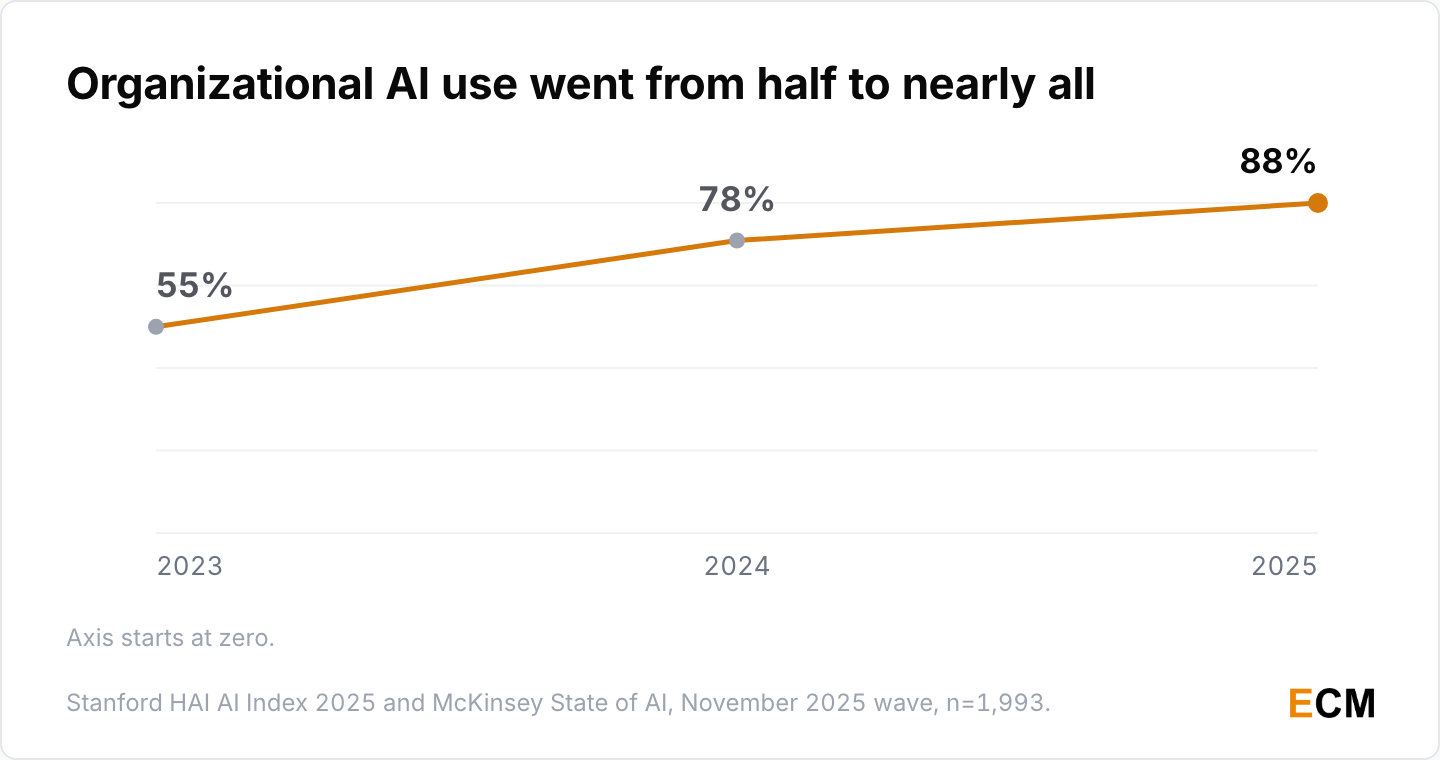
- 88% of organizations reported regular AI use in at least one business function in the November 2025 wave, up from 78% a year earlier, and the August 2026 wave reads at nearly nine in ten (McKinsey, The State of AI, n=1,993 across 105 nations in 2025, n=1,719 fielded May to June 2026).
- 78% of organizations reported using AI in 2024, up from 55% in 2023 (Stanford HAI AI Index Report 2025, Chapter 4, which republishes McKinsey survey data rather than measuring adoption itself).
- In the prior McKinsey edition, 71% of respondents said their organizations regularly use gen AI in at least one business function, up from 65% in early 2024 (McKinsey, March 2025).
- Four in five university students now use generative AI (Stanford HAI AI Index Report 2026).
Employee AI Use Inside Companies
Seniority predicts usage, and almost nothing predicts redesign except already being good at this.
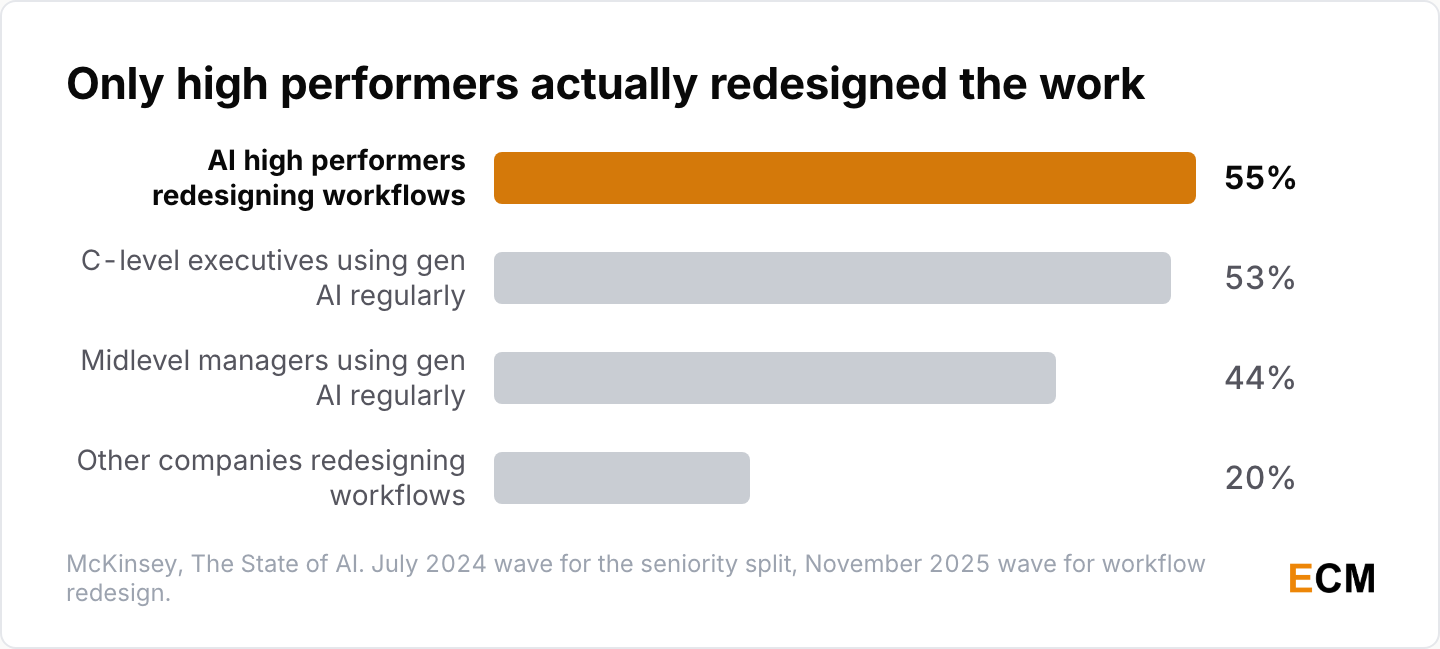
- 53% of C-level executives said they regularly use gen AI at work, against 44% of midlevel managers (McKinsey, fielded July 2024).
- 21% of respondents reporting gen AI use said their organizations had fundamentally redesigned at least some workflows (McKinsey, March 2025), and in the November 2025 wave workflow redesign split into 20% of other companies against 55% of AI high performers (McKinsey).
- Organizations most often used gen AI in marketing and sales, ahead of product and service development, service operations and software engineering (McKinsey, fielded July 2024).
Marketing and sales being the most common deployment function is why this page belongs on a content marketing site rather than an engineering one. The people writing the most consequential prompts in most companies are not engineers, and I wrote up how that plays out in prompt engineering for content marketing.
AI Spending and Adoption Barriers
Money is not the constraint. Governance is, and it has been for two straight survey waves.
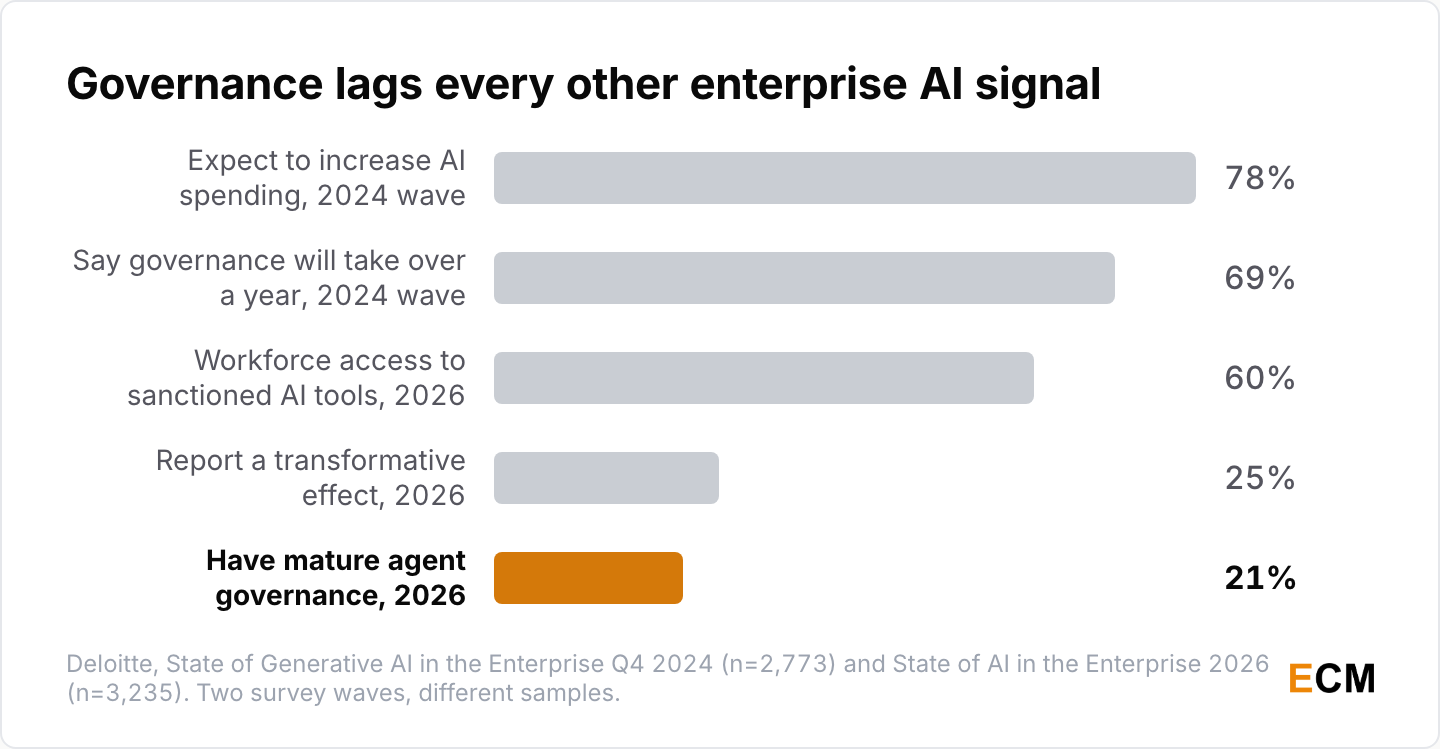
- 78% of respondents expect to increase overall AI spending in the next fiscal year, and 69% say fully implementing a governance strategy will take over a year (Deloitte, State of Generative AI in the Enterprise Q4 2024, n=2,773 director to C-suite leaders across 14 countries).
- Regulatory compliance rose from 28% to 38% as the top barrier between the first and fourth survey waves of 2024 (Deloitte).
- Workforce access to sanctioned AI tools grew from fewer than 40% to about 60% in a year (Deloitte, State of AI in the Enterprise 2026, n=3,235 across 24 countries).
- Only 21% of companies have mature agent governance models, while 25% report a transformative effect, more than double a year ago (Deloitte 2026).
- US private AI investment reached $109.1 billion in 2024, and global private investment in generative AI reached $33.9 billion the same year, up 18.7% from 2023 and more than a fifth of all AI private investment (Stanford HAI AI Index Report 2025, Chapter 4).
Both McKinsey and Deloitte sell AI advisory services, so read their optimism with that in mind. The friction numbers are the more useful half of both surveys.
Vendor-Reported AI Customer Outcomes
Named customers, named vendors, no independent audit and no disclosed measurement window.
- Stripe has enabled Claude Code across 1,370 engineers, and one Stripe team migrated 10,000 lines of Scala to Java in four days against an estimated ten engineering weeks by hand (Anthropic).
- Rakuten cut average time to market for new features from 24 working days to 5, a 79% reduction (Anthropic).
- Ramp reports early observations of up to 80% faster initial incident triage (Anthropic).
Quote these as what the vendor claims. They are not evidence of what you will get.
Prompting Technique Statistics From The Research
The academic record on prompting is thinner than the blog record, and the two most-cited findings both come with conditions that get dropped in the retelling.
Chain-of-Thought Prompting Accuracy Gains
The single largest measured prompting effect is also the one most likely to be obsolete on the model you use today.
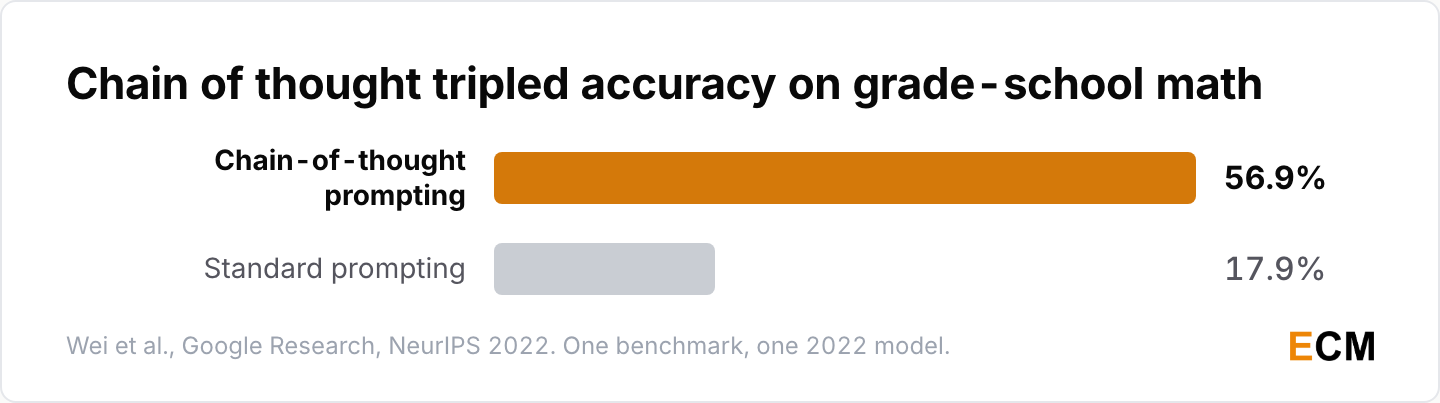
- PaLM 540B scored 56.9% on GSM8K math word problems with chain-of-thought prompting against 17.9% with standard prompting, a gain of 39.0 points (Wei et al., Google Research, NeurIPS 2022, Table 2).
- The effect only appears at scale, roughly 100 billion parameters and above (Wei et al., Figure 4).
I cite this as history rather than advice. Modern reasoning models train chain-of-thought behavior internally, which means the technique that produced a 39-point jump in 2022 is largely baked into the model you are using now.
Documented Prompting Technique Counts
One systematic review is the only census of the field, and it also fixed the vocabulary problem.
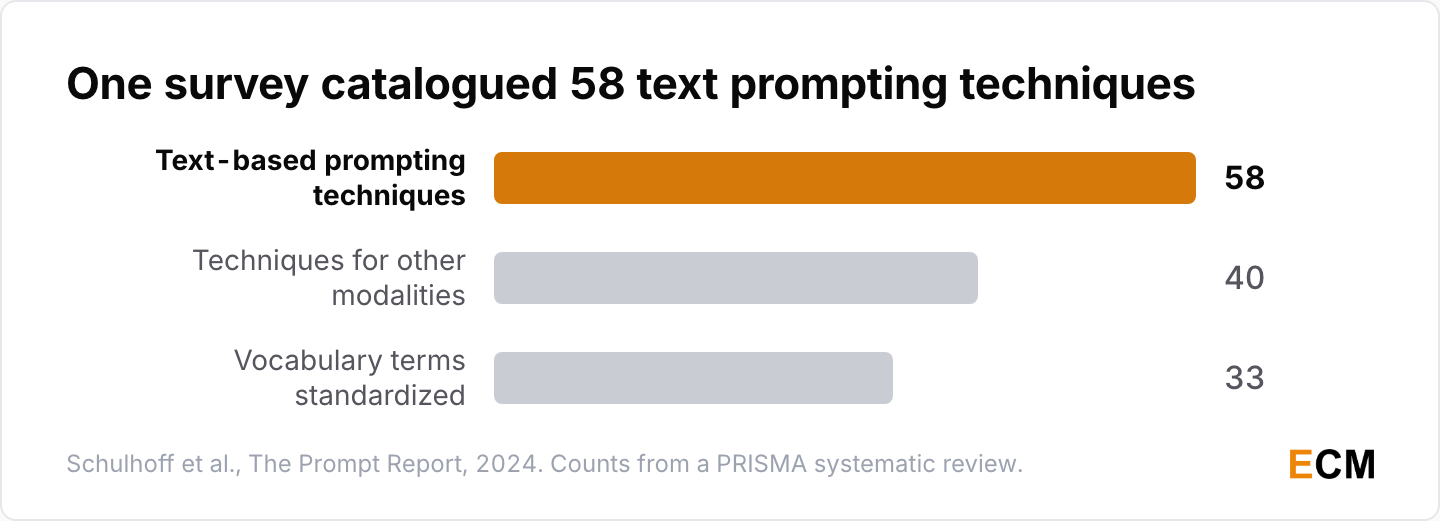
- A systematic survey catalogued 58 distinct text-based LLM prompting techniques, 40 techniques for other modalities, and standardized 33 vocabulary terms for a field that had been using words inconsistently (Schulhoff et al., The Prompt Report).
Prompt Wording Variance in Testing
The politeness finding is real and almost always quoted without the clause that matters.
- Wharton’s Generative AI Labs ran 100 repetitions per condition against GPT-4o and GPT-4o-mini on the GPQA Diamond benchmark (Wharton Generative AI Labs, March 4, 2025).
- Saying “Please” instead of “I order” shifted performance on individual questions by up to 60 percentage points in either direction, though the differences balanced out across the full dataset (Wharton Generative AI Labs).
Politeness is not a magic lever. What the study shows is that any single prompt-and-question pair carries enormous variance, which is the empirical case for testing prompts against a set of real inputs instead of eyeballing one good answer.
Prompt Patterns In Vendor Documentation
Model providers publish benchmark results for their own prompting patterns, and they name the benchmark, which is more than most sources manage.
- OpenAI reports that its own agentic scaffold for GPT-4.1 solves 55% of problems on SWE-bench Verified, and recommends three types of reminder in all agent prompts (OpenAI, GPT-4.1 Prompting Guide, April 2025).
- GPT-5 introduced a “minimal” reasoning effort tier, the fastest option that still uses the reasoning paradigm (OpenAI, GPT-5 Prompting Guide, August 2025).
- Anthropic announced Agent Skills on October 16, 2025 and published them as an open standard for cross-platform portability on December 18, 2025 (Anthropic).
Both vendor guides say the same uncomfortable thing in different words. Prompts need re-engineering when models change generation, so anything you write today is a depreciating asset.
Context Engineering And Token Statistics
Datadog’s production telemetry shows 69% of input tokens are system prompts (Datadog, Fact 4), which is the evidence behind the rename that happened in June 2025.
Tobi Lütke, Shopify’s CEO, wrote on 18 June 2025 that he preferred “the term ‘context engineering’ over prompt engineering” because “it describes the core skill better: the art of providing all the context for the task to be plausibly solvable by the LLM.”
Andrej Karpathy endorsed it a week later, calling context engineering “the delicate art and science of filling the context window with just the right information for the next step.”
What Fills the Context Window
Roughly two thirds of what you send is scaffolding rather than the user’s question.
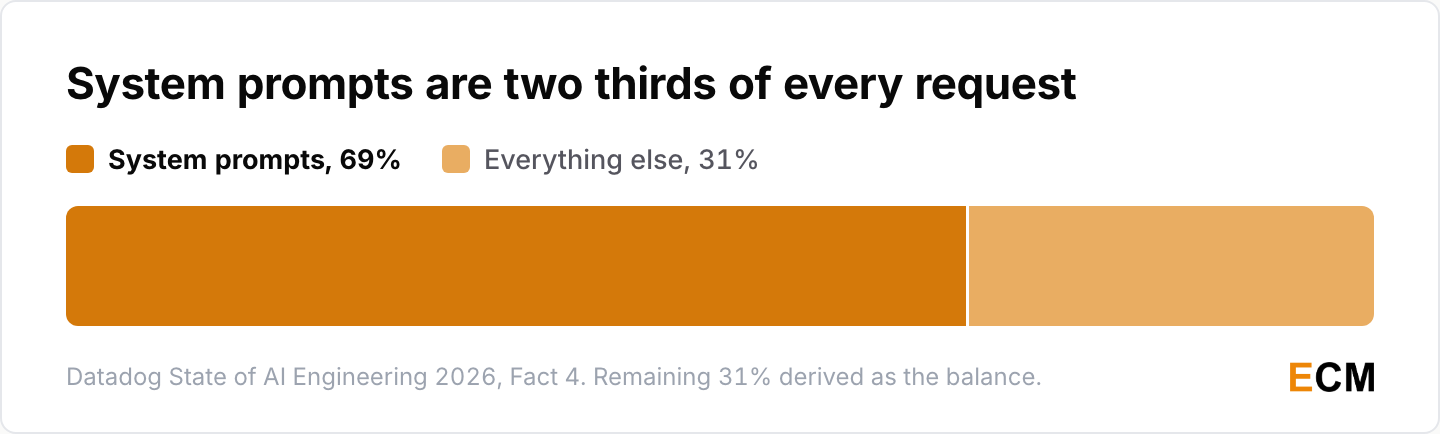
- 69% of all input tokens in customer traces were system prompts: internal instructions, policy definitions and tool guidance. The remaining 31% is everything else, the user’s own question included (Datadog, Fact 4).
- Among models that support prompt caching, only 28% of LLM call spans show any cached-read input tokens (Datadog, Fact 4).
- The average number of tokens per request more than doubled year over year for median customers, and ninetieth-percentile power users quadrupled theirs over the same period (Datadog, Fact 5).
Datadog measures message roles and cache reads, not whether the text is byte-identical between calls, so treat the caching number as a prompt to check your own.
Multi-Model Use by Organizations
A prompt that works on one model is not a prompt that works.
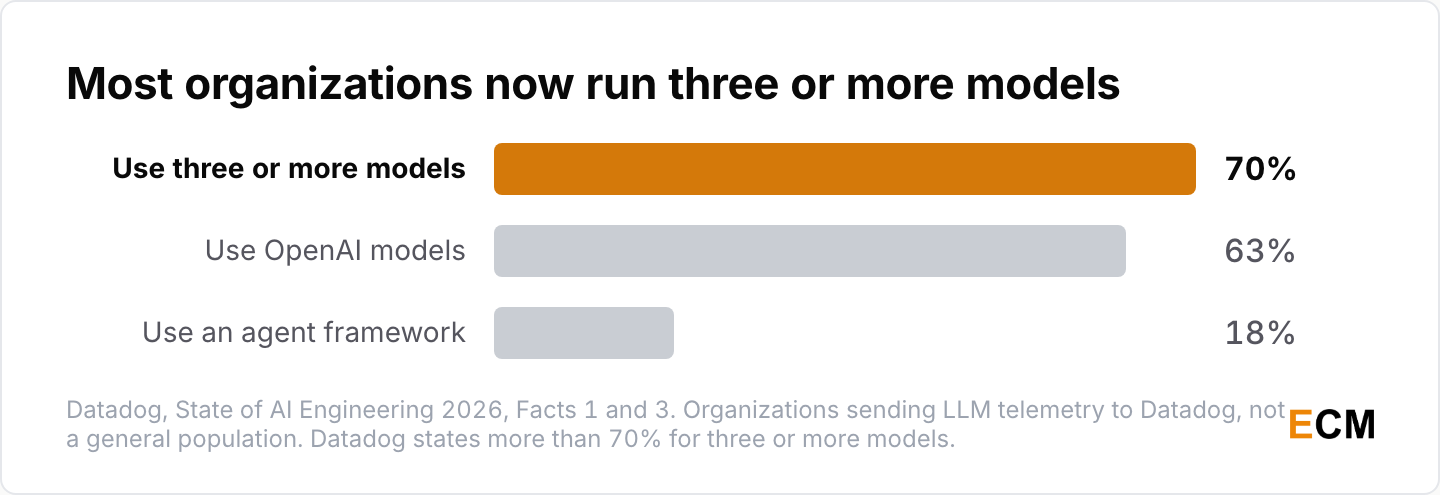
- 63% of organizations sending Datadog LLM telemetry use OpenAI models, down from a 75% share a year ago, though the number of customers using OpenAI more than doubled over the same period (Datadog, Fact 1).
- Google Gemini and Anthropic Claude gained 20 and 23 percentage points respectively over the last year (Datadog, Fact 1).
- More than 70% of organizations now use three or more models, and the share using more than six models nearly doubled (Datadog, Fact 1).
If most organizations run three or more models, the portable artifact is the context you assemble, not the phrasing you tuned against one provider. That is worth remembering when you pick tools from the AI content marketing stack.
Agent Framework Adoption and Behavior
Frameworks are spreading faster than the behavior they were built for.
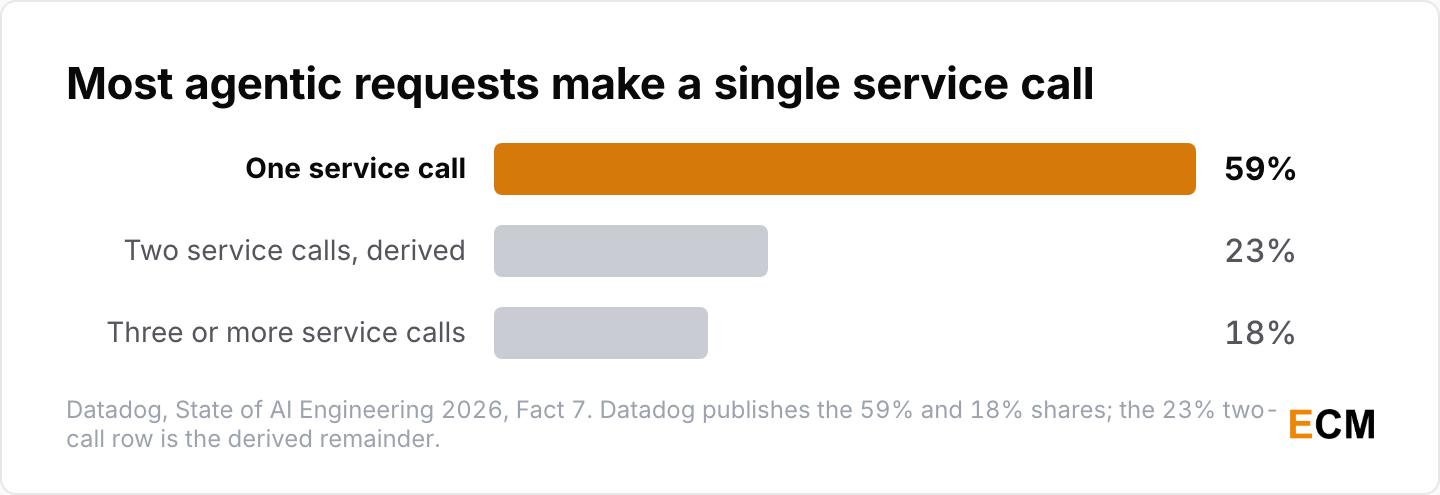
- Agent framework adoption nearly doubled year over year, from more than 9% of organizations in early 2025 to almost 18% by the beginning of 2026 (Datadog, Fact 3).
- 59% of agentic application requests made only a single service call, and only 18% made three or more (Datadog, Fact 7).
Where LLM Calls Fail
Most production failures are quota, not quality.
- In February 2026, 5% of all LLM call spans reported an error and 60% of those errors were caused by exceeded rate limits (Datadog, Fact 6).
- In March 2026, 2% of spans returned an error, with rate limits accounting for almost a third of them, nearly 8.4 million rate-limit errors in total (Datadog, Fact 6).
Datadog sells observability tooling and the report argues for its own product category. Its disclosure is still the most detailed in this corpus: per-fact method notes, a stated character-count proxy for tokens, and a CC BY-ND license. The sample skews toward teams serious enough about production AI to instrument it.
AI Skills And Training Statistics
Employers say AI skills are the binding constraint on transformation, and the training data shows people responding at a pace no other skill has matched.
What Employers Say They Need
The skills gap outranks cost, regulation and infrastructure as the stated barrier.
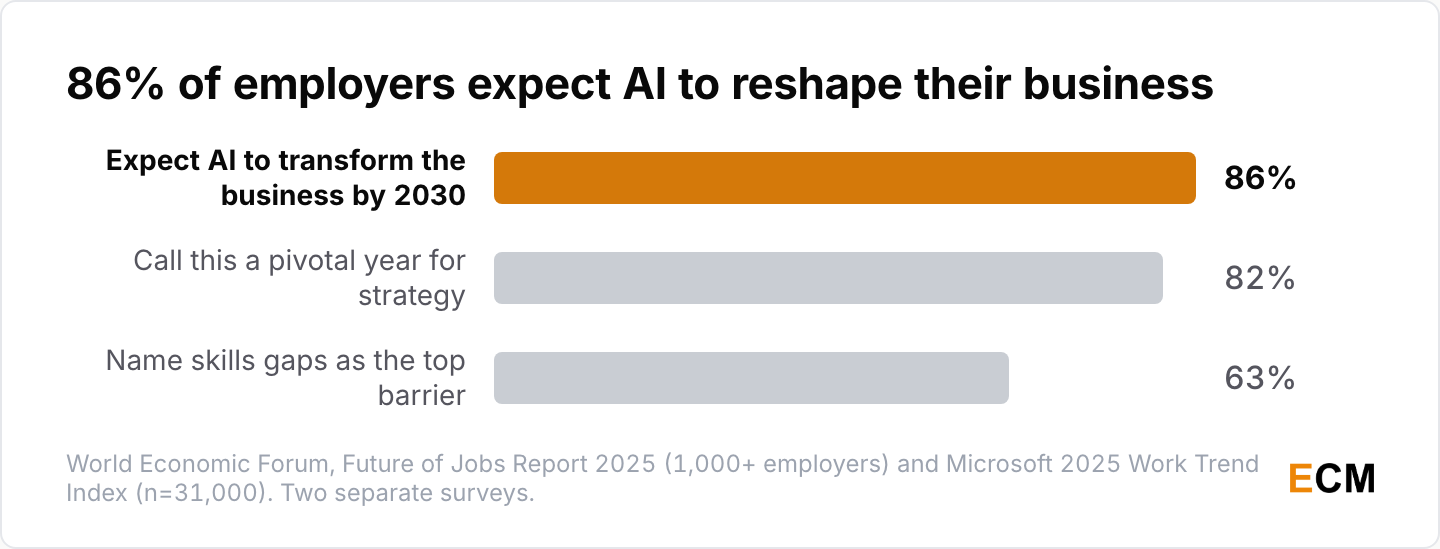
- 86% of employers expect AI and information processing technologies to transform their business by 2030, and 63% name skills gaps as the top barrier to that transformation (World Economic Forum, Future of Jobs Report 2025, 1,000+ employers representing over 14 million workers across 55 economies).
- AI and big data top the list of fastest-growing skills for 2025 to 2030, followed by networks and cybersecurity, then technological literacy (World Economic Forum).
- 82% of leaders say this is a pivotal year to rethink key aspects of strategy and operations (Microsoft, 2025 Work Trend Index, n=31,000 across 31 markets, administered by Edelman Data x Intelligence).
AI Course Enrollment Growth
A sevenfold increase in enrollment pace between 2023 and 2026, on one platform, with a consistent method.
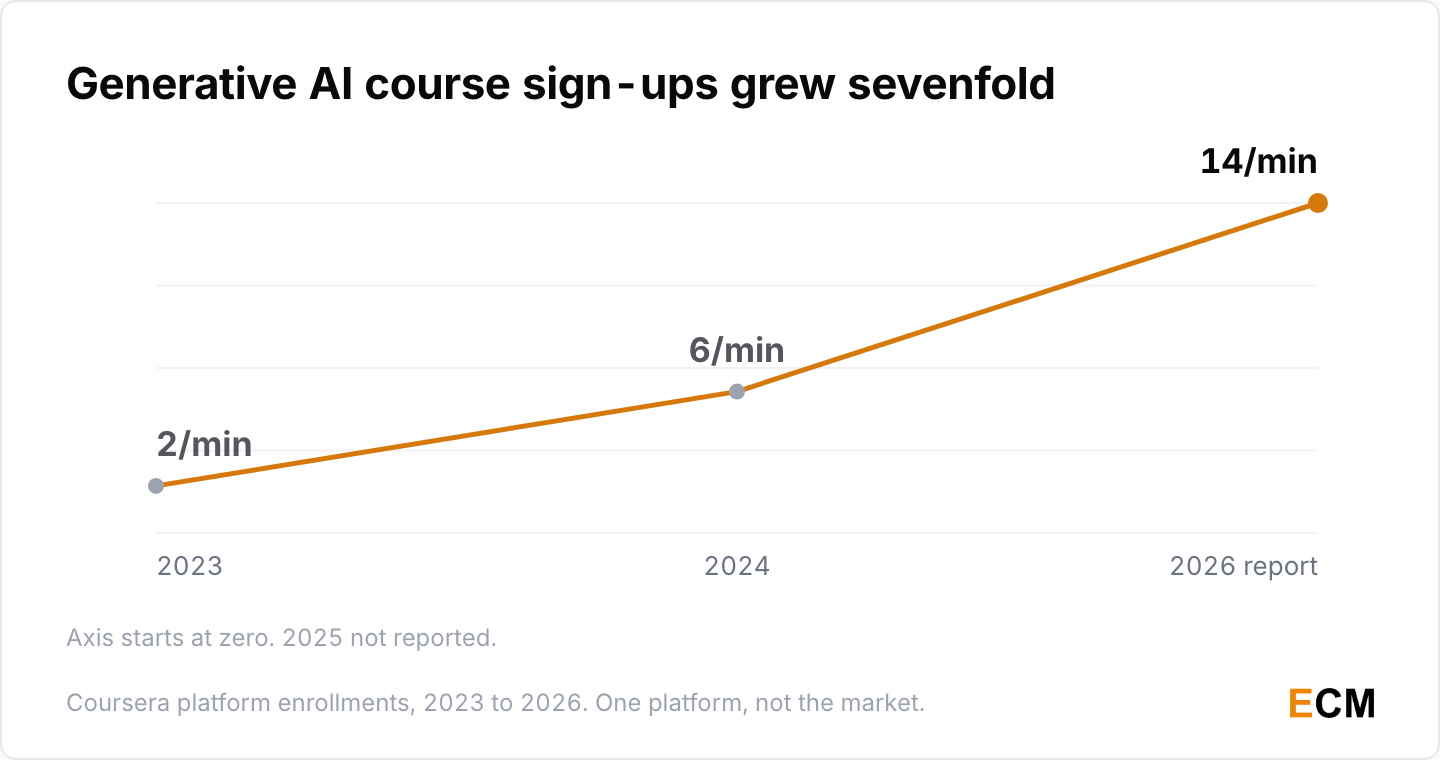
- Over 3.2 million of nearly 7.4 million AI enrollments on Coursera in 2024 were in generative AI training, an average of six enrollments per minute against two per minute in 2023, with India and the United States leading (Coursera).
- Generative AI enrollments have since reached 14 per minute, the most in-demand skill in Coursera’s history, and enterprise-learner enrollments grew 234% year over year (Coursera Job Skills Report 2026).
Coursera is reporting on its own platform, so this measures Coursera demand rather than world demand. It is still the only enrollment series in this category with a consistent method across three years, and its shape matches what the job posting data shows.
AI at Work Daily Patterns
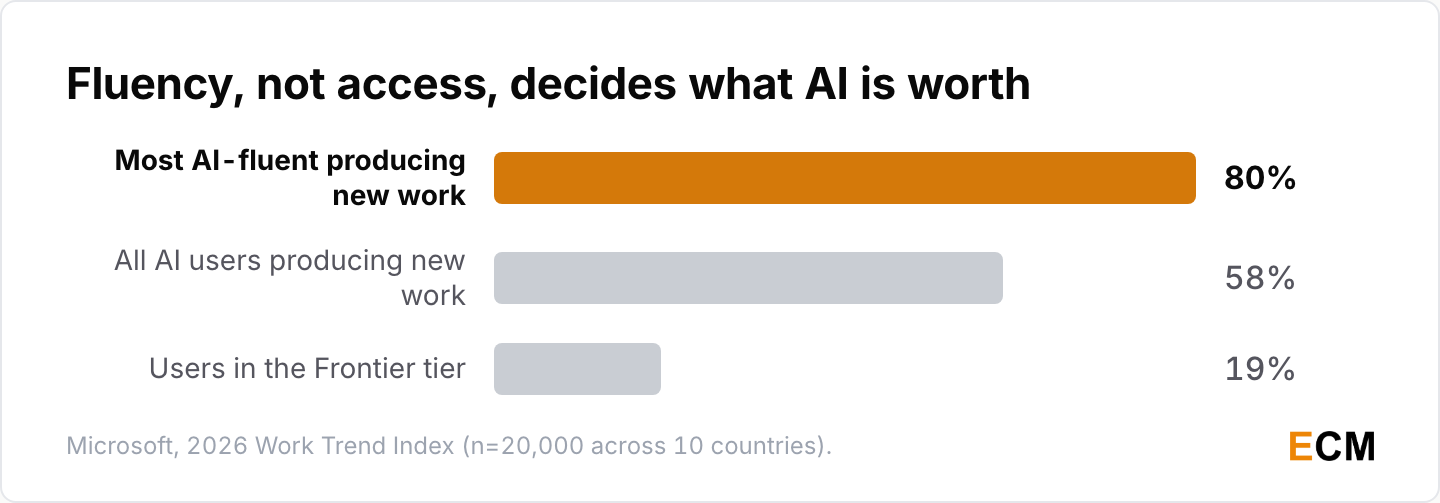
Access to the tools is nearly universal. Fluency with them is not.
- The average worker receives 117 emails daily and 153 Teams messages per weekday (Microsoft, Breaking Down the Infinite Workday, June 2025).
- 58% of AI users say they are producing work they could not have produced a year ago, rising to 80% among the most AI-fluent group, while only 19% fall into Microsoft’s “Frontier” tier where organizational capability and individual readiness are both high (Microsoft, 2026 Work Trend Index, n=20,000 across 10 countries).
Microsoft sells the productivity stack it is measuring and the telemetry comes from Microsoft 365 customers only, so I read these as directional.
Frequently Asked Questions
How Many Job Postings Mention Prompt Engineering?
US AI job postings citing prompt engineering grew from 1,393 in 2023 to 6,263 in 2024, 350% growth, and the skill appeared in 5.68% of AI postings that year (Stanford HAI AI Index Report 2025, Lightcast data). The denominator matters: those are AI job postings, not all US postings. The widely repeated “1,200% year over year” figure matches no measured dataset.
What Is The Prompt Engineering Market Worth In 2026?
It depends entirely on scope. Fortune Business Insights projects $673.6 million (Fortune Business Insights) and The Business Research Company $1.49 billion (The Business Research Company). Mordor reads $6.95 billion for 2025 because its category includes agent programming tools (Mordor Intelligence). Grand View jumps from $374.9 million in 2024 straight to 2030, so it has no 2026 number (Grand View Research).
What Is The Average Prompt Engineer Salary?
There is no audited industry median, and the crowdsourced figures in circulation do not disclose their sample sizes. The cleanest first-party disclosure is Anthropic’s Prompt Engineer and Librarian listing at $175,000 to $335,000 base in San Francisco (Fortune, March 2023). Use it as one employer’s number for one unusual role, not as a market rate. The often-quoted $525,000 figure belongs to a different, unnamed employer.
What Share Of LLM Input Tokens Are System Prompts?
69%, across telemetry from more than a thousand LLM Observability customers (Datadog, State of AI Engineering 2026, Fact 4). Those tokens are internal instructions, policy definitions and tool guidance rather than the user’s own question. Among models that support prompt caching, only 28% of call spans show any cached-read tokens, so it is worth checking your own caching.
What Is Prompt Engineering?
Prompt engineering is the practice of writing and testing the instructions a large language model receives, then measuring what changes in the output. The field has a published census: 58 distinct text-based techniques and 33 standardized vocabulary terms (Schulhoff et al., The Prompt Report). In production the work has shifted toward assembling context, since 69% of input tokens are now system prompts (Datadog, Fact 4).
How Does Prompt Engineering Work?
You give the model instructions, context and examples, then iterate on what comes back. The instruction layer dominates: 69% of input tokens in production traces are system prompts rather than user input, and only 28% of cache-eligible calls read anything from the cache (Datadog, Fact 4). Most of the craft is deciding what goes into the context window, not phrasing one question well.
What Are The Benefits Of Prompt Engineering?
The largest measured gain is chain-of-thought prompting, which lifted PaLM 540B from 17.9% to 56.9% on GSM8K math problems, 39.0 points (Wei et al., Table 2). That effect is now largely trained into reasoning models. The durable benefit is reliability: individual question accuracy swings by up to 60 percentage points on wording alone (Wharton Generative AI Labs), so tested prompts beat clever ones.
Is ChatGPT Good At Statistics?
Treat any single answer as a draw from a distribution. Wharton ran 100 repetitions per condition against GPT-4o and GPT-4o-mini and found individual question accuracy moving by up to 60 percentage points on prompt wording alone, with the differences balancing out across the full dataset (Wharton Generative AI Labs). For quantitative work, run the same prompt several times and check the spread.
How Is Prompt Engineering Used In Data Science?
Mostly as a reasoning aid on structured problems. Chain-of-thought prompting was benchmarked on math word problems, where it moved PaLM 540B accuracy 39.0 points (Wei et al.). Inside companies, gen AI shows up most in marketing and sales, ahead of product development, service operations and software engineering (McKinsey, fielded July 2024).
What Are Common Prompt Engineering Techniques?
The only census of the field catalogued 58 distinct text-based techniques, plus 40 for other modalities (Schulhoff et al., The Prompt Report). Chain-of-thought is the most studied: it lifted PaLM 540B from 17.9% to 56.9% on GSM8K (Wei et al.). Vendor guides add scaffolding patterns, such as the three agent reminders OpenAI recommends (OpenAI).
What Skills Does A Prompt Engineer Need?
Employers describe the requirement as AI literacy rather than prompt-writing. AI and big data top the fastest-growing skills list for 2025 to 2030, and 63% of employers name skills gaps as the top barrier to transformation (World Economic Forum). In practice the job is assembling context across three or more models, which more than 70% of organizations now run (Datadog, Fact 1).
Is Prompt Engineering Still A Real Job In 2026?
No dataset measures how many roles carry the title. ChatGPT, Conversational AI and Chatbot skill clusters all declined from 2024 to 2025 while the agentic AI share of postings grew from 0.06% to 0.23%, roughly 90,000 postings (Lightcast). Pure prompt-writing roles have been absorbed into applied AI roles that assume you can write a system prompt, evaluate output and iterate.
Why Do These Statistics Vary So Much?
Three reasons. Scope, when analysts include or exclude agent tooling, which produces the tenfold market-size gap. Recency, when a 2024 survey wave gets quoted as though it describes 2026. And provenance, when an aggregator repeats a figure with no underlying study. The same problem runs through the content marketing statistics, SEO statistics and website statistics circuits.
Written by
Editorial Staff
The Editorial Staff represents the writers, editors, and content creators who have worked (or work) at Elite Content Marketer. The experimenter-in-chief behind the team is Chintan Zalani, who has close to a decade of experience trying to make sense of the content marketing industry. Started in 2019, Elite Content Marketer is on a mission to help creators build sustainable businesses.
Related Articles

Marketing Data
Creator Economy Statistics 2026: 60 Facts + $250B Market
60 creator economy statistics: a $250B market (2023), $37B projected US creator ad spend, 10.1M US independent creators, earnings, AI and burnout.
Oct 24, 2026Read more →
Marketing Data
Affiliate Marketing Statistics 2026: 60 Facts + $13.6B Spend
60 affiliate marketing statistics: $13.62B in US spend in 2024, 9.4% of US e-commerce sales, a 15X UK return and what affiliates really earn.
Oct 23, 2026Read more →

Marketing Data
Black Friday Statistics 2026: 57 Facts + $11.8B in Sales
57 Black Friday statistics: $11.8B in US online sales in 2025, 202.9M US weekend shoppers, and 84% of shoppers suspect inflated pre-sale prices.
Oct 22, 2026Read more →