68.01% of US Google searches ended without a click in early 2026, against 60.45% in 2024 (SparkToro, 2026). These zero-click search statistics cover the click loss, what AI Overviews did to click-through rates, and what publishers lost.
60 Zero-Click Search Statistics for 2026: 68% No Click
 Written by Editorial Staff
Key Takeaways
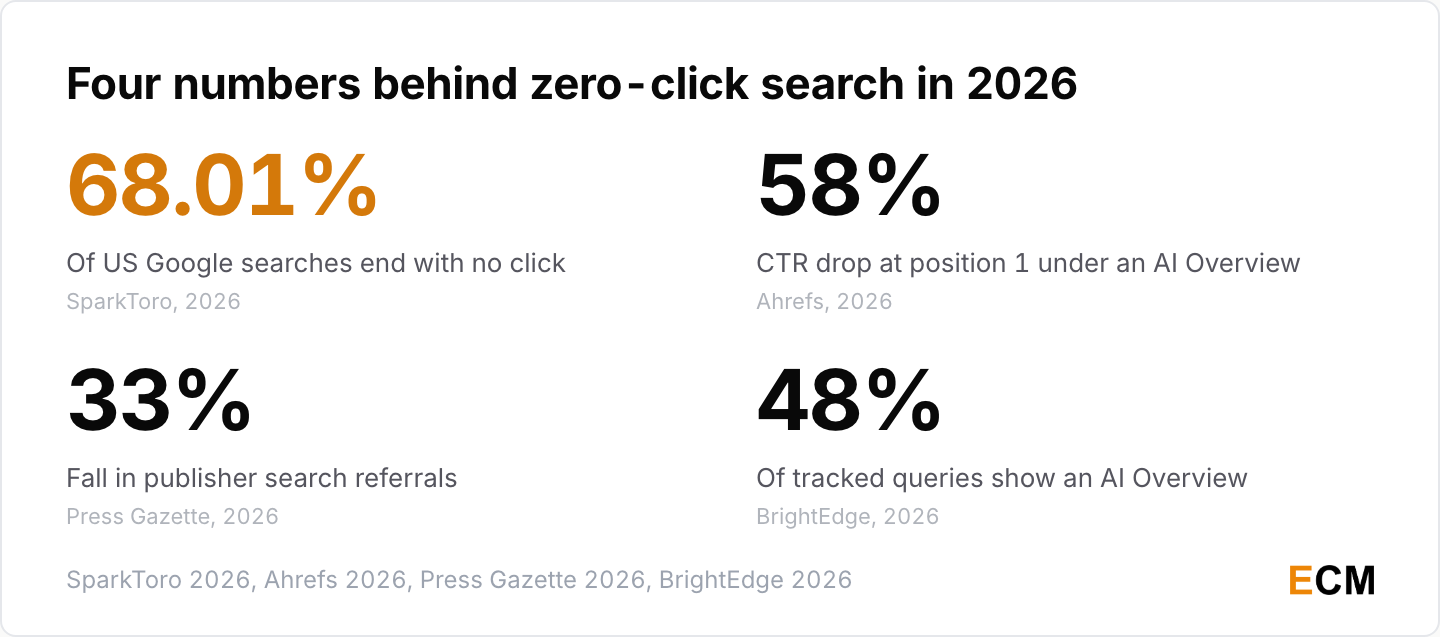
- 68.01% of US Google searches ended with no click between January and April 2026, up 7.56 points on 2024 (SparkToro, 2026).
- Position 1 desktop CTR on AI Overview keywords fell 58% once the wider decline is controlled for (Ahrefs, 2026).
- Only 8% of searches showing an AI summary produced a click on a search result, against 15% without one (Pew Research Center, 2025).
- Publisher search referrals fell about 33% globally in the year to November 2025, and 38% in the US (Reuters Institute via Press Gazette, 2026).
- AI Overviews now appear on about 48% of tracked queries, up from roughly 30% a year earlier (BrightEdge, 2026).
- Google Search and other revenue still grew 17% year over year in the fourth quarter of 2025, to $63.07B (Alphabet, 2026).
- AI tools held 0.55% of US browsing activity in March 2025 against 10.55% for search engines (Search Engine Land, 2025).
How Many Searches End Without a Click
The headline number moved fast in two years, and the definition decides how big it looks. Most Google searches now end without a click. My SEO statistics roundup covers the ranking side of the same shift.
The Headline Zero-Click Rate
Two thirds of US Google searches now end on the search results page itself.
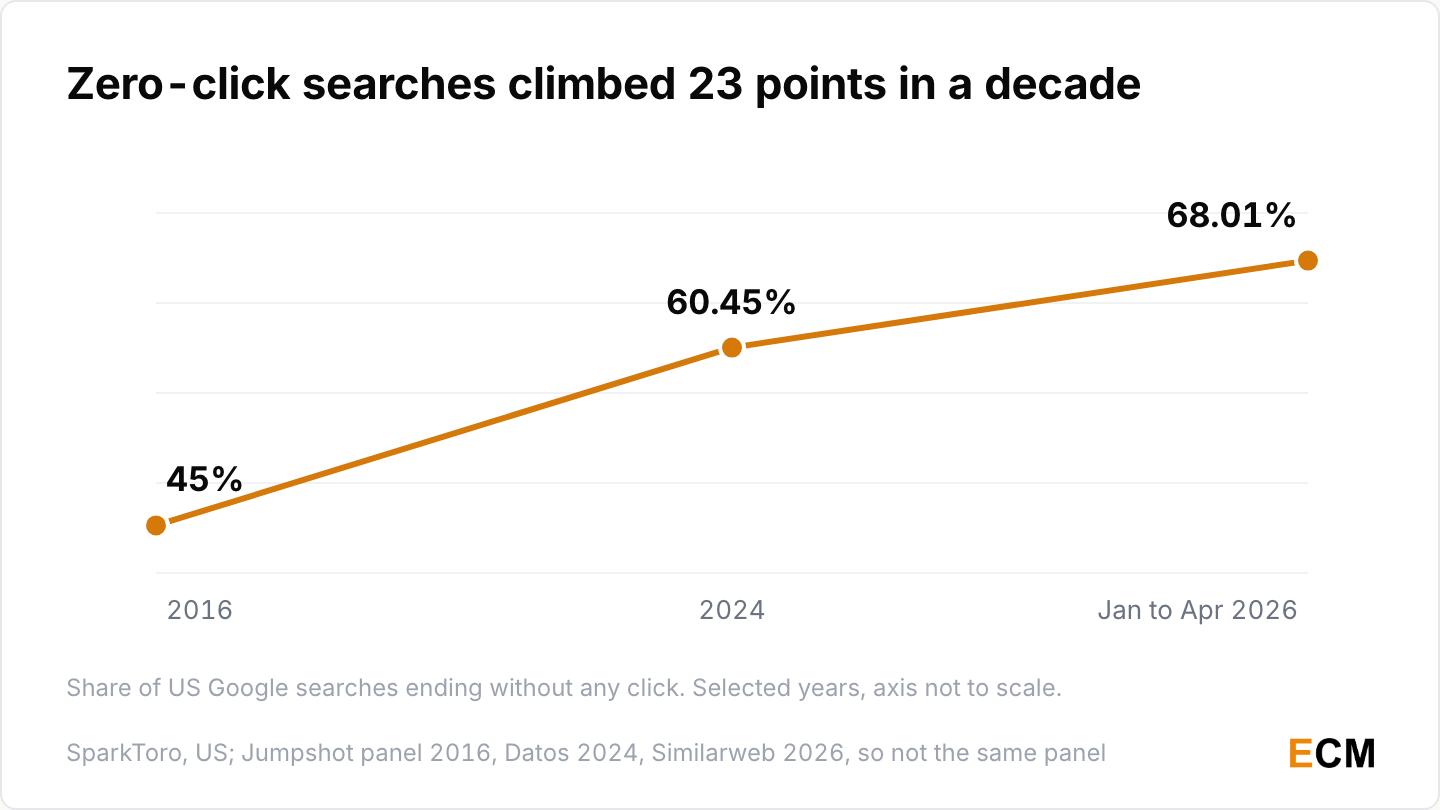
- 68.01% of US Google searches ended with no click between January and April 2026, against 60.45% in 2024, a rise of 7.56 points or 12.5% (SparkToro, 2026).
- Around 45% of searches were zero-click in 2016, so the rate has climbed 23 points in a decade (SparkToro, 2026).
- The share of searches producing at least one click fell 9.51 points between 2024 and 2026, a 22.9% decline, while searches that led to another Google search rose 7.2 points (SparkToro, 2026).
Why the Estimates Disagree
Every study draws the line somewhere different, which is why the range runs from 58.5% to 69%.
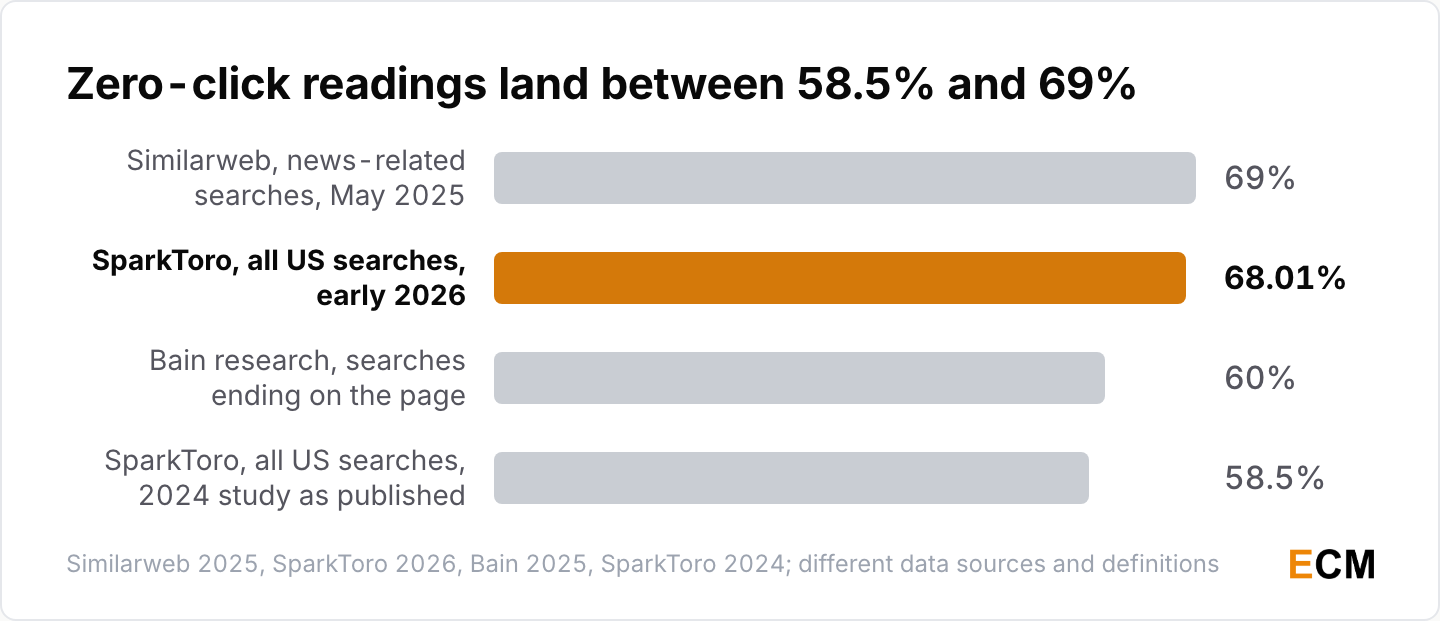
- Similarweb put news-related searches ending without a click at nearly 69% by May 2025, up from 56% (Similarweb via TechCrunch, 2025).
- Bain’s research found about 60% of searches end without the user moving to another site, and it estimates zero-click habits cut organic web traffic 15% to 25% (Bain, 2025).
- The 2024 study that set the earlier baseline put the US at 58.5% and the EU at 59.7% (SparkToro, 2024), while the same team’s 2026 post puts 2024 at 60.45% and early 2026 at 68.01%, and never reconciles the two 2024 readings (SparkToro, 2026).
Desktop and Mobile Get Measured Apart
The strictest definition, desktop sessions that simply stop, produces the smallest numbers.
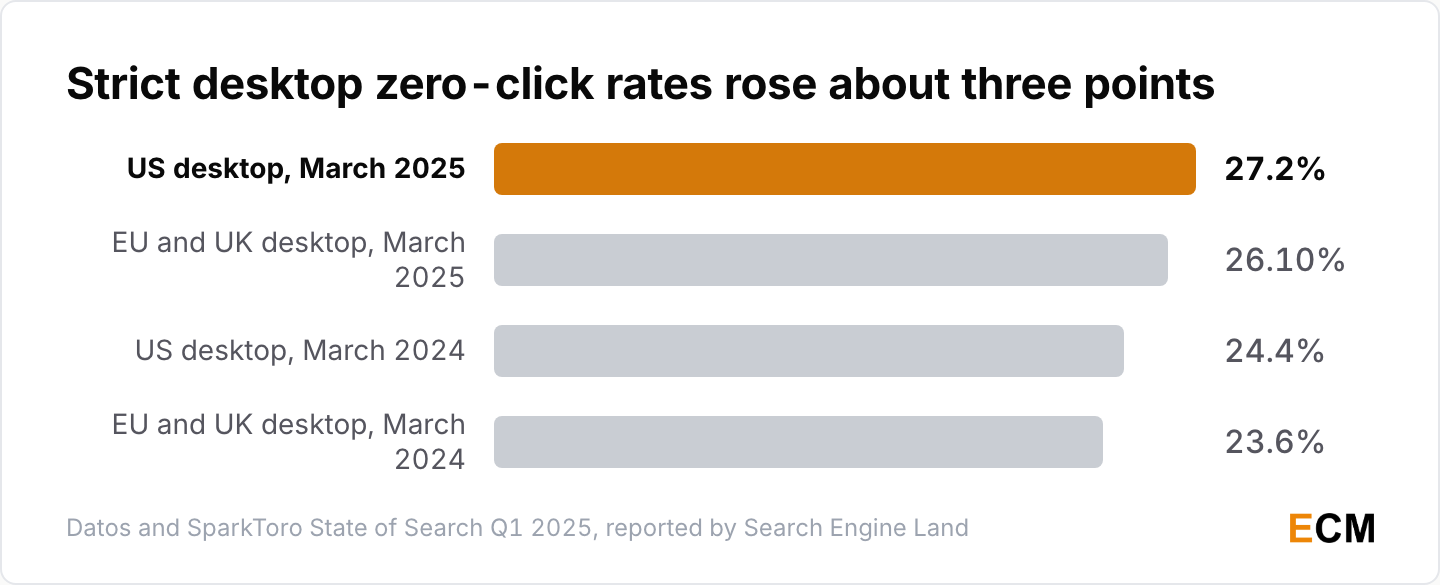
- On that strict desktop reading, US zero-click ran 27.2% in March 2025 against 24.4% a year earlier, and the EU and UK moved from 23.6% to 26.10% (Datos and SparkToro via Search Engine Land, 2025).
- US organic click share fell from 44.2% to 40.3% over that year while clicks to other Google properties rose from 12.1% to 14.3% (Datos and SparkToro via Search Engine Land, 2025). The 2026 headline instead assumes two thirds of searches happen on mobile and one third on desktop (SparkToro, 2026).
What AI Overviews Do to Clicks
This is where the click went. Google AI Overviews changed results pages faster than any search feature before them, and most panels measure clicks falling under them.
How Often AI Overviews Appear
Coverage of AI search results is volatile rather than a straight climb, which makes any single snapshot misleading.
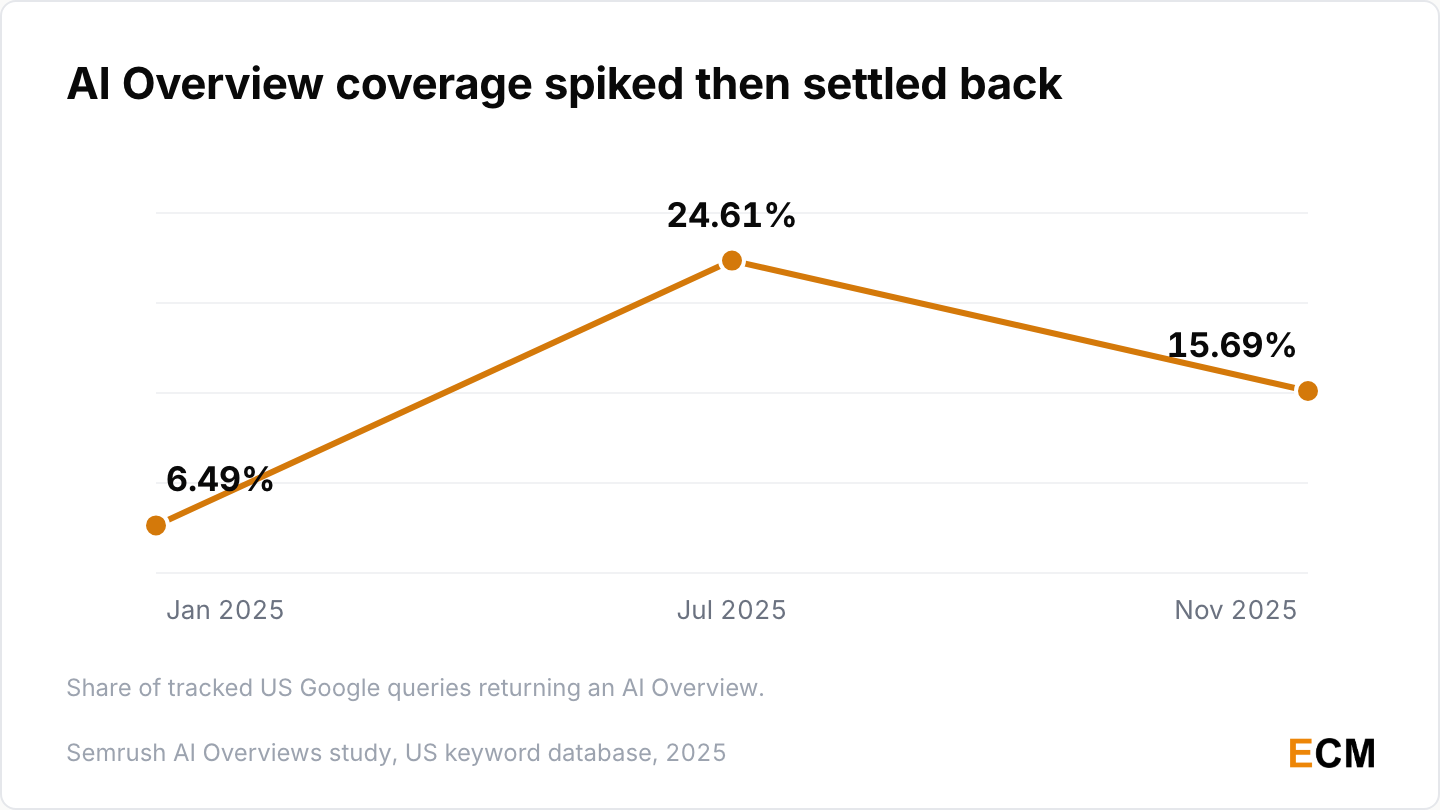
- AI Overview coverage of US queries went from 6.49% in January 2025 to a peak of 24.61% in July, then settled at 15.69% in November (Semrush, 2025), and SparkToro’s 2026 post, citing Ahrefs, puts them on more than 20% of all searches (SparkToro, 2026).
- BrightEdge has AI Overviews on about 48% of tracked queries, up from roughly 30% a year earlier (BrightEdge, 2026), and 27.3% of single-word informational queries trigger one (Seer Interactive, 2026).
- 18% of Google searches in Pew’s March 2025 panel returned an AI Overview, and 58% of people saw at least one that month (Pew Research Center, 2025).
- Google is also widening which queries get one: 91.3% of AI Overview queries were informational in January 2025, and 57.1% by October (Semrush, 2025).
Which Industries Get Them Most
Generative AI answers now cover most health, education and B2B technology queries, and the spread is uneven by industry.
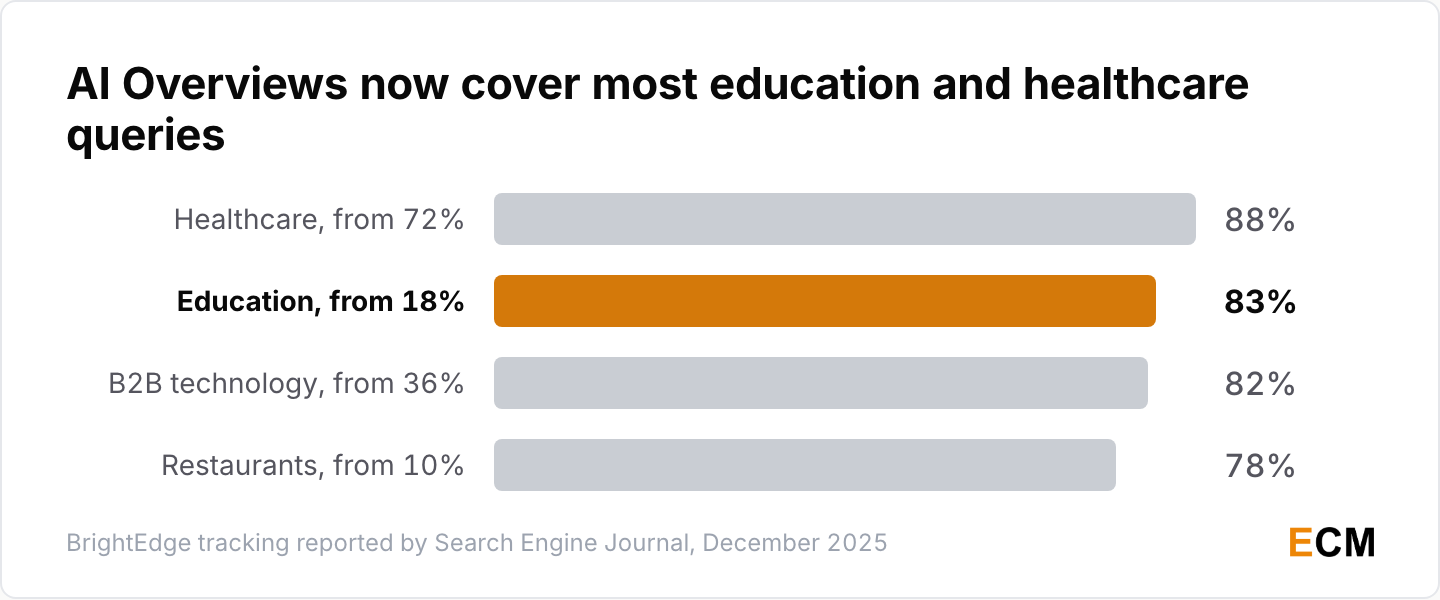
- AI Overviews reach 88% of healthcare queries, 83% of education, 82% of B2B technology and 78% of restaurant queries (BrightEdge via Search Engine Journal, 2026).
- Education moved from 18% of queries to 83%, restaurants from 10% to 78%, B2B technology from 36% to 82% and healthcare from 72% to 88% (BrightEdge via Search Engine Journal, 2026).
- Only about 17% of the sources cited in an AI Overview also rank in the organic top 10, and the average AI Overview now runs over 1,200 pixels tall, up from about 1,050 a year earlier (BrightEdge, 2026).
How Big the CTR Loss Is
Four panels, four definitions: three found a large loss, and Semrush’s same-keyword tracking did not.
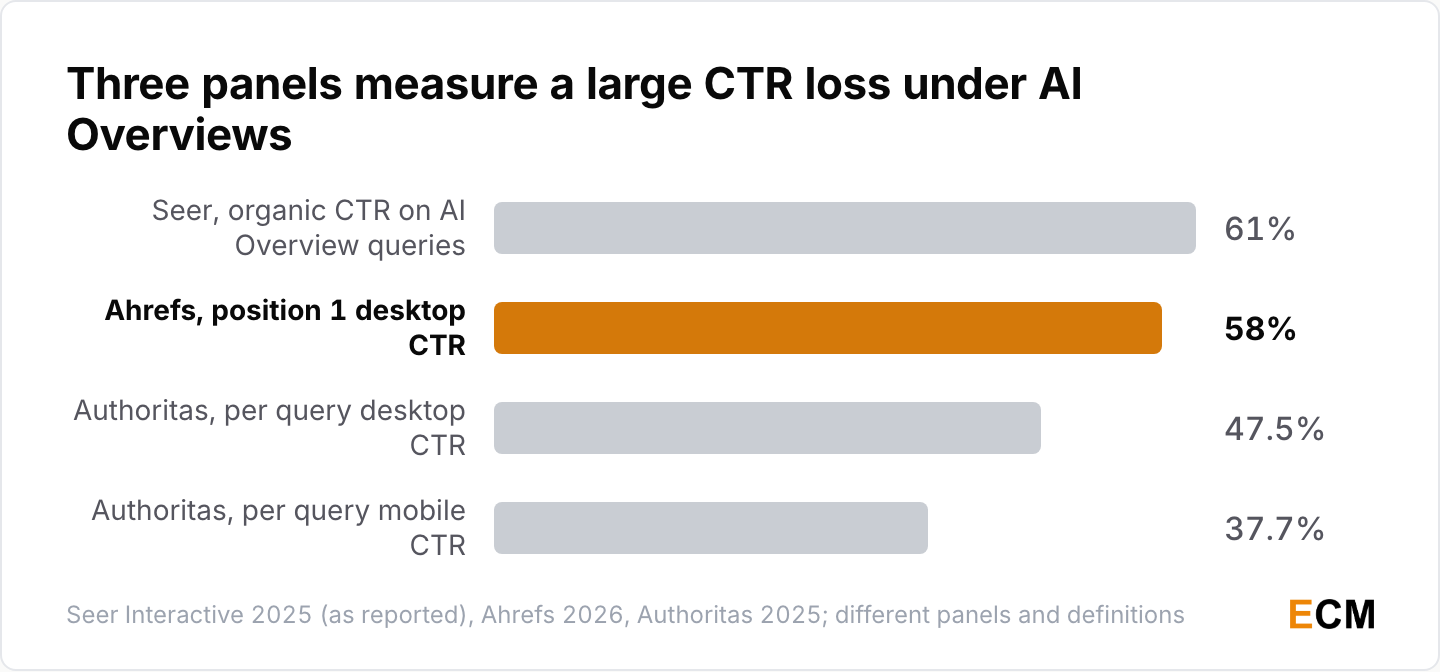
- Ahrefs measured position 1 desktop CTR on AI Overview keywords falling from 7.3% in December 2023 to 1.6% in December 2025, a 58% loss once the wider CTR decline is controlled for (Ahrefs, 2026), against the 34.5% its April 2025 version reported (Ahrefs, 2025).
- Seer Interactive reported organic CTR on AI Overview queries down 61%, from 1.76% in June 2024 to 0.61% in September 2025, a cut it also calls nearly two-thirds (Seer Interactive, 2025).
- Semrush found the reverse on same-keyword tracking: for keywords that gained an AI Overview between May and October 2025, the zero-click rate fell from 33.75% to 31.53% (Semrush, 2025).
- Authoritas found per query CTR on UK news results falling 47.5% on desktop and 37.7% on mobile when an AI Overview is present (Authoritas via Press Gazette, 2025).
Clicks Inside the Summary
The citation links inside an AI Overview are close to decorative.
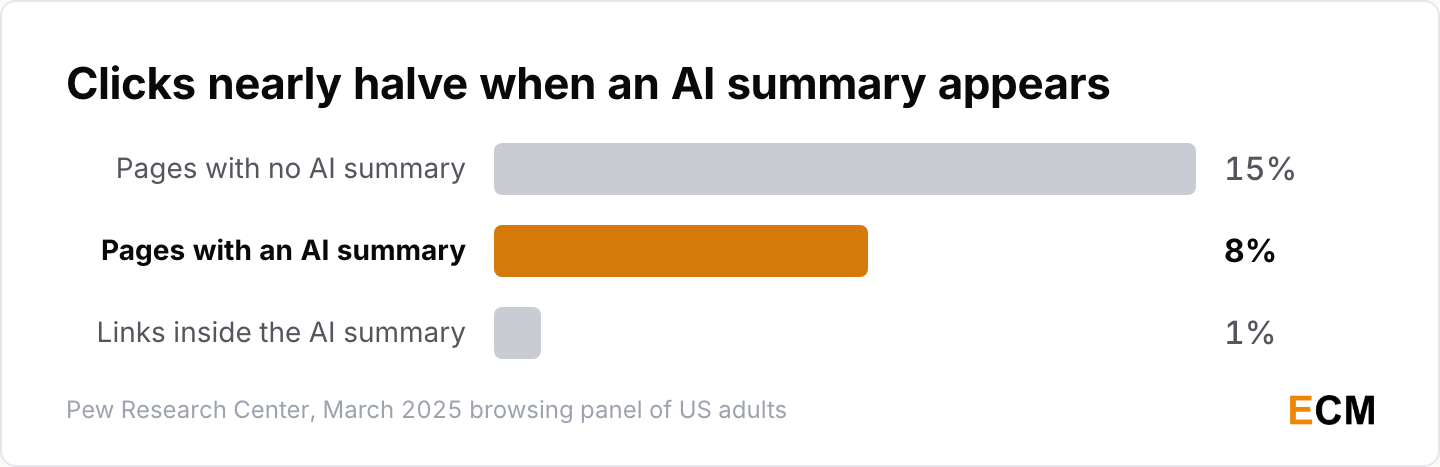
- 8% of searches showing an AI summary produced a click on a traditional result against 15% on pages without one, and 1% of those visits ended in a click on a link inside the summary (Pew Research Center, 2025).
- 26% of searches with an AI Overview ended the browsing session outright, against 16% without one (Pew Research Center, 2025).
- The median AI Overview ran 67 words and 88% cited three or more sources, with Wikipedia, YouTube and Reddit most often among them (Pew Research Center, 2025).
Where the CTR Curve Turned
The floor looks like it arrived in December 2025. Seer rebased between updates, so read this series on its own.
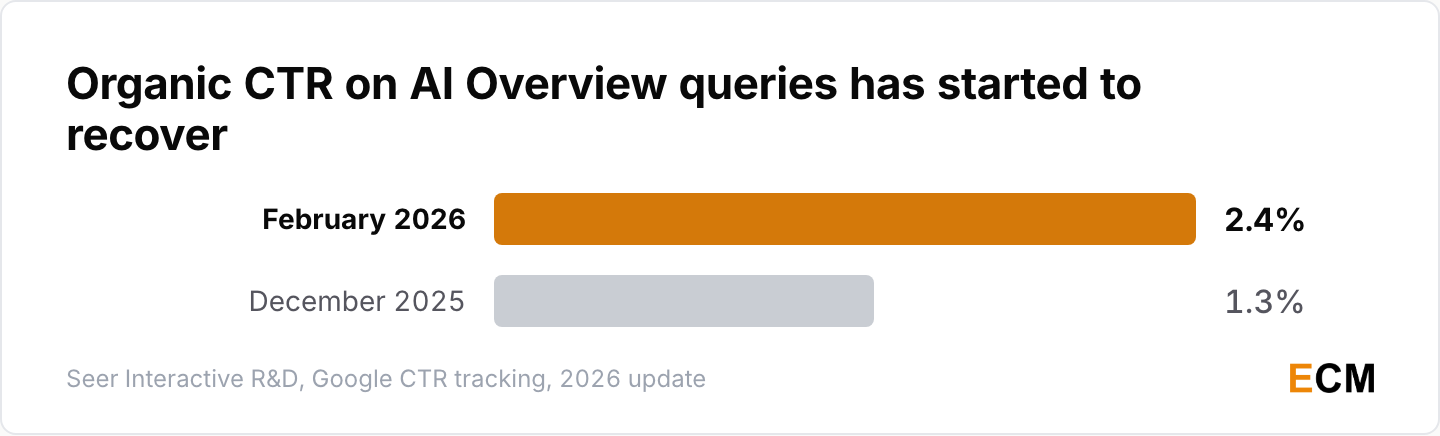
- Organic CTR on AI Overview queries bottomed at 1.3% in December 2025 and recovered to 2.4% in February 2026, an 85% rise, while paid CTR stayed in a consistent 13% to 16% range (Seer Interactive, 2026).
- Pages cited in an AI Overview earn about 120% more clicks per impression than uncited pages, but still 38% fewer than pages on a clean results page (Seer Interactive, 2026).
- Brands cited inside an AI Overview earned 35% higher organic CTR and 91% higher paid CTR than brands with no citation (Seer Interactive, 2025).
How Far Organic Click-Through Rates Fell
Rank one still beats rank ten, but it is worth a third less than it was. Traditional SEO reporting hides that, because rank holds while clicks fall. The same pressure shows up in my content marketing statistics.
Position One Is Worth Less
The premium on the top slot has shrunk, and the tail has picked some of it up.
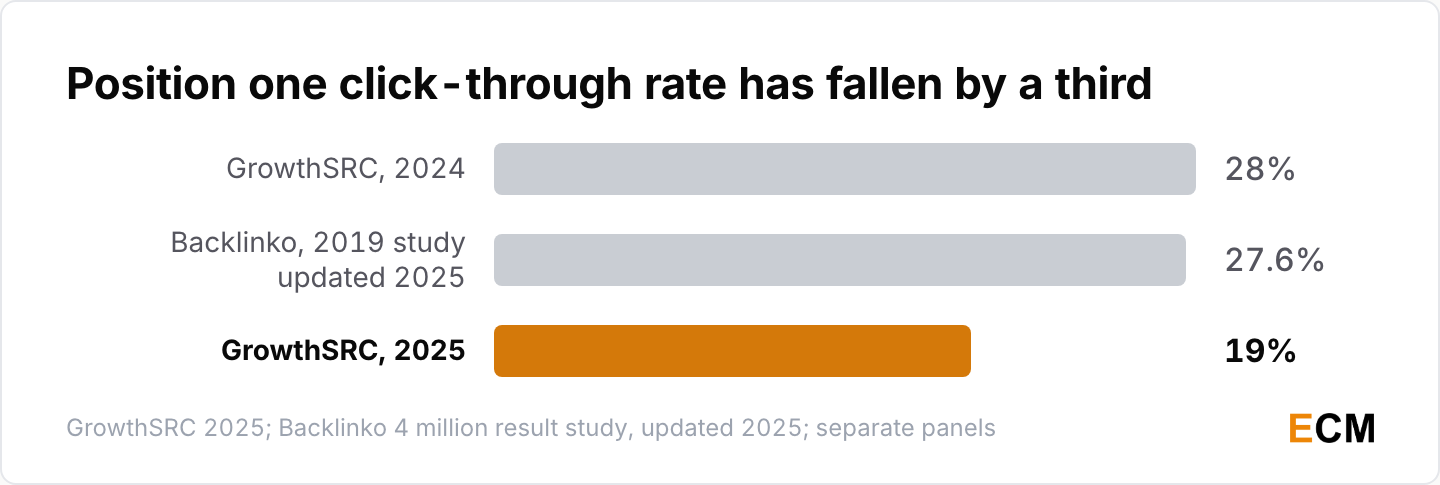
- GrowthSRC measured position 1 organic CTR falling from 28% in 2024 to 19% in 2025, with position 2 down from 20.83% to 12.60% (GrowthSRC, 2025).
- Positions 6 to 10 gained about 30% in CTR, which reads like people scrolling past the summary to find a source (GrowthSRC, 2025).
- An older Backlinko study of 4 million results, last updated in 2025, puts position 1 at 27.6%, with all of page two sharing 0.63% of clicks (Backlinko, 2025).
What SERP Features Take
On First Page Sage’s numbers, a local pack takes far more from position one than an AI Overview does, which is not what Ahrefs or Seer measured.
- The top three organic results take 68.7% of clicks on a results page with no other features (First Page Sage, 2025).
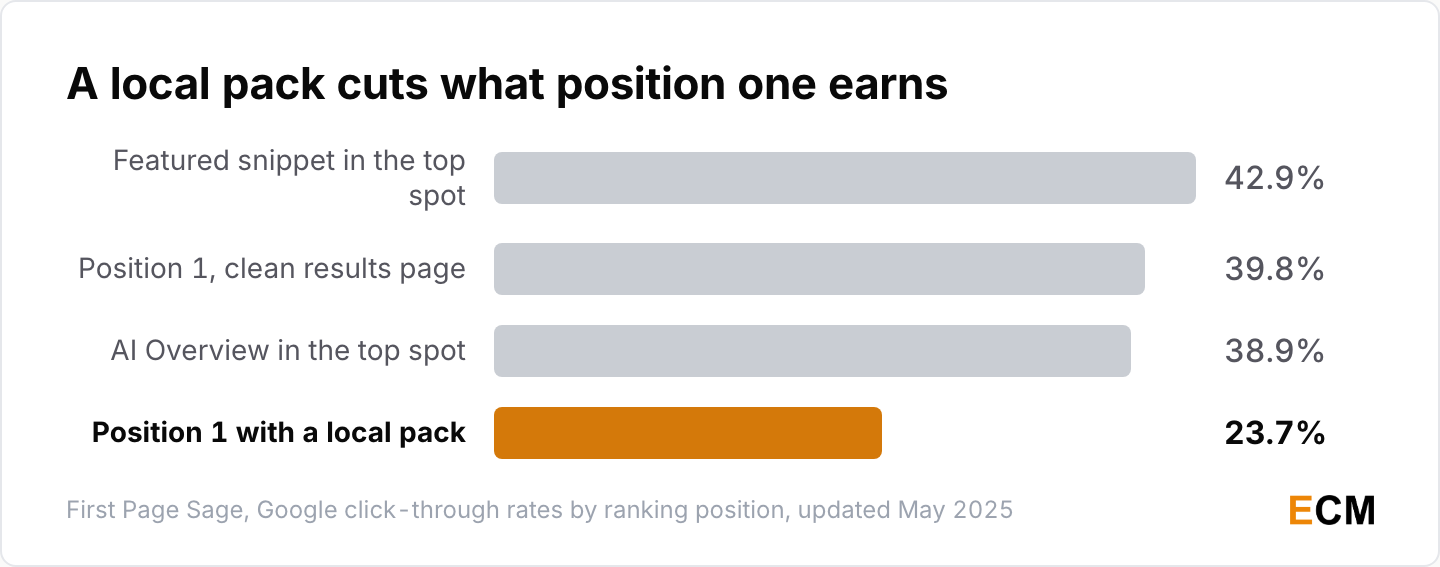
- Position 1 earns 39.8% of clicks on a clean page and 23.7% with a local pack, while a featured snippet or AI Overview in the top spot draws 42.9% or 38.9% (First Page Sage, 2025).
- Branded desktop position 1 CTR fell 1.52 points quarter on quarter in the third quarter of 2025, and commercial desktop top-two CTR fell 4.20 points (Advanced Web Ranking, 2025).
Where Rankings Still Pay Off
Two things are happening at once, and only one of them is AI Overviews.
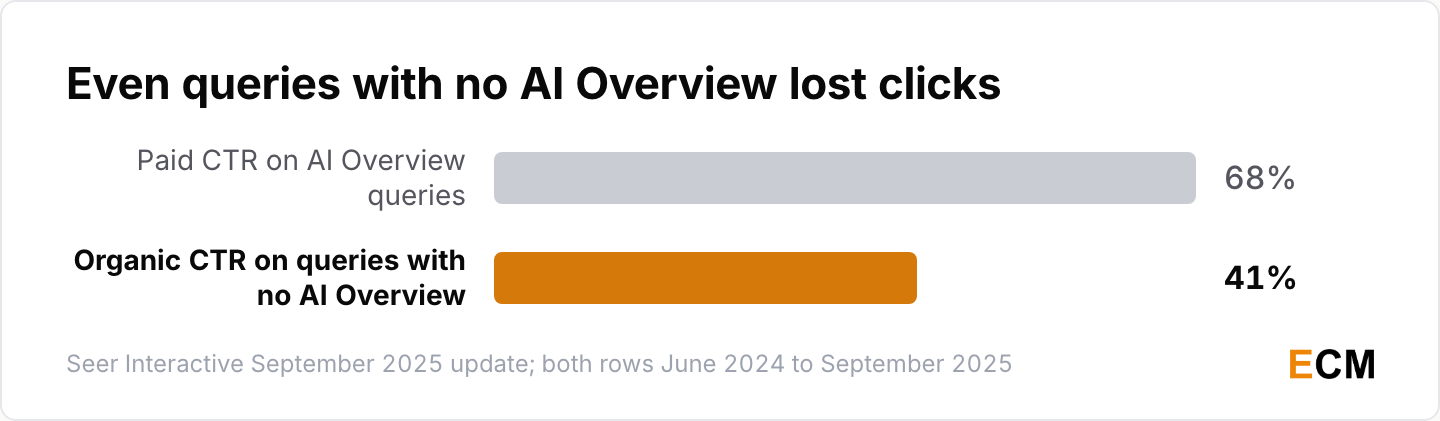
- Organic CTR on queries with no AI Overview still fell 41% between June 2024 and September 2025, from 2.72% to 1.62% (Seer Interactive, 2025).
- Paid CTR on AI Overview queries fell 68%, from 19.7% to 6.34% (Seer Interactive, 2025).
- News is the outlier: position 1 desktop CTR rose 1.43 points in Q3 2025 on a 49.25% rise in search demand (Advanced Web Ranking, 2025).
What Publishers Lost to Zero-Click Search
Publishers are the clearest read on what happens to a business built on search referrals.
How Far Referrals Fell
Over eight weeks in mid 2025 the median site lost a tenth. Over the year to November 2025 the average publisher lost a third.
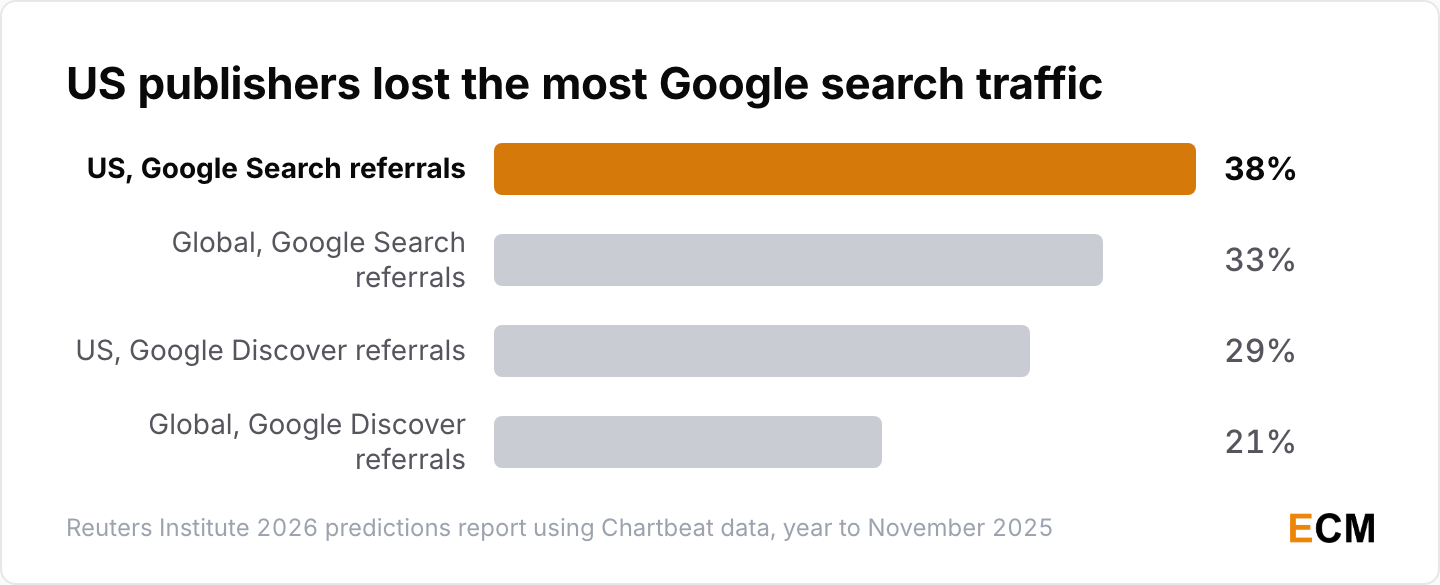
- Google Search referrals to publishers fell 33% globally in the year to November 2025, with US publishers down 38%, while Discover referrals fell 21% globally and 29% in the US (Reuters Institute via Press Gazette, 2026).
- Across an eight week window in mid 2025, Digital Content Next members saw a median 10% fall, 7% for news brands and 14% for non-news entertainment, with declines outnumbering gains two to one (Digital Content Next, 2025).
- 78% of that group’s digital revenue comes from advertising, so referral loss lands straight on the income statement (Digital Content Next, 2025).
What Publishers Expect Next
The people living through this expect it to get worse before it settles.
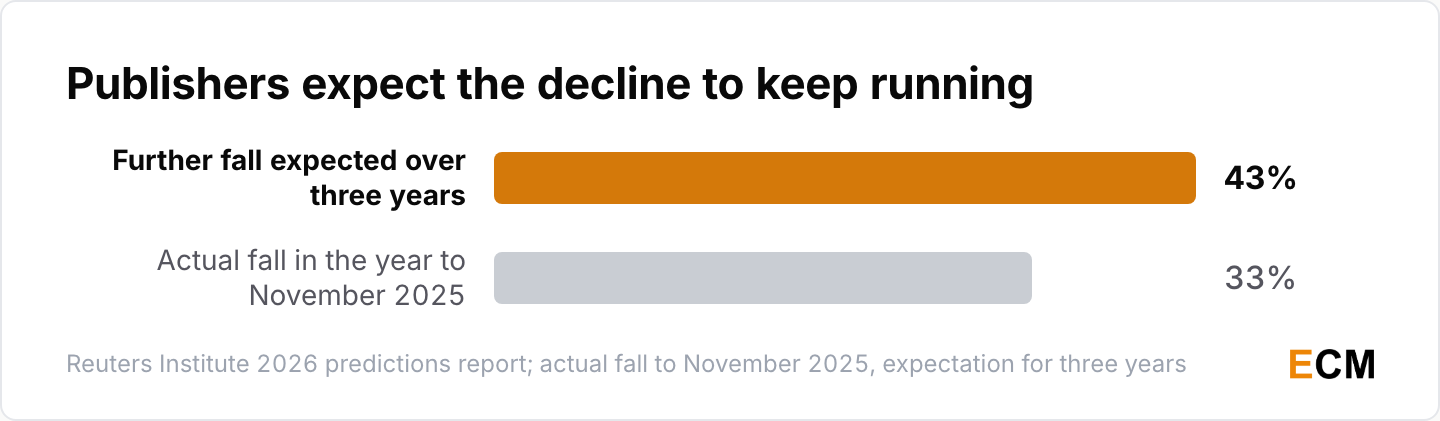
- Publishers expect traffic to decline a further 43% on average over the next three years, on top of the 33% already gone, and 20% of them expect a loss of more than 75% (Press Gazette, 2026).
- Organic visits to global news sites had already fallen from a peak above 2.3 billion a month in mid 2024 to under 1.7 billion by May 2025 (Similarweb via TechCrunch, 2025).
- Business Insider lost 55% of organic search traffic between April 2022 and April 2025 and cut 21% of staff (Wall Street Journal, 2025), and Chegg reported non-subscriber traffic down 49% in January 2025 against 8% down in the second quarter of 2024 (Chegg, 2025).
Where the Traffic Went Instead
Discover replaced Search as Google’s main pipe to news, and Discover is not something you can rank for.
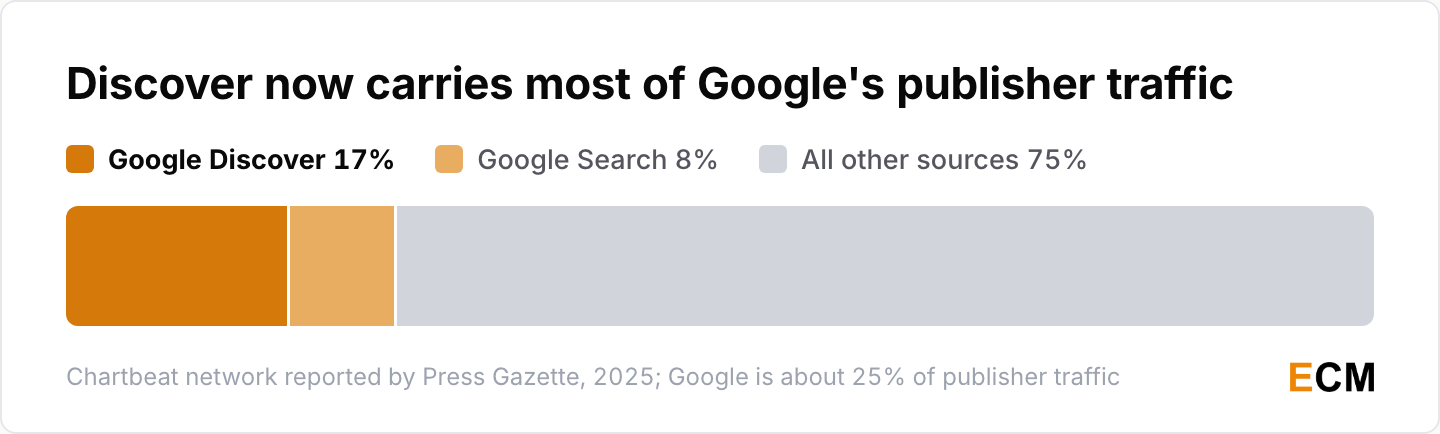
- 68% of Google traffic to sites in the Chartbeat network now comes from Discover against 32% from Search, and Google is about 25% of publisher traffic overall, 17% from Discover and 8% from Search, with the other 75% arriving from everywhere else (Press Gazette, 2025).
- Breaking news traffic rose 103% across Search and Discover since November 2024, with Discover up 168%, while topic page traffic at the top 15 US publishers fell 48% and homepage traffic fell 19% (Press Gazette, 2026).
- ChatGPT referrals to news sites grew from just under 1 million to more than 25 million, a 25 times increase (Similarweb via TechCrunch, 2025), and ChatGPT still makes up 0.02% of publisher referral traffic (Press Gazette, 2026).
What Google Says About Search Clicks
Google’s numbers and the panel data tell different stories, and both sides are quoting real figures.
Google’s Own Numbers
The rise of AI answers did not dent search revenue. It accelerated through the year the click collapsed.
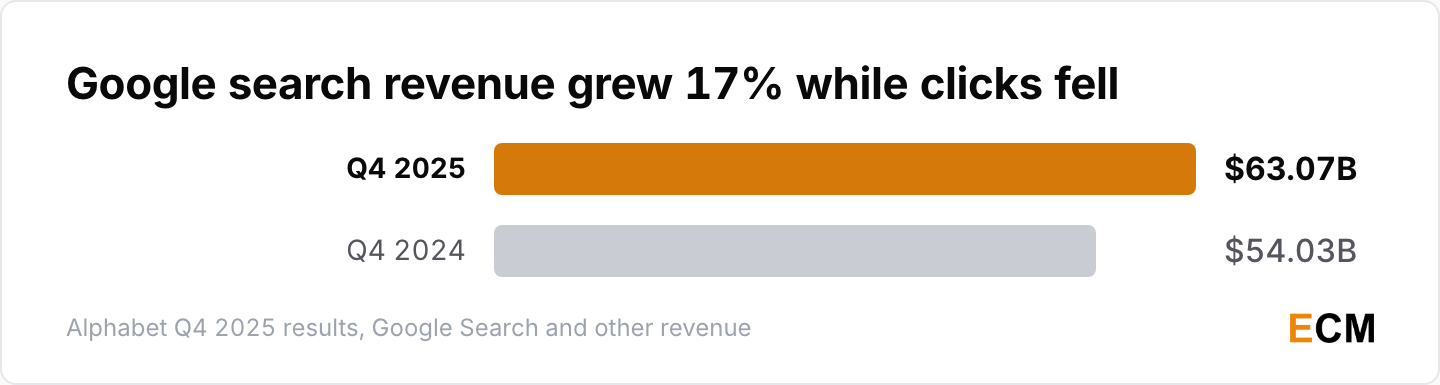
- Google Search and other revenue reached $63.07B in the fourth quarter of 2025, up 17% on the $54.03B of a year earlier (Alphabet, 2026).
- Google says AI Overviews drive more than 10% more queries globally for the query types that show them (Alphabet, 2025).
- AI Overviews reached 2 billion monthly users by mid 2025 (Alphabet, 2025), and AI Mode passed 75 million daily active users worldwide by the third quarter, with US queries doubling on the quarter (Alphabet, 2025).
Two Stories, One Set of Pages
Google talks about stable click volume. Publishers report the opposite, with their own numbers.
- Liz Reid says total organic click volume from Google to websites has been relatively stable year over year, and that average click quality has increased (Google, 2025).
- Google later framed the loss as fewer bounce clicks, visits where someone grabbed a fact and left, without publishing data behind it (Search Engine Journal, 2026), and, asked whether the Gemini app was cannibalizing Search, Sundar Pichai said Google has not seen “any evidence of cannibalization”, calling Search, AI Overviews, AI Mode and the Gemini app together “an expansionary moment” (Alphabet, 2026).
- A UK lifestyle publisher’s CTR on one page-one query fell from 5.1% to 0.6% year over year, and an automotive title lost 25% of traffic on articles still ranking first (Press Gazette, 2025).
- The News/Media Alliance called the shift theft, saying links were the last redeeming quality of search that gave publishers traffic (News/Media Alliance, 2025).
Where Search Happens Beyond Google Now
If you expect AI search engines to replace the traffic, the numbers say not yet. Search behavior is spreading, but Google still owns the referrals. My website statistics roundup has the wider picture.
Google’s Share of Referrals
Google sends nine in ten search referrals, so its product decisions move everyone’s traffic.
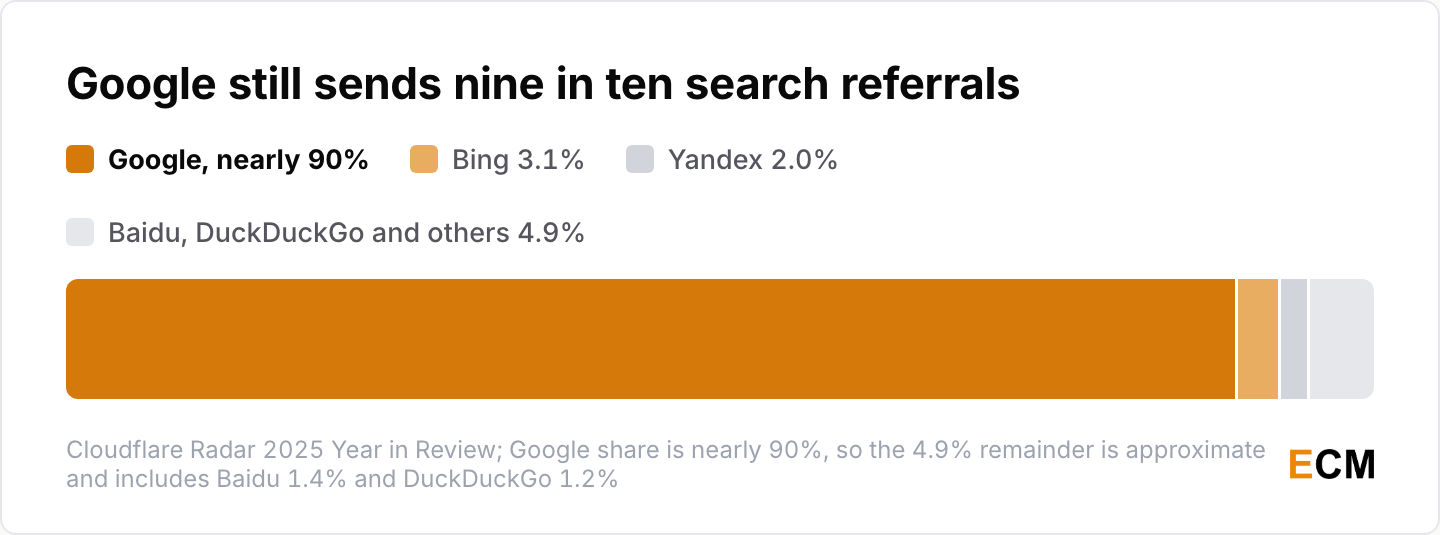
- Google delivered nearly 90% of search engine referral traffic in 2025, with Bing at 3.1% and Yandex at 2.0%, leaving a derived remainder of 4.9% covering Baidu at 1.4%, DuckDuckGo at 1.2% and the rest (Cloudflare, 2025).
- Googlebot generated over 28% of all verified bot traffic and 4.5% of HTML requests, more than every AI bot combined, which together made about 4.2% (Cloudflare, 2025).
- Google’s US share of desktop search activity fell 3.5 points during 2025, and 2 points across the EU and UK (SparkToro, 2026).
How Much Search Moved to AI
AI tools are growing fast from a tiny base, and AI Mode sends almost nothing out.
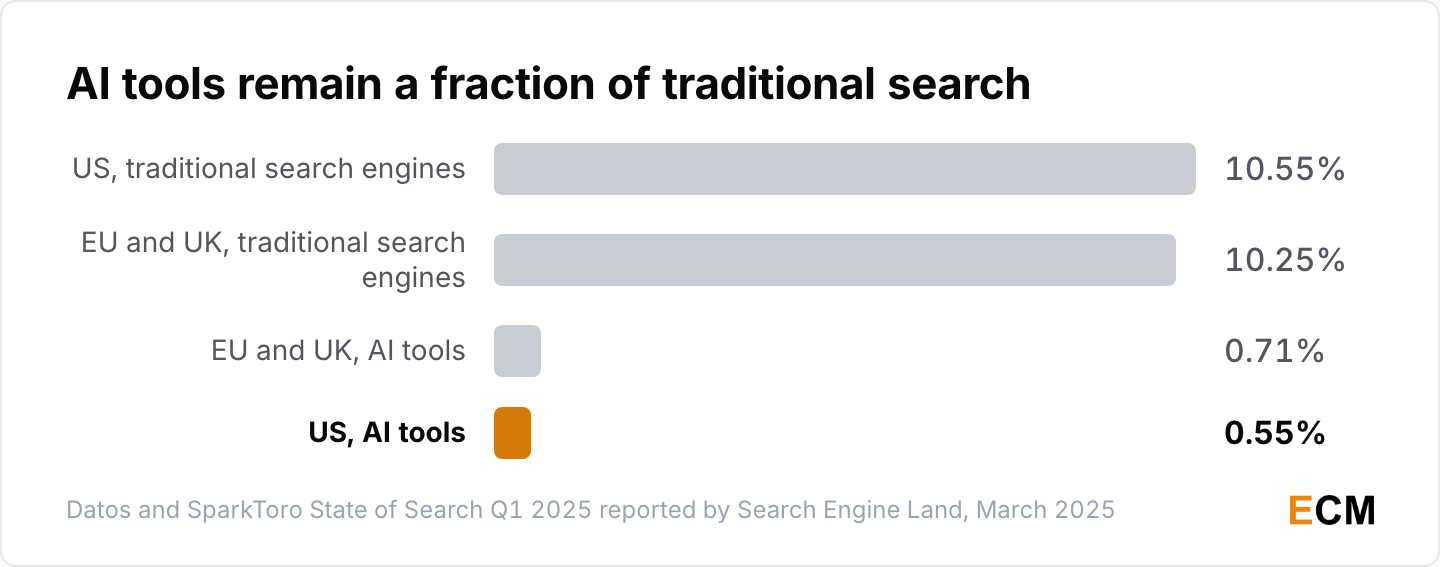
- AI tools accounted for 0.55% of US browsing activity in March 2025 against 10.55% for traditional search engines, and 0.71% against 10.25% in the EU and UK (Datos and SparkToro via Search Engine Land, 2025).
- Only 0.34% of searches moved into AI Mode between January and April 2026, ahead of Google reporting that AI Mode had passed 1 billion monthly users (SparkToro, 2026).
- 6% to 8% of AI Mode sessions include an external click, and the average AI Mode query runs about 7 words against 4 on standard search (Semrush, 2025).
What the AI Crawlers Take Back
The crawl to referral ratio is the number I would watch across AI platforms.
- Anthropic’s crawl to referral ratio fell from 286,930:1 in January 2025 to 38,065:1 in July, after Claude added web search (Cloudflare, 2025).
- Perplexity moved the other way over the same months, from 54:1 to 195:1 (Cloudflare, 2025).
- Training drove 79% of AI bot crawling by July 2025, up from 72% a year earlier, while search-related crawling fell from 26% to 17% (Cloudflare, 2025).
- 23 of 41 domains analyzed each held more than 0.1% of all search activity, at least 5 billion searches apiece, so search is spread across YouTube, Reddit, Amazon and TikTok as well (SparkToro, 2026).
Frequently Asked Questions
What percent of searches are zero-click?
68.01% of US Google searches ended without a click between January and April 2026 (SparkToro, 2026). SparkToro’s 2024 study, which used Datos data rather than the Similarweb panel behind the 2026 figure, read 58.5% (SparkToro, 2024), a stricter desktop-only definition gives 27.2% (Search Engine Land, 2025), and news-related searches run to 69% (Similarweb via TechCrunch, 2025). Check the definition before you quote a number.
What is a zero-click search?
A search that ends on the search results page, with no click to any external site. Google answers it in place with a snippet, a knowledge panel, a local pack or a generative AI summary. Definitions also differ on what counts as the end of a search: the share of searches that led to another Google search rose 7.2 points between 2024 and 2026 (SparkToro, 2026).
Why are zero-click searches increasing?
Google keeps answering more queries itself. AI Overviews now sit on about 48% of tracked queries (BrightEdge, 2026), and their presence cuts position 1 CTR by around 58% (Ahrefs, 2026). Even queries without one lost 41% of organic CTR between June 2024 and September 2025 (Seer Interactive, 2025), so habit is shifting alongside the feature.
Do consumers rely on zero-click results?
Yes. About 80% of consumers rely on zero-click results in at least 40% of their searches, which Bain estimates cuts organic web traffic by 15% to 25% (Bain, 2025). Pew found 26% of searches with an AI Overview ended the browsing session entirely, against 16% without one (Pew Research Center, 2025).
How do AI Overviews affect click-through rates?
Most studies say they cut it hard. Ahrefs puts the position 1 desktop loss at 58% (Ahrefs, 2026), Seer reports a 61% fall in organic CTR on AI Overview queries (Seer Interactive, 2025) and Authoritas at 47.5% per query on UK news results (Authoritas via Press Gazette, 2025). Being cited helps: cited pages get about 120% more clicks per impression than uncited ones (Seer Interactive, 2026).
Is SEO dead in a zero-click world?
No, but traditional SEO pays less per ranking than it did. Position 1 organic CTR fell from 28% to 19% in a year (GrowthSRC, 2025), while the top three still take 68.7% of clicks on a clean search engine results page (First Page Sage, 2025). Chatbots are not the replacement yet, at 0.55% of US browsing activity (Search Engine Land, 2025).
What is the 80/20 rule of SEO here?
The short version: a small slice of positions earns almost everything. The top three organic results take 68.7% of clicks on a clean results page, and all of page two shares 0.63% (First Page Sage, 2025; Backlinko, 2025). A local pack cuts that top slot to 23.7% (First Page Sage, 2025).
How should businesses adapt to zero-click search?
Chase citation as well as rank. Cited brands earn 35% higher organic CTR and 91% higher paid CTR (Seer Interactive, 2025), and only about 17% of AI Overview citations also rank in the organic top 10 (BrightEdge, 2026). Clean structured data and plain answers help AI search engines quote you, which is what generative engine optimization means in practice. For publishers, Discover sends 68% of Google’s traffic (Press Gazette, 2025).
What should you measure instead of clicks?
Impressions and citation share, then clicks. Google Search Console will show position 1 holding while CTR falls from 5.1% to 0.6% (Press Gazette, 2025), so a ranking report alone looks fine while traffic halves. Watch crawl to referral ratios too: Anthropic’s sat at 38,065:1 in July 2025 (Cloudflare, 2025).
Written by
Editorial Staff
The Editorial Staff represents the writers, editors, and content creators who have worked (or work) at Elite Content Marketer. The experimenter-in-chief behind the team is Chintan Zalani, who has close to a decade of experience trying to make sense of the content marketing industry. Started in 2019, Elite Content Marketer is on a mission to help creators build sustainable businesses.
Related Articles

Marketing Data
SaaS Statistics 2026: 60 Facts on Spend, Churn and AI
60 SaaS statistics for 2026: $488.5B market, 305 apps per company, 22% median growth, churn and retention benchmarks, Rule of 40 and AI.
Oct 27, 2026Read more →
Marketing Data
Quora Statistics 2026: 59 Facts on Users, Traffic and Ads
59 Quora statistics for 2026: 400M+ claimed visitors, 306.18M visits, US share, demographics, valuation, AI Overview citations and ad costs.
Oct 26, 2026Read more →
Marketing Data
Influencer Marketing Statistics 2026: 60 Facts + $33B Market
60 influencer marketing statistics: a $32.55B industry in 2025, $10.5B US spend, budgets, ROI, platforms, consumer trust, creator pay and burnout.
Oct 25, 2026Read more →