37% of respondents attribute any EBIT impact to their AI use and 6% qualify as AI high performers, both flat on the previous wave (McKinsey, August 2026). The AI workflow automation statistics that matter track that gap, not adoption.
60 AI Workflow Automation Statistics for 2026
 Written by Editorial Staff
Key Takeaways
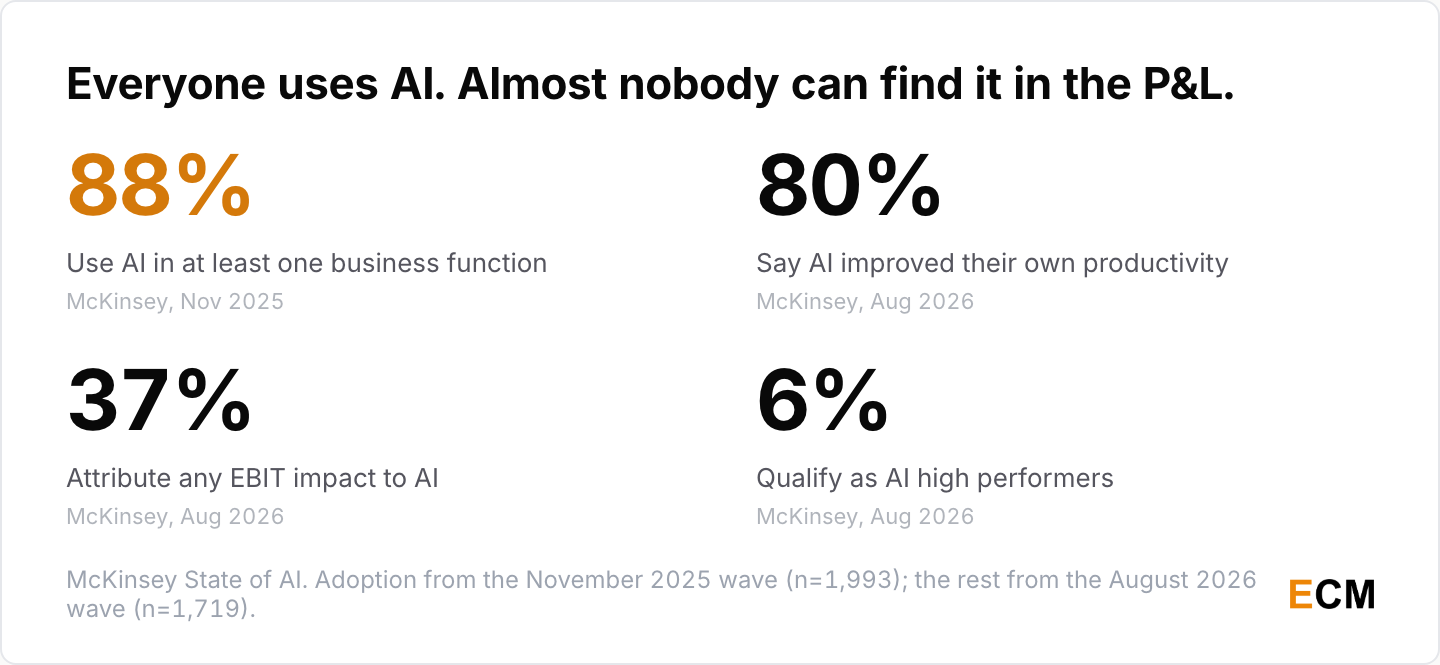
- Adoption is near universal and profit impact is flat. 88% of organizations used AI somewhere in McKinsey’s November 2025 wave (McKinsey, 2025); in August 2026, 37% of respondents attribute any EBIT impact and 6% qualify as high performers (McKinsey, 2026).
- The productivity gain is real and it’s personal. 80% of respondents say AI improved their individual productivity, while the organization-level financial impact hasn’t followed (McKinsey, August 2026).
- Executives and employees describe different companies. 97% of executives say their company deployed AI agents in the past year; 52% of employees say they use them (WRITER, April 2026).
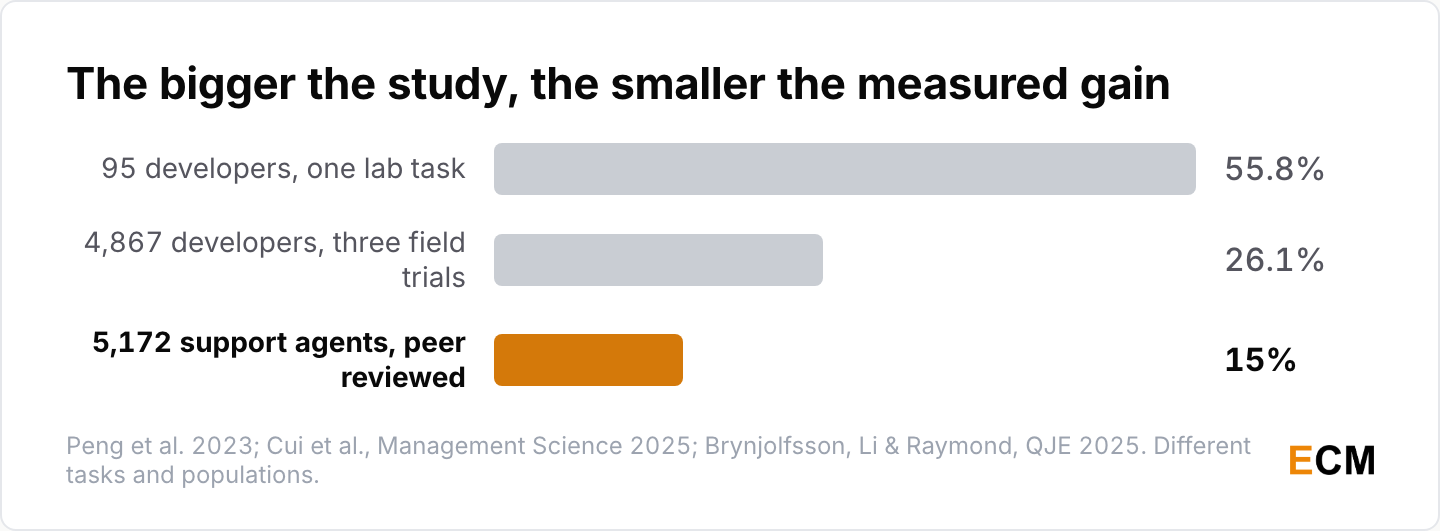
- The cleanest productivity number is 15%, not 55.8%. The largest peer-reviewed field study found 15% among support agents (Brynjolfsson, Li and Raymond, 2025); the 55.8% came from a 95-person lab trial (Peng et al., 2023).
- Coding gains shrink on the way to shipped software. Autonomous coding agents raise commits by 240%, which falls to 80% for projects started and 30% for actual releases (NBER, 2026).
- Agent scaling is a big-company story. 40% of respondents at organizations above $1 billion in revenue are scaling AI agents, up from 27% in the previous wave (McKinsey, August 2026).
- Workflow redesign is the lever, not tool spend. AI high performers are about three times more likely to have fundamentally redesigned individual workflows (McKinsey, November 2025).
AI Workflow Automation Adoption Rates in 2026
Every survey defines adoption differently, so I read these as a range rather than a consensus.
McKinsey AI Adoption and EBIT Impact
AI use is close to universal, and the profit impact behind it has not moved in a year.
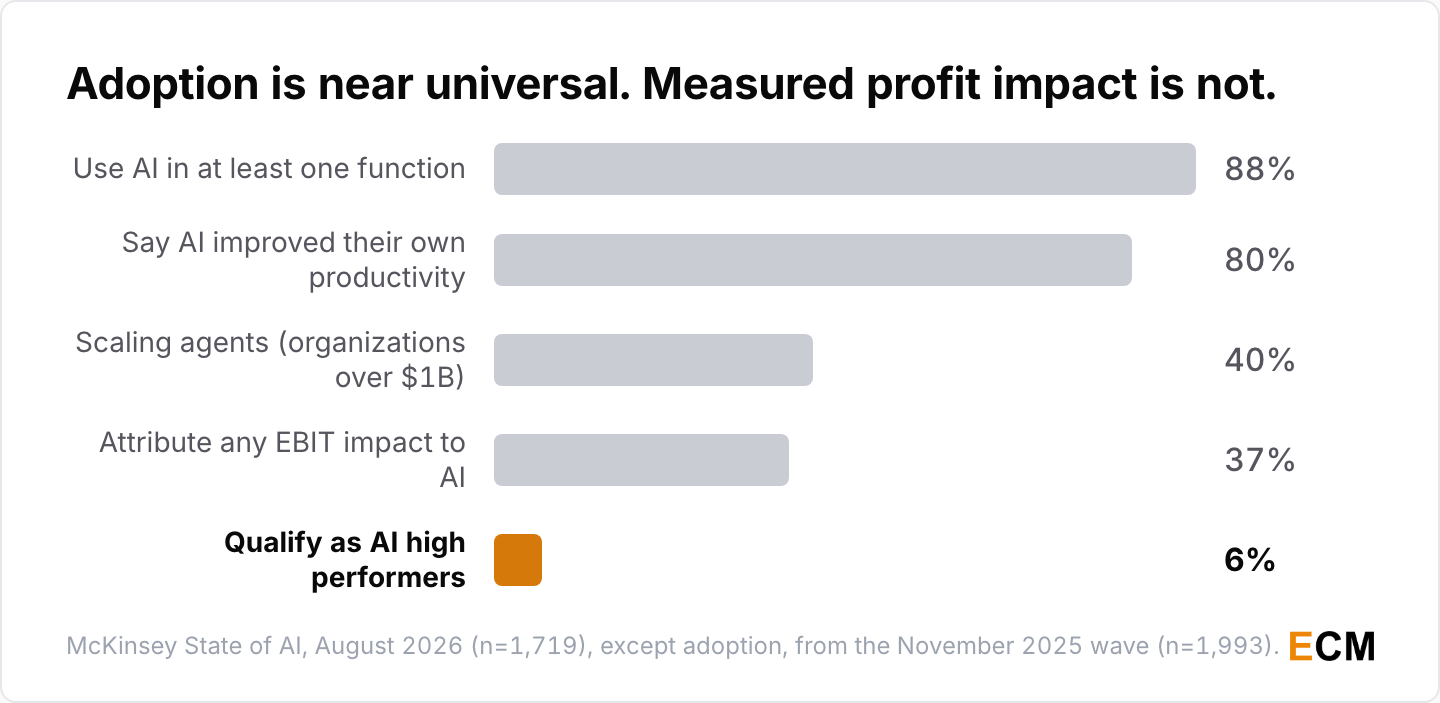
- 88% of organizations report using AI regularly in at least one business function, up from 78% a year earlier, yet only about one-third had begun to scale their AI programs (McKinsey, The state of AI, November 2025 wave, n=1,993 across 105 nations).
- 37% of respondents attribute at least some EBIT impact to their AI use, and 6% qualify as AI high performers, meaning at least 5% of EBIT from AI; both shares are flat on the previous wave (McKinsey, The state of AI in 2026: On the road to ROI, 25 August 2026, n=1,719).
- 80% of respondents say AI has improved their individual productivity, and 44% report AI scaling across their enterprise, up from 38% a year earlier (McKinsey, August 2026).
- 40% of respondents at organizations above $1 billion in annual revenue say they are scaling AI agents, up from 27% in the previous wave (McKinsey, August 2026).
Executive Claims Versus Employee AI Use
A 45-point gap separates what executives say about agents from what their employees say.
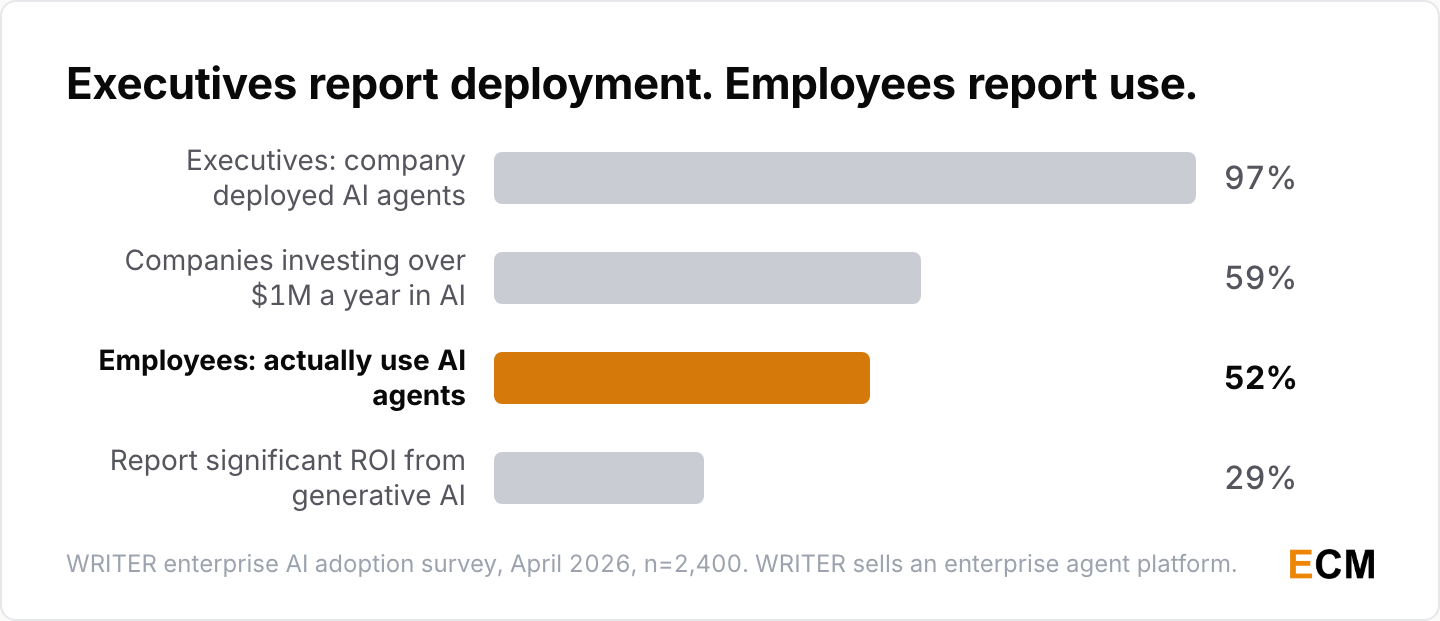
- 97% of executives say their company deployed AI agents in the past year, while 52% of the employees surveyed say they actually use them (WRITER, April 2026, n=2,400 split evenly between C-suite and employees).
- 59% of companies invest more than $1 million a year in AI technology, and 29% report significant ROI from generative AI (WRITER, April 2026).
- 79% of executives acknowledge struggling with issues including lagging ROI, strategy gaps and internal power struggles, and 75% say their company’s AI strategy is “more for show” than real guidance (WRITER, 7 April 2026).
WRITER sells an enterprise agent platform. The gap still counts, because the same survey asked both groups at the same time.
Enterprise AI Adoption Across Industries
Scaling trails use by a wide margin, and skills are the bottleneck when teams try to automate a business process.
- 66% of organizations report productivity or efficiency gains from AI (Deloitte, State of AI in the Enterprise 2026, 2026, n=3,235 leaders across 24 countries, fielded August to September 2025).
- Worker access to AI rose by 50% during 2025, and insufficient worker skills is the single biggest barrier to integrating AI into existing workflows (Deloitte, 2026).
- The number of companies with at least 40% of their AI projects in production is set to double within six months (Deloitte, 2026).
Both McKinsey and Deloitte sell AI implementation work, and both samples lean toward leaders already piloting generative AI.
Knowledge Worker AI Usage Rates
The largest knowledge-work sample in this category dates from 2024, so treat it as a baseline.
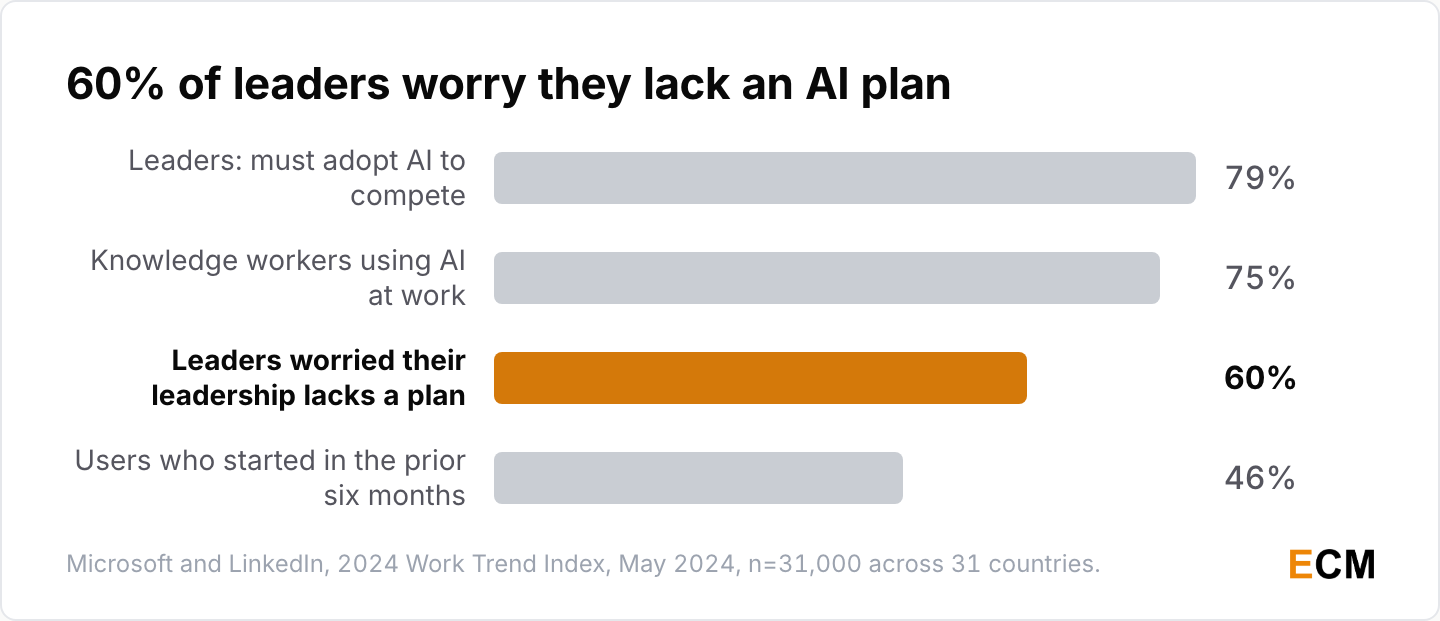
- 75% of knowledge workers use AI at work, and 46% of those users started less than six months before the survey, meaning generative AI use nearly doubled in half a year (Microsoft and LinkedIn, 2024 Work Trend Index, May 2024, n=31,000 across 31 countries).
- 79% of leaders agree their company needs to adopt AI to stay competitive, while 60% worry their leadership lacks a plan and vision to implement it (Microsoft and LinkedIn, May 2024).
Marketing AI Adoption and Content Use
Marketers want repetitive tasks gone, and almost all of them plan to automate part of content production.
- 82% of marketers name reducing the time they spend on repetitive, data-driven tasks as their top AI goal (Marketing AI Institute, 2025 State of Marketing AI Report, May 2025, n=almost 1,900).
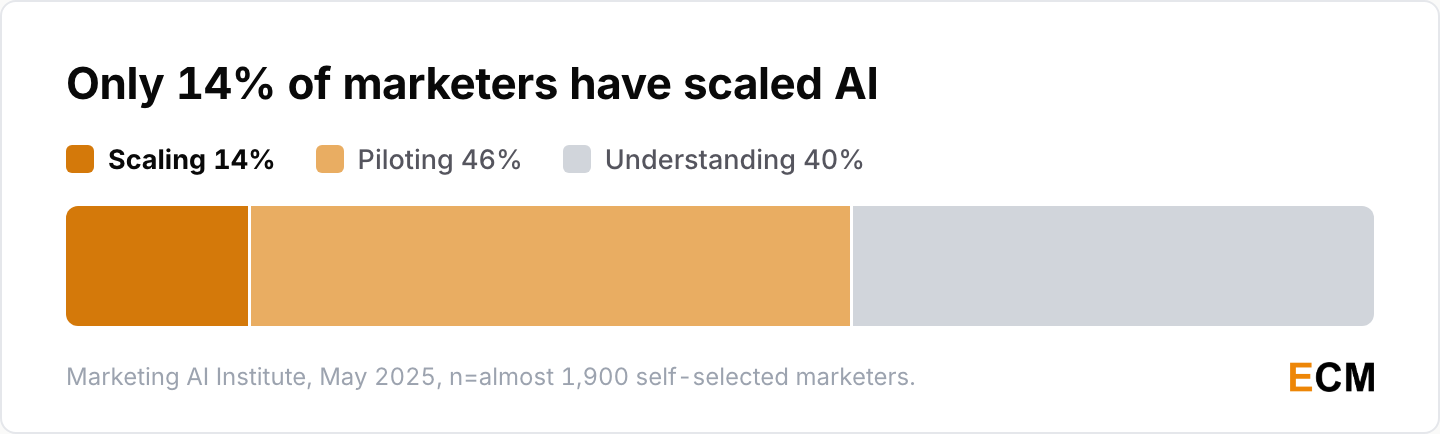
- AI maturity splits 40% Understanding, 46% Piloting and 14% Scaling (Marketing AI Institute, May 2025).
- 62% cite lack of training and education as a top barrier to AI adoption (Marketing AI Institute, May 2025).
- 94% of marketers plan to use AI in their content creation processes, including blog articles, and nearly 30% report decreased search traffic as consumers turn to AI tools (HubSpot, State of Marketing Report 2026).
The Marketing AI Institute samples its own newsletter and podcast audience, and HubSpot sells Breeze agents, so both run warm. The GEO and AEO statistics show where those clicks went, and what happens to AI drafts once they publish is in the AI content detection statistics.
AI Agents in Production: Deployment Statistics
“Agents in production” is the most abused phrase in this category, because the definition moves with whoever is asking.
Agent Adoption Rates by Company Size
In the developer community closest to agents, more than half now run them in production.
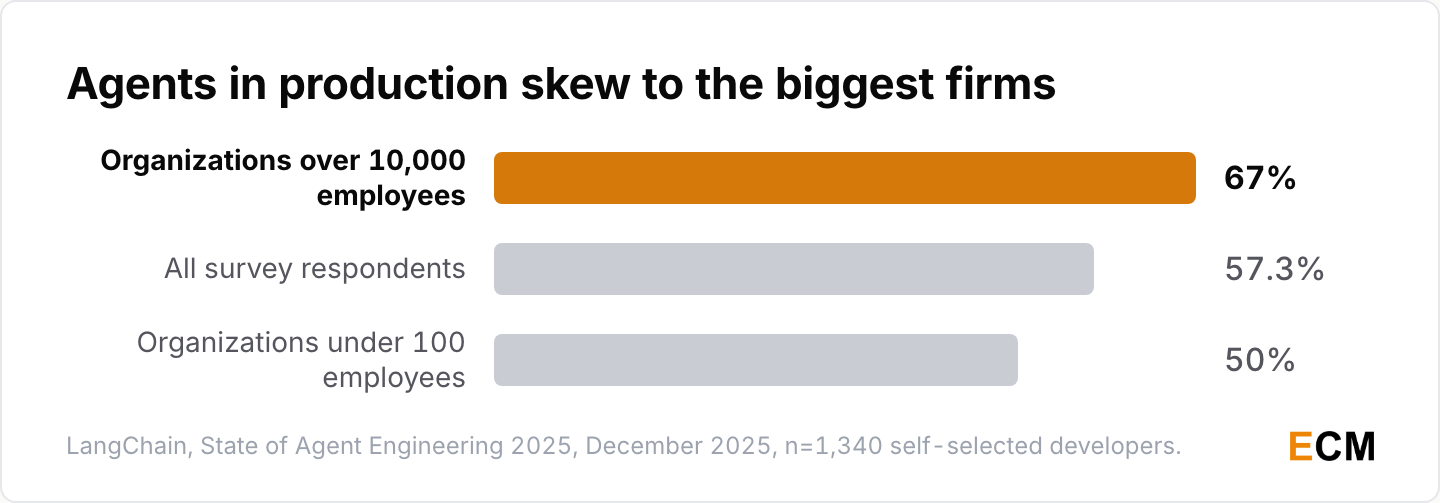
- 57.3% of respondents have agents running in production, up from 51% the year before (LangChain, State of Agent Engineering 2025, December 2025, n=1,340).
- 67% of organizations with more than 10,000 employees have agents in production, against 50% of organizations under 100 employees (LangChain, December 2025).
LangChain surveys developers already building agents, so these shares describe that community rather than all companies. Small teams are only 17 points behind the giants, which is the closest thing here to an answer for small businesses.
Which Departments Use AI Agents Most
Customer service leads, and content-adjacent research work is a close second.
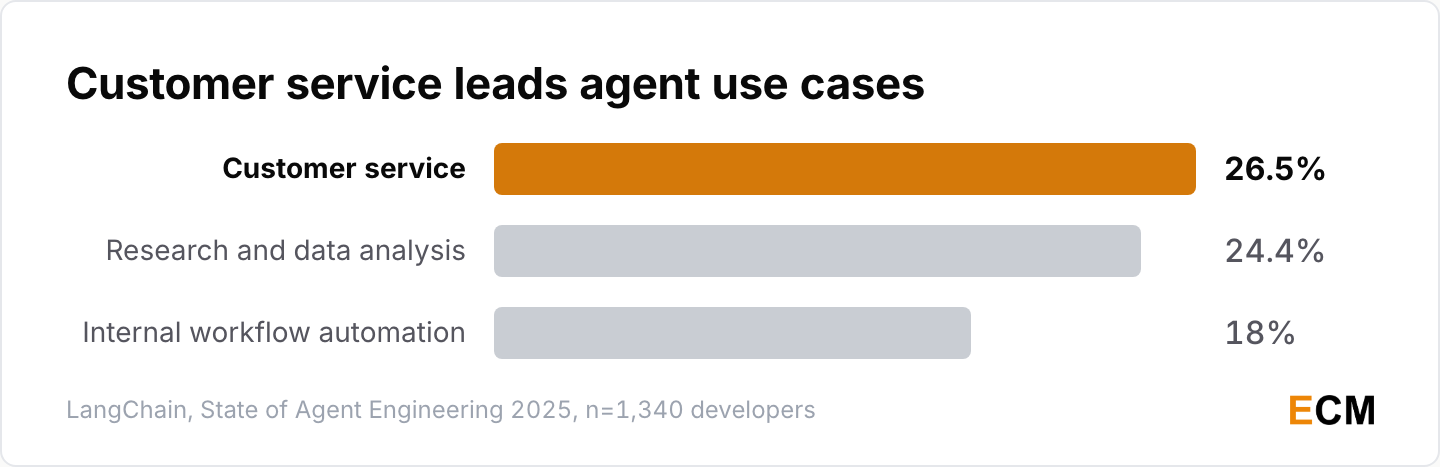
- Customer service is the most common agent use case at 26.5%, followed by research and data analysis at 24.4% and internal workflow automation at 18% (LangChain, December 2025).
- 52.4% of organizations run offline evaluations against test sets, 37.3% run online evaluations, and 59.8% still rely on human review (LangChain, December 2025).
Human review is still the most common way teams judge whether an agent works, which is how I’d measure success too before trusting any dashboard.
Automation Versus Augmentation in Claude Telemetry
One vendor publishes usage telemetry instead of survey answers, and the split moved toward augmentation.
- Directive, automation-style task delegation on Claude.ai rose from 27% to 39% of conversations across three sampling waves (Anthropic Economic Index, September 2025, drawn from around 1 million Claude.ai conversations and 1 million API transcripts).
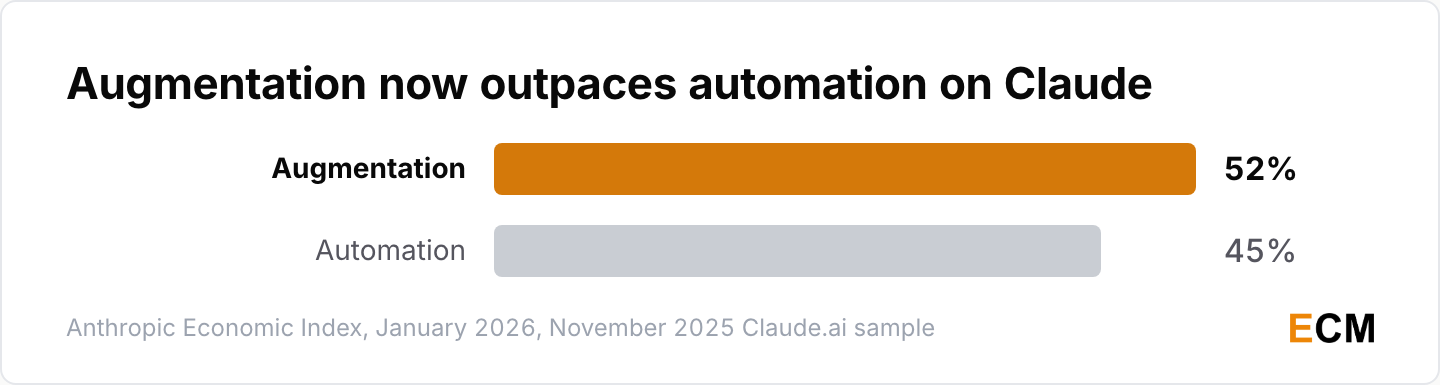
- Augmentation has since overtaken automation as the most common Claude.ai pattern, at 52% augmentation against 45% automation in a November 2025 sample (Anthropic, January 2026).
- On Anthropic’s first-party API, the top 10 O*NET tasks rose from 28% to 33% of traffic between August 2025 and February 2026 (Anthropic, March 2026).
This is one vendor’s users rather than the workforce. I include it because the split is measured behavior, not a survey answer.
AI Automation Productivity and Efficiency Statistics
Most hours-saved figures for workflow automation are self-reported. A handful of studies measured the work instead.
AI Support Agents Resolve 15% More Cases
The largest peer-reviewed field study of AI at work is a customer-support deployment, and novices gained the most.
- 15% average increase in issues resolved per hour among 5,172 customer-support agents given a generative AI conversational assistant (Brynjolfsson, Li and Raymond, Quarterly Journal of Economics, 2025, vol. 140(2)).
- The earlier working-paper version, with 5,179 agents, reported a 14% average gain and a 34% improvement for novice and low-skilled workers (NBER WP 31161, April 2023, revised November 2023).
- Less experienced workers improved both speed and quality, the most experienced saw small speed gains and small quality declines, gains were largest on moderately rare problems, and customers became more polite and less likely to ask for a manager (Brynjolfsson, Li and Raymond, 2025).
Developer Productivity Gains in Controlled Trials
Three randomized trials and one lab study point the same way at very different sizes.
- 26.08% increase in completed tasks among developers given an AI coding assistant, pooled across three randomized controlled trials and 4,867 developers at Microsoft, Accenture and an anonymous Fortune 100 company, with a standard error of 10.3% and less experienced developers gaining most (Cui et al., Management Science, 2026).
- 55.8% faster task completion for developers using GitHub Copilot, with a 95% confidence interval of 21% to 89% (p=0.0017), on a lab task implementing an HTTP server in JavaScript from scratch, with effects skewed toward less experienced developers (Peng et al., February 2023, n=95 professional programmers, authors at GitHub, Microsoft and MIT).
The 55.8% is three years old, vendor-authored, and measures a greenfield task nobody does at work. The larger and more realistic the study, the smaller the measured gain.
Where Coding Gains Stop Before Release
Task-level gains are enormous, and they attenuate at every step toward shipped software.
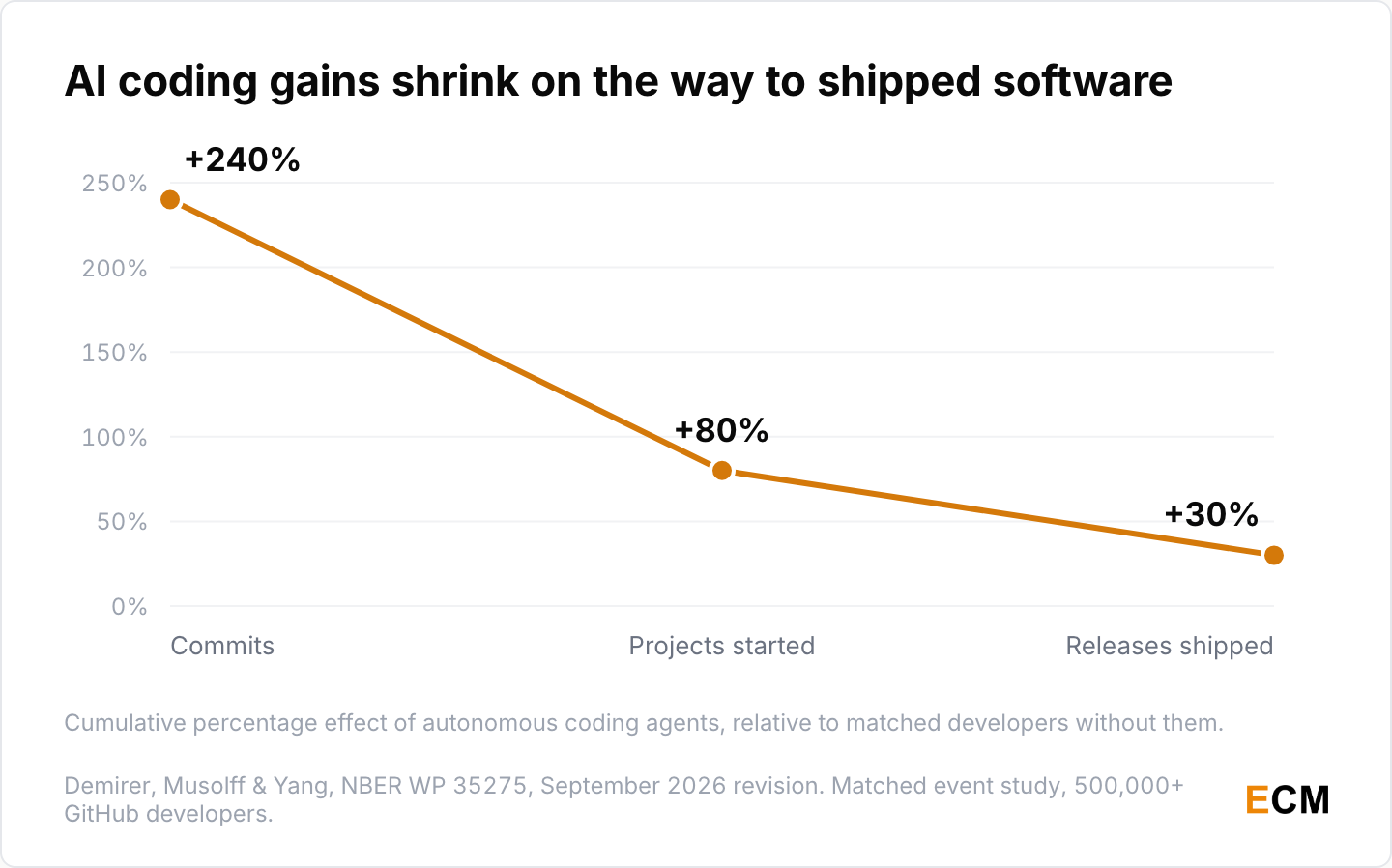
- Autocomplete, interactive coding agents and autonomous coding agents raise commits by cumulative effects of 30%, 180% and 240% respectively (Demirer, Musolff and Yang, NBER WP 35275, 2026, more than 500,000 GitHub developers).
- That 240% cumulative effect falls to 80% for the number of projects and to 30% for actual releases (Demirer, Musolff and Yang, 2026).
- The estimated elasticity of substitution between AI and human effort is 0.23, strong complementarity rather than replacement, and four major software marketplaces saw a sharp rise in new apps but no increase in total usage (Demirer, Musolff and Yang, 2026).
The human review steps around the automated ones didn’t get faster. That’s the same shape as personal productivity running far ahead of EBIT impact. For where those review steps belong, see human in the loop content marketing.
Self-Reported Time Savings From AI Tools
These are the weakest numbers on this page and the most widely quoted ones.
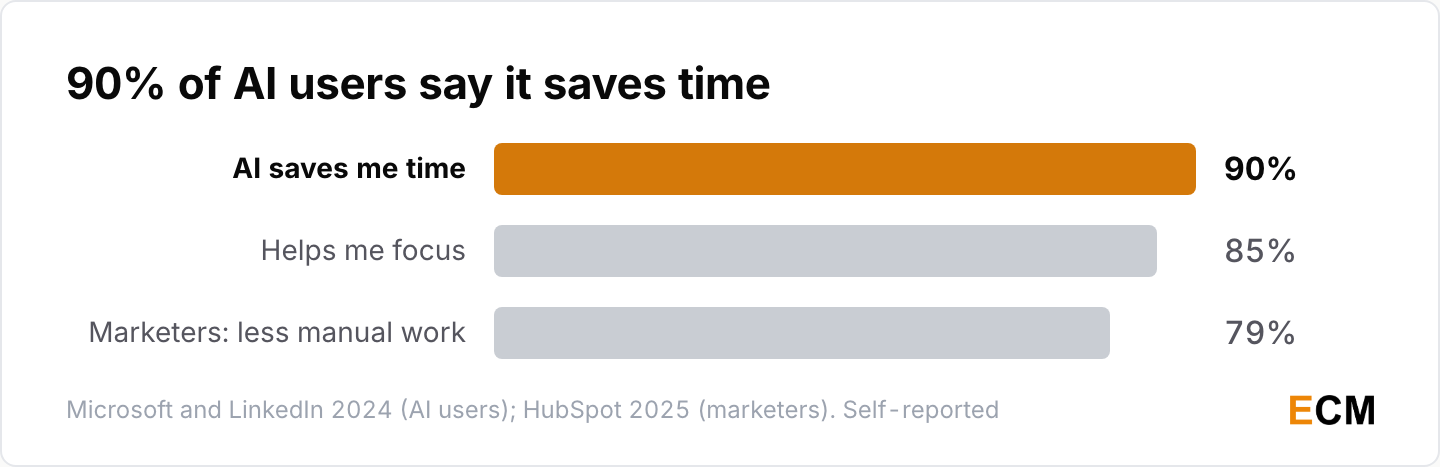
- 90% of AI users say it helps them save time, and 85% say it helps them focus on their most important work (Microsoft and LinkedIn, May 2024, self-reported).
- Marketers using AI report saving an average of one to two hours in their workday, and 79% of marketers agree AI and automation tools help them spend less time on manual tasks (HubSpot, 2025 survey).
Nobody measured a clock. People were asked how much time they thought they saved, and that’s what marketing teams are deciding on.
ROI of Workflow Automation: Spend and Returns
Buying agents doesn’t move EBIT. Restructuring the work around them appears to.
Workflow Redesign and AI High Performers
Redesign is the variable with the strongest link to enterprise-level impact in McKinsey’s model.
- AI high performers are roughly three times more likely than their peers to have fundamentally redesigned individual workflows, one of the strongest contributors to business impact across 31 variables tested (McKinsey, November 2025, Exhibit 11).
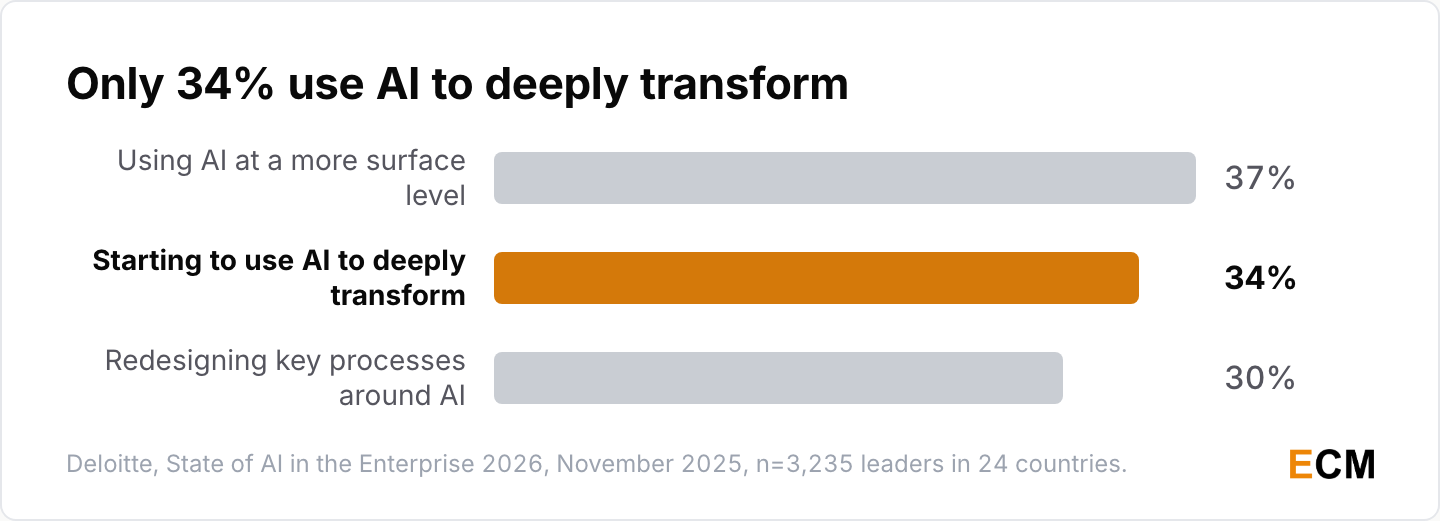
- 34% of organizations are starting to use AI to deeply transform, meaning new products or business models, 30% are redesigning key processes around it, and 37% are using it at a more surface level (Deloitte, 2026).
If you track one lever off this page, it’s that redesign figure. High performers aren’t buying more AI, they’re restructuring the work around it. What that looks like for a content team is in content marketing automation.
Enterprise AI Investment and Reported ROI
Marketing leaders report the most positive returns, while a fifth of McKinsey respondents say running costs constrain their AI use.
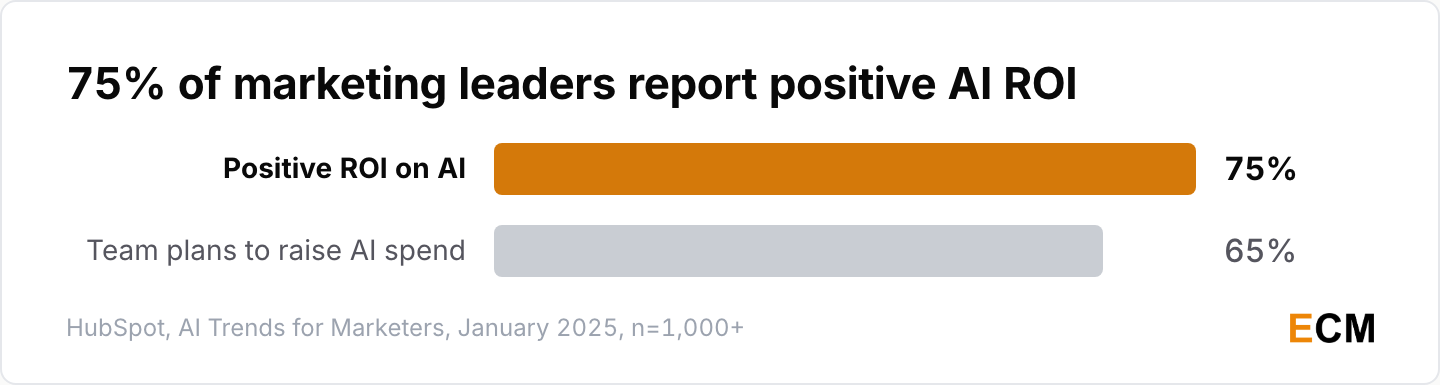
- 75% of marketing leaders whose organizations invested in AI say the investment yielded a positive ROI, and 65% say their team plans to increase investment in AI and automation tools over the year (HubSpot, AI Trends for Marketers, 2025 survey, n=1,000+).
- 20% of respondents say AI-related operating costs have constrained their use of the technology (McKinsey, August 2026).
- 92% of the C-suite admit they are actively cultivating a new class of “AI elite” employees (WRITER, 7 April 2026).
AI Workflow Automation Challenges and Failure Rates
The numbers about what isn’t working are the ones vendors have the least reason to inflate, though Gartner’s still comes with a sales angle.
Negative AI Outcomes and Job Cuts
Half of organizations report a downside, and expectations of AI job cuts are rising.
- 51% of respondents from organizations using AI report at least one negative consequence, and nearly one-third report consequences stemming from AI inaccuracy (McKinsey, November 2025).
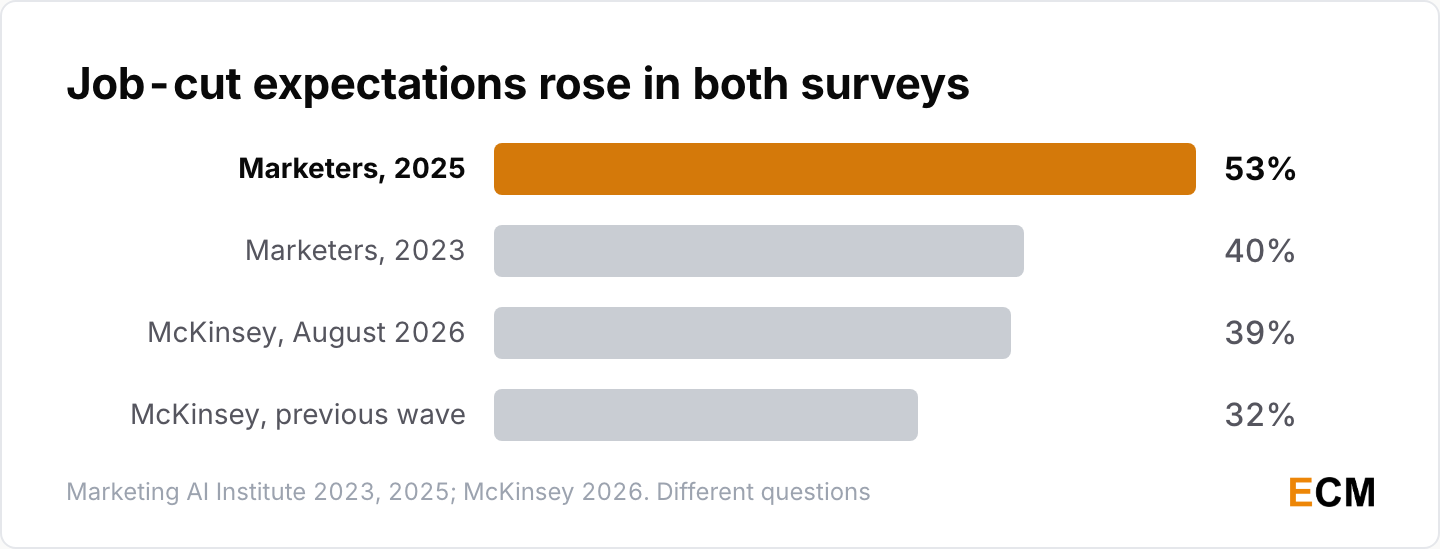
- 39% of respondents expect AI-related declines in their organization’s total employment in the coming year, up from 32% in the previous wave, while 43% expect no AI-related change (McKinsey, August 2026).
- 53% of marketers believe AI will eliminate more marketing jobs than it creates, the highest reading since the question was first asked and up 13 points from 40% in 2023 (Marketing AI Institute, May 2025).
Inaccuracy is the number to sit with if you automate anything that publishes. The model-level error rates behind it are in the AI hallucination statistics.
How AI Automation Affects Jobs and Leaders
CEOs report personal stress over AI strategy, and many companies plan to act on employees who won’t adopt it.
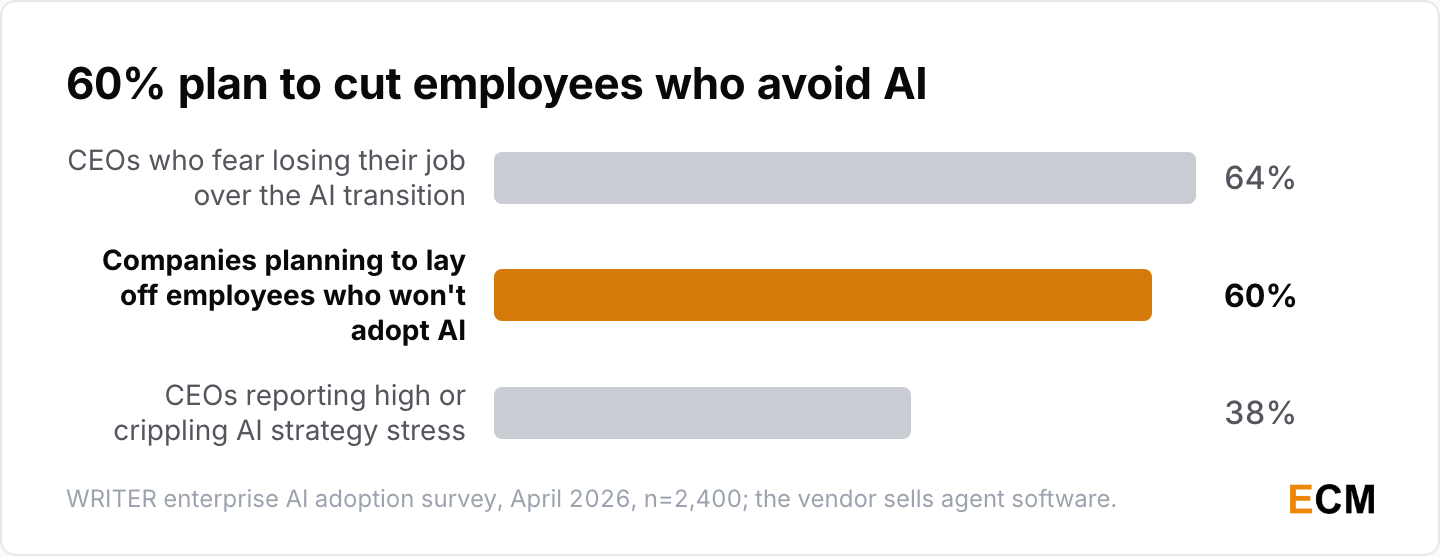
- 38% of CEOs report a high or crippling amount of stress around AI strategy, and 64% fear losing their job if they fail to lead their organization through the AI transition (WRITER, April 2026).
- 60% of companies plan to lay off employees who will not adopt AI (WRITER, April 2026).
Klarna’s AI Customer Service Reversal
The most quoted automation case study in this category also has the most quoted walk-back.
- Klarna’s OpenAI-powered assistant handled 2.3 million conversations in its first month, about two-thirds of its customer-service chats, across 23 markets and more than 35 languages (Klarna, February 2024).
- Klarna called that the equivalent work of 700 full-time agents and projected a $40 million profit improvement for 2024 (Klarna, February 2024).
- Resolution time fell from 11 minutes to under 2 minutes, with a 25% drop in repeat inquiries (Klarna, February 2024).
- By May 2025 Klarna confirmed it was re-hiring human customer-service staff, with the chatbot still handling two-thirds of inquiries and response times improved 82% (CX Dive, May 2025).
Klarna didn’t switch the bot off. It stopped treating humans as optional. The $40 million was a forward-looking projection, not a reported result.
Gartner Agentic AI Project Cancellations
Gartner’s cancellation forecast is the single most repeated number in agentic AI coverage.
- More than 40% of agentic AI projects will be canceled by the end of 2027 on escalating costs, unclear value and inadequate risk controls, and of the thousands of self-described agentic AI vendors Gartner estimates roughly 130 are real (Gartner, 25 June 2025).
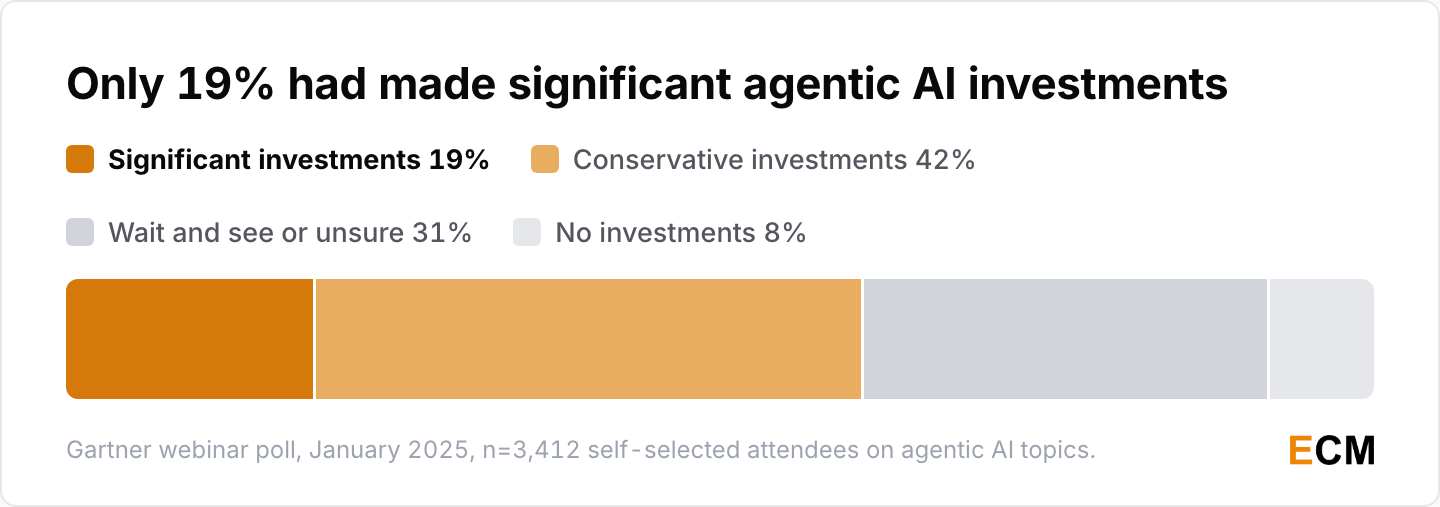
- In a January 2025 Gartner webinar poll of 3,412 attendees, 19% of organizations had made significant agentic AI investments, 42% conservative investments and 8% none, with the remaining 31% waiting or unsure (Gartner, June 2025).
That poll is a self-selected sample of people who registered for a webinar about agentic AI. The cancellation figure is analyst judgment, and it deserves the word forecast every time it’s quoted.
Automation Platform Revenue and Funding Statistics
Workflow automation market forecasts are mostly paywalled analyst estimates, and third-party ARR figures get repeated until they read like filings. These are the filings and company disclosures.
Salesforce Agentforce Revenue and Deal Counts
Agentforce is the only agent product with revenue inside an SEC-filed earnings release.
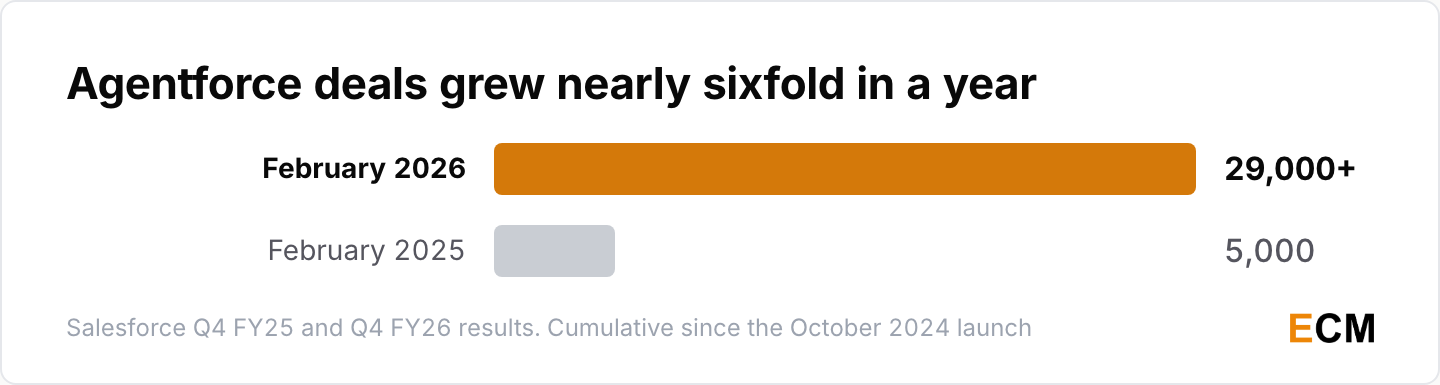
- Salesforce reported $800 million in Agentforce annual recurring revenue in Q4 FY26, up 169% year over year, and more than 29,000 Agentforce deals closed since launch, up 50% quarter over quarter (Salesforce, February 2026). By Q2 FY27, Agentforce ARR passed $1.5 billion, up more than 240% year over year, on a broader definition that now also counts Slackbot and Headless 360 (Salesforce, 26 August 2026).
- Data 360 ingested 112 trillion records in FY26, up 114% year over year, and Salesforce has processed 19 trillion tokens to date, converting them into more than 2.4 billion agentic work units (Salesforce, February 2026).
- A year earlier, Salesforce had closed 5,000 Agentforce deals since October 2024, of which more than 3,000 were paid, on $900 million of Data Cloud and AI annual recurring revenue, up 120% year over year (Salesforce, February 2025).
- On help.salesforce.com, Agentforce handled 380,000 support conversations with an 84% resolution rate (Salesforce, February 2025).
The FY25 release split out paid deals, more than 3,000 of 5,000. The FY26 release gives one combined count, so I read 29,000 as a ceiling on paid deployments. It’s still worth more than an analyst’s estimate of the same thing.
AI Automation Startup Funding Milestones
The fastest revenue ramps here are self-announced, and the funding rounds carry dates.
- Lovable passed $100 million ARR eight months after its first $1 million (Lovable, July 2025), and raised $200 million from Accel at a $1.8 billion valuation the same month (Lovable, July 2025).
- Vercel raised a $300 million Series F at a $9.3 billion valuation, co-led by Accel and GIC (Vercel, 30 September 2025), after doubling its user base with 82% top-line growth year over year (GIC, September 2025).
- More than 4 million people have used Vercel’s v0 to turn ideas into apps (Vercel, February 2026).
Zapier, n8n and Workato Usage Numbers
The no-code automation platforms marketers actually shortlist publish user counts rather than revenue.
- n8n closed a €55 million Series B led by Highland Europe with more than 200,000 users worldwide (n8n, March 2025), and its lead investor put the count at 230,000 active users, ARR grown 5x, and LLM integrations at more than 75% of workflows (Highland Europe, March 2025).
- Zapier’s platform processes more than 2 billion AI tasks per month across 3.7 million total companies (Zapier, April 2026).
- At Zapier Central’s launch, more than 388,000 customers were using Zapier’s AI products and integrations to delegate more than 50 million tasks to automation (Zapier press release, March 2024).
- Workato’s last publicly disclosed valuation is the $5.7 billion attached to its $200 million Series E (Workato, Series E announcement).
The ARR figures circulating for Zapier and Workato come from third-party trackers rather than from the companies. If you’re choosing between these platforms instead of counting them, the reviews of n8n and Zapier go into pricing and where each one breaks.
Frequently Asked Questions
How Many Companies Use AI In Their Workflows?
88% of organizations regularly use AI in at least one business function, up from 78% a year earlier (McKinsey, November 2025, n=1,993). Its August 2026 follow-up found 37% attributing any EBIT impact (McKinsey, n=1,719). Microsoft and LinkedIn found 75% of knowledge workers using AI at work (Work Trend Index, 2024). All of these count “uses AI somewhere,” not “runs automated workflows.”
What ROI Does AI Workflow Automation Deliver?
It depends who you ask. 75% of marketing leaders say their AI investment paid back (HubSpot, 2025 survey), but only 29% of companies report significant ROI from generative AI despite 59% spending over $1 million a year (WRITER, April 2026). At the profit line, 6% qualify as high performers (McKinsey, August 2026).
What Is The Realistic AI Automation Productivity Gain?
15% on average for support work (Brynjolfsson, Li and Raymond, 2025, 5,172 agents) and around 26% for software development (Cui et al., 2026, 4,867 developers). The 55.8% figure everybody quotes comes from a 95-person vendor-authored lab trial on a greenfield coding task (Peng et al., 2023).
How Many Companies Run AI Agents In Production?
It depends entirely who you ask. LangChain’s developer community says 57.3% (LangChain, December 2025). McKinsey says 40% of respondents at organizations above $1 billion in revenue are scaling agents (McKinsey, August 2026). WRITER found 97% of executives claiming deployment against 52% of employees reporting use (WRITER, April 2026).
Why Doesn’t AI Productivity Show Up In Company Results?
Because the gain attenuates at every handoff. Autonomous coding agents raise commits by 240%, falling to 80% for projects and 30% for releases (NBER, 2026). McKinsey shows the same shape: 80% of respondents report personal productivity gains against 37% reporting any EBIT impact (McKinsey, August 2026).
What Are The Biggest Challenges In AI Workflow Automation?
Inaccuracy, skills and cost. Nearly one-third of respondents report consequences from AI inaccuracy (McKinsey, November 2025), 62% of marketers name lack of training as a top barrier (Marketing AI Institute, 2025), and 20% say operating costs have constrained their AI use (McKinsey, August 2026).
How Does AI Automation Affect Jobs?
39% of respondents expect AI-related declines in their organization’s total employment in the coming year, up from 32% (McKinsey, August 2026). 53% of marketers think AI will eliminate more marketing jobs than it creates (Marketing AI Institute, 2025), and Klarna’s bot claimed the work of 700 agents (Klarna, February 2024) before the company re-hired humans (CX Dive, May 2025).
What Share Of Agentic AI Projects Will Fail?
Gartner forecasts that more than 40% of agentic AI projects will be canceled by the end of 2027, and estimates only around 130 of the thousands of self-described agentic AI vendors are real (Gartner, June 2025). Both are forecasts, not measurements.
How Many Companies Use Zapier And n8n?
Zapier reports 3.7 million total companies on its platform and more than 2 billion AI tasks a month (Zapier, April 2026). n8n’s lead investor put its base at 230,000 active users, with LLM integrations in more than 75% of workflows (Highland Europe, March 2025).
Written by
Editorial Staff
The Editorial Staff represents the writers, editors, and content creators who have worked (or work) at Elite Content Marketer. The experimenter-in-chief behind the team is Chintan Zalani, who has close to a decade of experience trying to make sense of the content marketing industry. Started in 2019, Elite Content Marketer is on a mission to help creators build sustainable businesses.
Related Articles
Marketing Data
Creator Economy Statistics 2026: 60 Facts + $250B Market
60 creator economy statistics: a $250B market (2023), $37B projected US creator ad spend, 10.1M US independent creators, earnings, AI and burnout.
Oct 24, 2026Read more →
Marketing Data
Affiliate Marketing Statistics 2026: 60 Facts + $13.6B Spend
60 affiliate marketing statistics: $13.62B in US spend in 2024, 9.4% of US e-commerce sales, a 15X UK return and what affiliates really earn.
Oct 23, 2026Read more →
Marketing Data
Black Friday Statistics 2026: 57 Facts + $11.8B in Sales
57 Black Friday statistics: $11.8B in US online sales in 2025, 202.9M US weekend shoppers, and 84% of shoppers suspect inflated pre-sale prices.
Oct 22, 2026Read more →