78% of marketers need more personalized content than they can produce, and 98% hit barriers when they try (Salesforce, State of Marketing, 10th edition, 2026). These AI personalization statistics show the gap sits in the data, not the models.
58 AI Personalization Statistics for 2026: ROI + Adoption
 Written by Editorial Staff
Key Takeaways
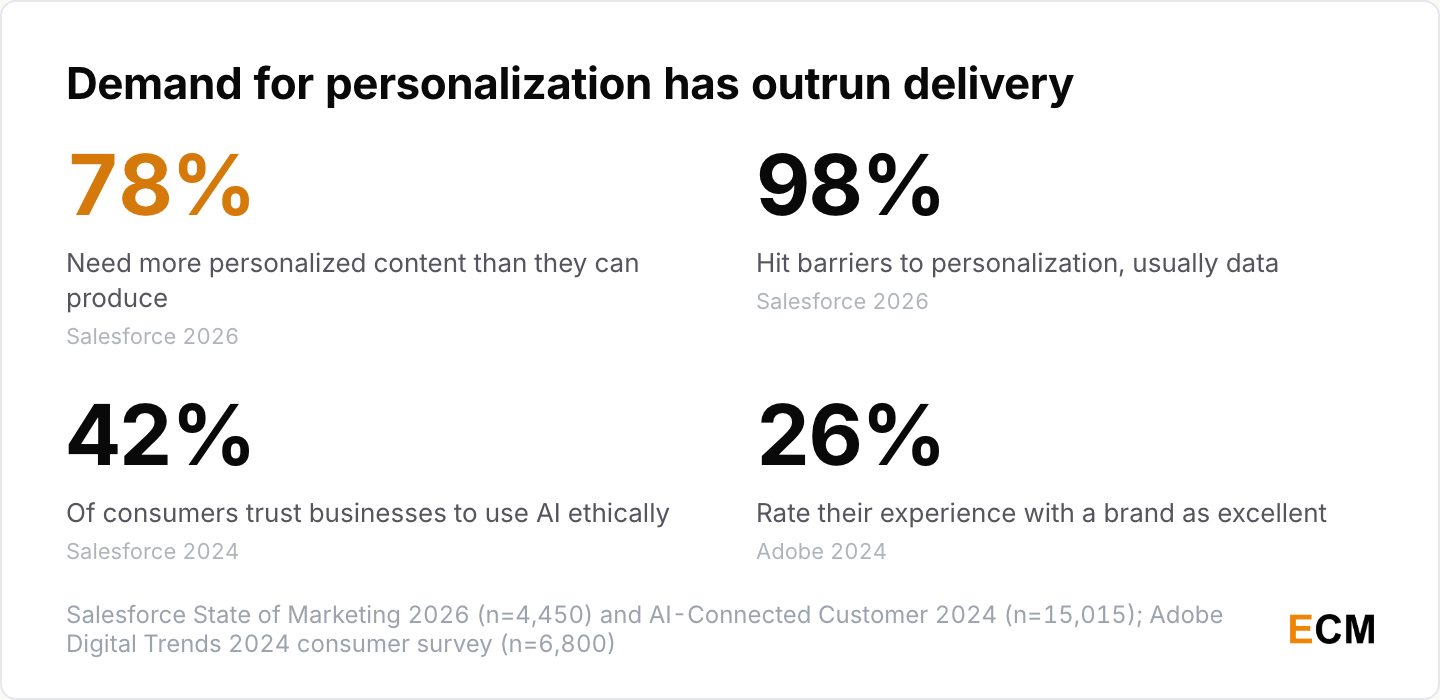
- Demand has outrun production. 78% of marketers need more personalized content than they can make, and 98% hit barriers, with data issues the most common culprit (Salesforce, 10th edition, 2026).
- Brands grade themselves far higher than customers do. 87% of brand leaders rate their personalization good or excellent, while only 29% of consumers agree (Deloitte Digital, Personalizing growth, 2026).
- Trust in ethical AI use is falling. 42% of customers trust businesses to use AI ethically, down from 58% in 2023 (Salesforce, State of the AI-Connected Customer, 2024).
- The most-quoted consumer figures date to 2021. McKinsey’s 71% expectation and 76% frustration figures come from one November 2021 article (McKinsey, 2021).
- The bottleneck is the data layer. 89% of organizations have cloud infrastructure ready for generative AI, but only 51% have it for agentic AI (Adobe, 2026 AI and Digital Trends, 2026).
- The biggest ROI numbers are projections. BCG’s $2 trillion figure is a five-year forecast from a firm that sells personalization consulting (BCG, 2024).
AI Personalization Adoption Rates Among Marketers
AI experimentation is widespread. What separates the surveys is the gap between having AI and having the data to point it at.
How Many Marketers Use AI to Personalize
Surveys from 2024 to 2026 disagree on marketer AI use by a wide margin, depending on how loosely each one defines “use.”
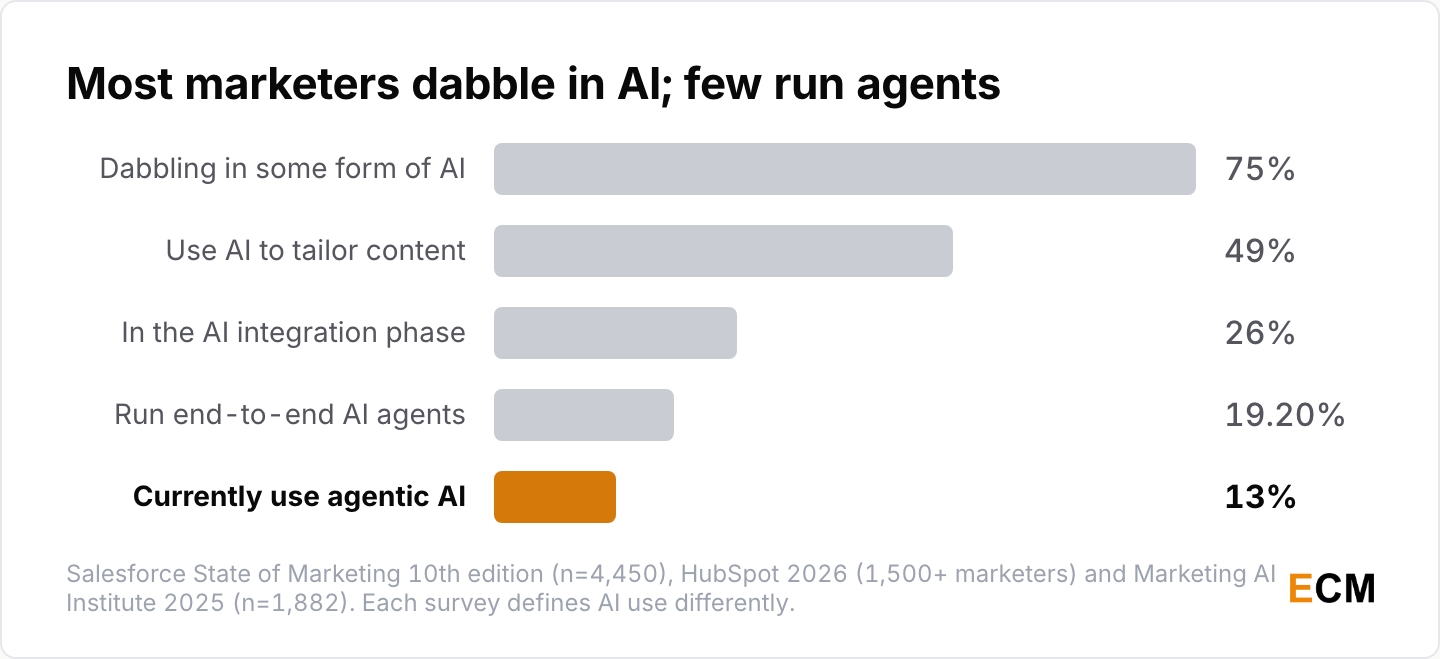
- 75% of marketers are dabbling in some form of AI, whether predictive, generative or agentic, but only 13% currently use agentic AI (Salesforce, 10th edition, 2026). Two years earlier, 75% of marketers were already experimenting with or had fully implemented AI (Salesforce, 9th edition, 2024). “Dabbling” is Salesforce’s own word, and it does a lot of work in every deck that quotes this as adoption.
- 49% of marketers already use AI to tailor content, the most-adopted trend of the year (HubSpot, 2026 State of Marketing, 2026), and 19.20% use AI agents to automate marketing initiatives end to end (HubSpot 2026, 2026).
- 26% of marketing and business professionals place themselves in the “Integration” phase, embedding AI into workflows and processes (Marketing AI Institute and SmarterX, 2025 State of Marketing AI, 2025).
Benefits of AI Personalization Marketers Report
The stated payoff is customer engagement and time, and both come from marketers rating their own results.
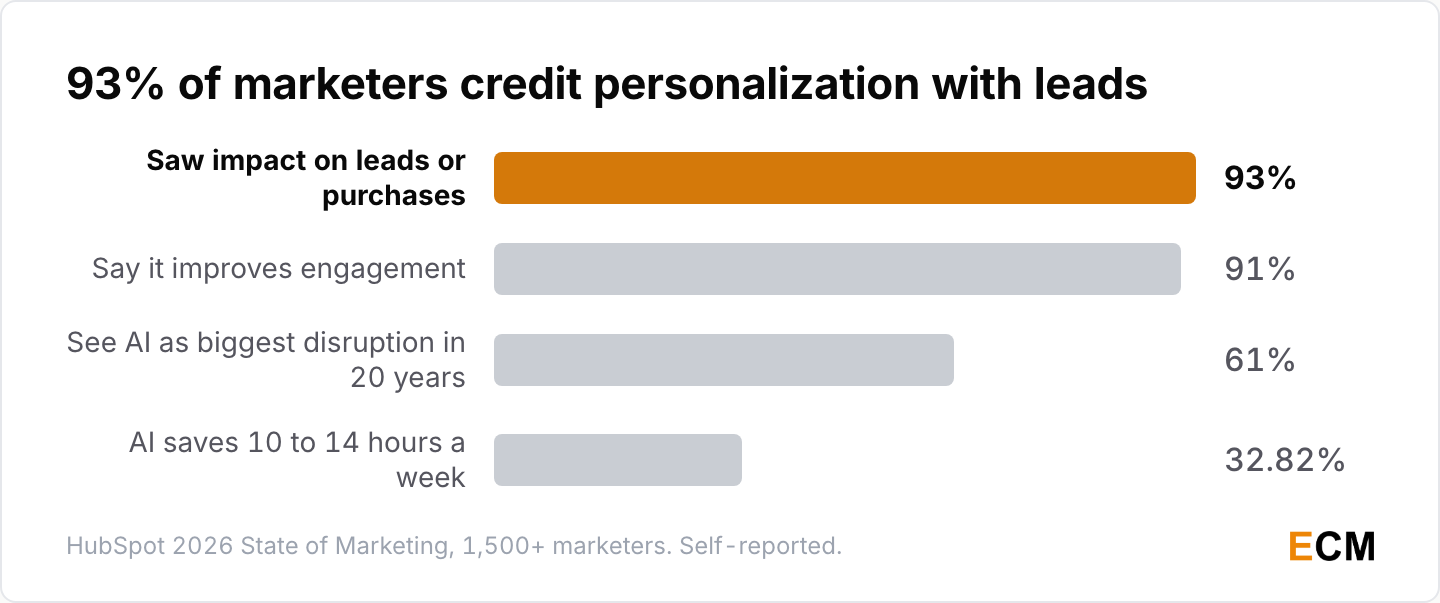
- 93% of marketers saw a great impact on leads or purchases from personalized experiences, and 91% say personalization improves engagement (HubSpot 2026, 2026).
- 75% of marketers are turning to AI to help close the personalized-content gap (Salesforce, 10th edition, 2026).
- 61% of marketers believe marketing is going through its biggest disruption in 20 years because of AI (HubSpot 2026, 2026), and 32.82% say AI tools save their teams 10 to 14 hours per week (HubSpot 2026, 2026).
- 75% of marketers who have AI are satisfied with their ability to connect touchpoints, against 60% of those without it (Salesforce, 10th edition, 2026). A 15-point gap is real, but it’s self-reported satisfaction, not measured performance.
Challenges of Implementing AI Personalization
Widespread AI experimentation sits beside widespread generic output, because tailored experiences at scale need customer data most teams don’t have.
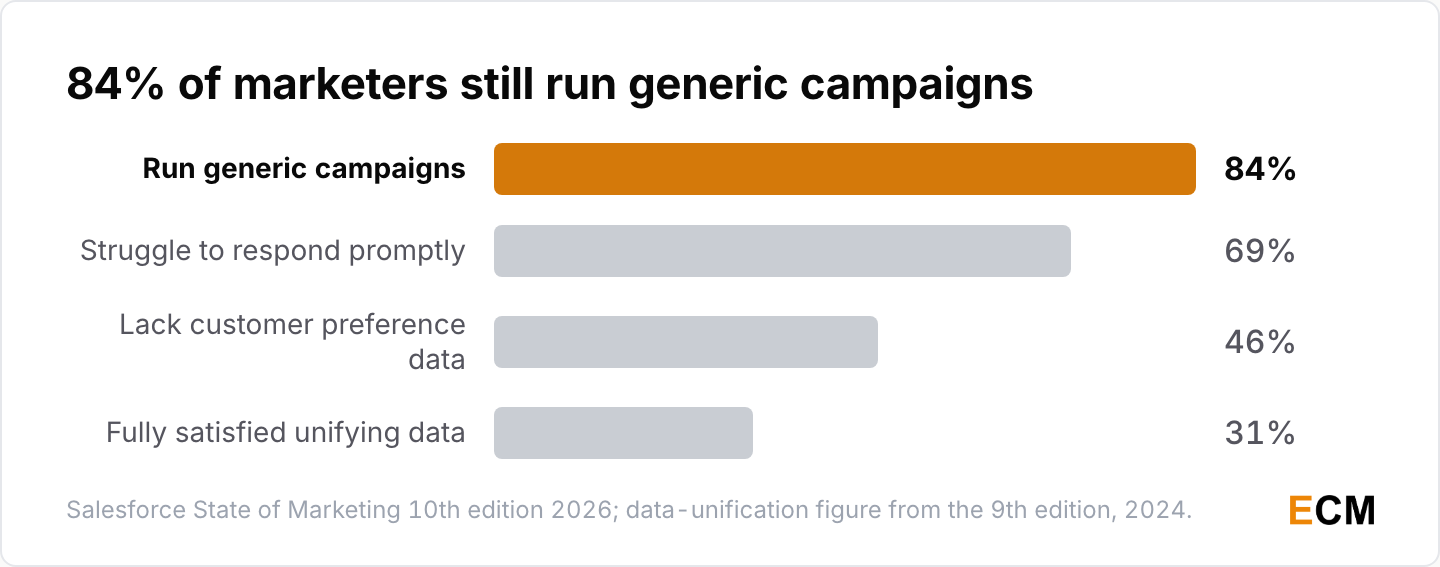
- 84% of nearly 4,500 marketers admit to running generic campaigns, and 69% still struggle to respond to customers promptly (Salesforce, 10th edition, 2026). This is the number I’d put next to any personalization vendor’s pitch deck.
- 78% of marketers need more personalized content than they can produce, and 98% hit barriers to personalization, with data issues the most common culprit (Salesforce, 10th edition, 2026).
- 46% of marketing teams report lacking data on customer preferences and struggling to provide content relevant to customer needs (Salesforce, 10th edition, 2026), and only 31% are fully satisfied with their ability to unify customer data sources (Salesforce, 9th edition, 2024).
- High-performing marketers are 2.2 times more likely than underperformers to have optimized for AI search (Salesforce, 10th edition, 2026).
If you’re working out which tools actually close that gap, the AI marketing use cases breakdown covers where the output holds up and where it doesn’t.
Consumer Personalization Expectations and the Delivery Gap
The most-cited consumer figures are also the oldest numbers on this page, so I’d pair them with the 2026 data every time.
McKinsey Personalization Statistics Everyone Quotes
Four canonical consumer figures come from one McKinsey article published in November 2021.
- 71% of consumers expect companies to deliver personalized interactions, and 76% get frustrated when that doesn’t happen (McKinsey, The value of getting personalization right or wrong is multiplying, 2021).
- Companies that grow faster drive 40% more of their revenue from personalization than slower-growing peers, and moving US industries to top-quartile personalization would generate over $1 trillion in value (McKinsey, 2021). The 40% is a share-of-revenue measure, often misquoted as “grow 40% faster,” and the $1 trillion is modelled, not measured.
- Personalization can cut customer acquisition costs by as much as 50%, lift revenues by 5% to 15% and raise marketing ROI by 10% to 30% (McKinsey, What is personalization?, 2023).
- Over 75% of consumers are turned off by content that doesn’t feel relevant (McKinsey, Discussing the future of AI-powered personalization, 2025). It’s a McKinsey partner’s spoken claim in an edited interview with the CMO of Jasper, a generative AI vendor, not a new survey figure.
Brands Versus Consumers on Personalization Quality
Deloitte Digital’s 2026 surveys of 480 brand leaders and 1,000 US consumers put the gap between how brands and consumers rate personalization at 58 points (Deloitte Digital, 2026).
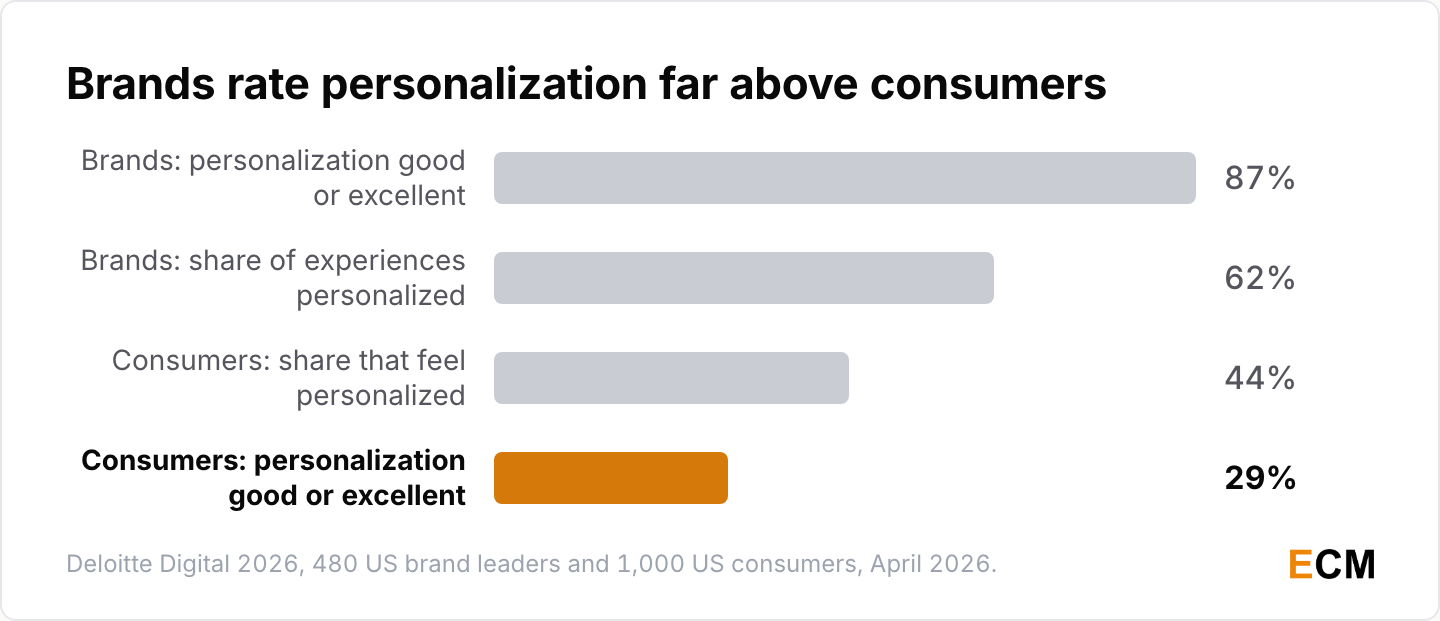
- 87% of brand leaders rate their personalization efforts as good or excellent, while only 29% of consumers agree, and brands estimate they personalize 62% of customer experiences against the 44% consumers say feel personalized (Deloitte Digital, Personalizing growth, 2026).
- Only 26% of consumers describe their digital experience with a brand they already deal with as “excellent” (Adobe and Econsultancy, 2024 Digital Trends, 2024).
- 57% of organizations say their digital customer experience is on par with or behind peers, and only about 36% consider themselves ahead (Adobe, 2026 AI and Digital Trends, 2026). Most respondents placing themselves at average or worse makes this more believable, not less.
How Consumers Feel About Personalization
Consumers reward personalization that does something useful for them, and a majority still say it makes them more likely to buy.
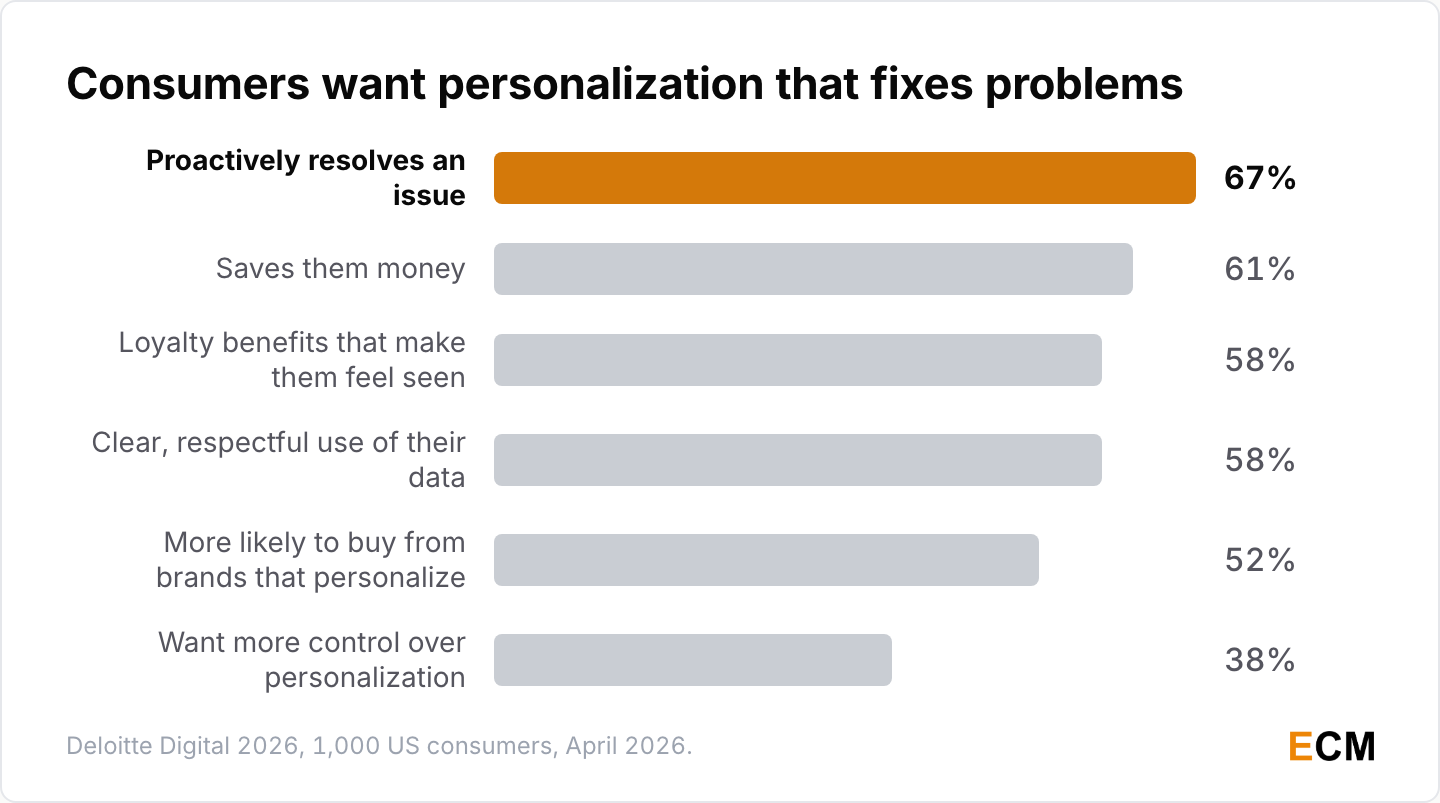
- Consumers value personalization when it proactively resolves an issue (67%), saves them money (61%) or delivers loyalty benefits that make them feel seen (58%) (Deloitte Digital, 2026).
- 58% of consumers value clear and respectful use of their data, and 38% want more direct control over how companies personalize for them (Deloitte Digital, 2026).
- 80% of consumers were more likely to buy when brands offered personalized experiences in Epsilon’s 2017 survey of 1,000 consumers aged 18 to 64, published January 2018 (Epsilon, The Power of Me, 2018). Deloitte Digital’s 2026 survey of US consumers, asking a similar question, puts it at 52%, and those buyers say they spend about 30% more (Deloitte Digital, 2026).
- 80% of consumers rate consistent experiences across online channels “important” or “critical,” 70% say the same of personalized product recommendations, and 91% say it of responsible data use, with 63% calling it “critically important” (Adobe 2024 Digital Trends, 2024).
Personalization Preferences by Generation
The spread between baby boomers and Gen Z is wider than any vendor-versus-vendor gap in this dataset.
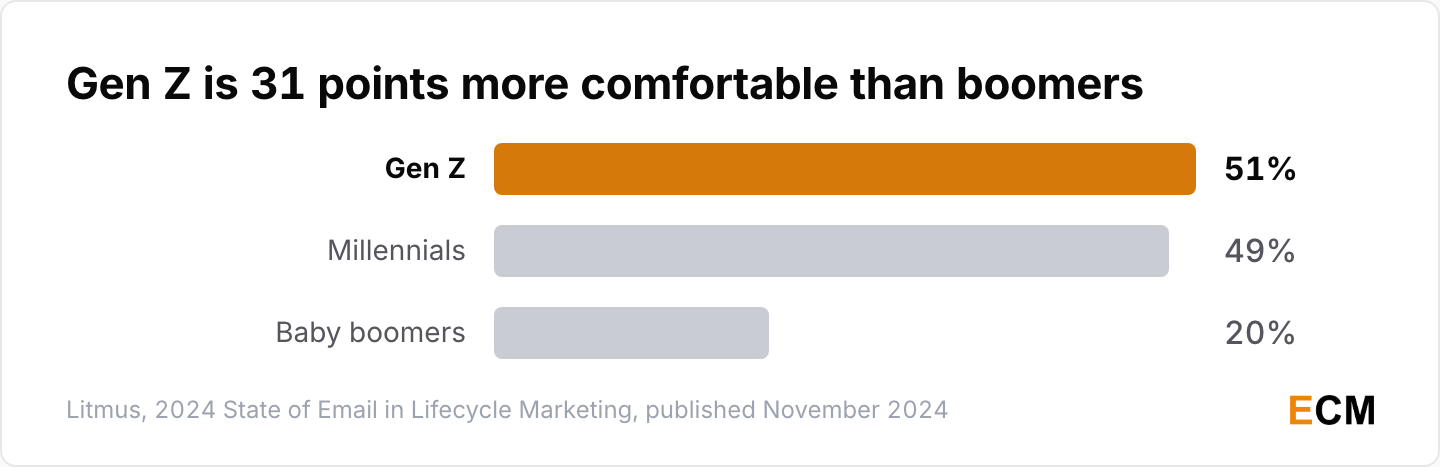
- Only 25% of baby boomers find personalization “extremely” or “very important,” against nearly 60% of millennials and Gen Z (Litmus, 2024 State of Email in Lifecycle Marketing, 2024).
- 51% of Gen Z and 49% of millennials are “very” or “somewhat comfortable” with companies using their data, while only 20% of baby boomers are (Litmus, 2024). That’s a 31-point gap between Gen Z and boomers.
Data Privacy and Consumer Trust in AI
Pew Research Center is the only nonprofit source in this set, and it sets the ceiling on what personalization can ask for.
American Views on Corporate Data Use
Pew surveyed 5,101 US adults in May 2023, and most of them feel they’ve lost control of their data (Pew Research Center, 2023).
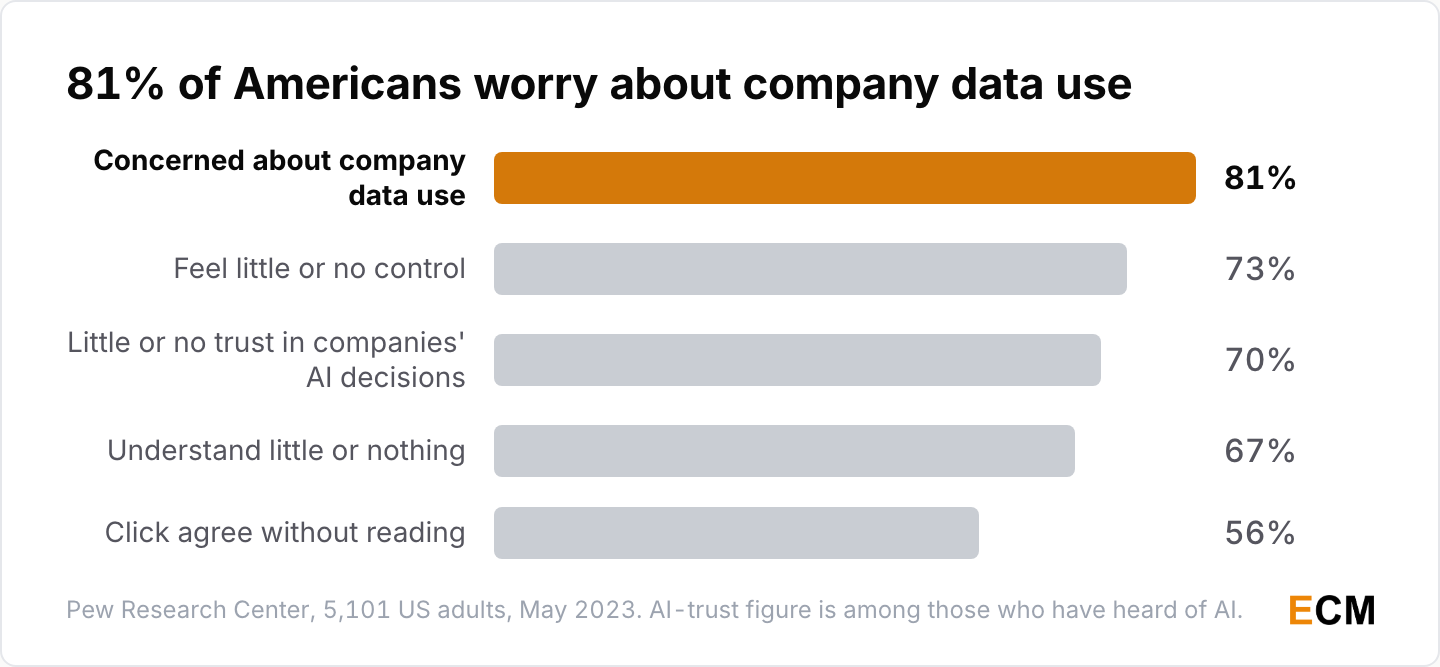
- 81% of Americans are very or somewhat concerned about how companies use the data they collect about them, and 71% say the same about government, up from 64% in 2019 (Pew Research Center, 2023).
- 73% feel they have little or no control over what companies do with their data, and 67% understand little to nothing about it, up from 59% (Pew, 2023).
- 70% of Americans who have heard of AI have little to no trust in companies to make responsible decisions about using it in their products (Pew, 2023).
- 56% frequently click “agree” on privacy policies without reading them (Pew, 2023). Consent, in practice, isn’t evidence of comfort.
Support for Personal Data Regulation
Regulation is the one question in Pew’s survey where the answer is close to lopsided.
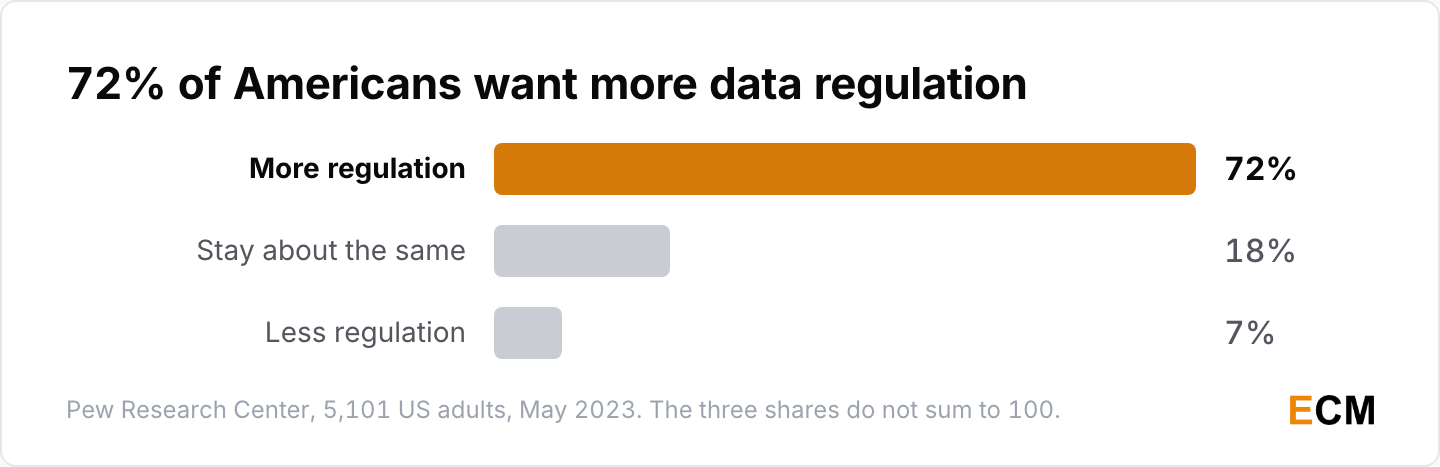
- 72% of Americans say there should be more government regulation of what companies can do with personal data, 18% say it should stay about the same and just 7% want less (Pew, 2023).
- 53% of consumers are aware of their country’s privacy laws, up from 36% in 2019 and the first majority since Cisco’s survey began (Cisco, 2024 Consumer Privacy Survey, 2024).
Consumer Trust in AI and Data Sharing
Use of generative AI is climbing while trust in the companies behind it falls, and every personalization roadmap has to survive that tension.
- 42% of customers trust businesses to use AI ethically, down from 58% in 2023, across 15,015 consumers and 1,570 business buyers in 18 countries (Salesforce, State of the AI-Connected Customer, 2024).
- 23% of the 2,600+ adults Cisco surveyed across 12 countries are regular users of generative AI, almost double the 12% of a year earlier (Cisco, 2024, 2024).
- More than 75% of consumers won’t buy from an organization they don’t trust with their data (Cisco, 2024, 2024).
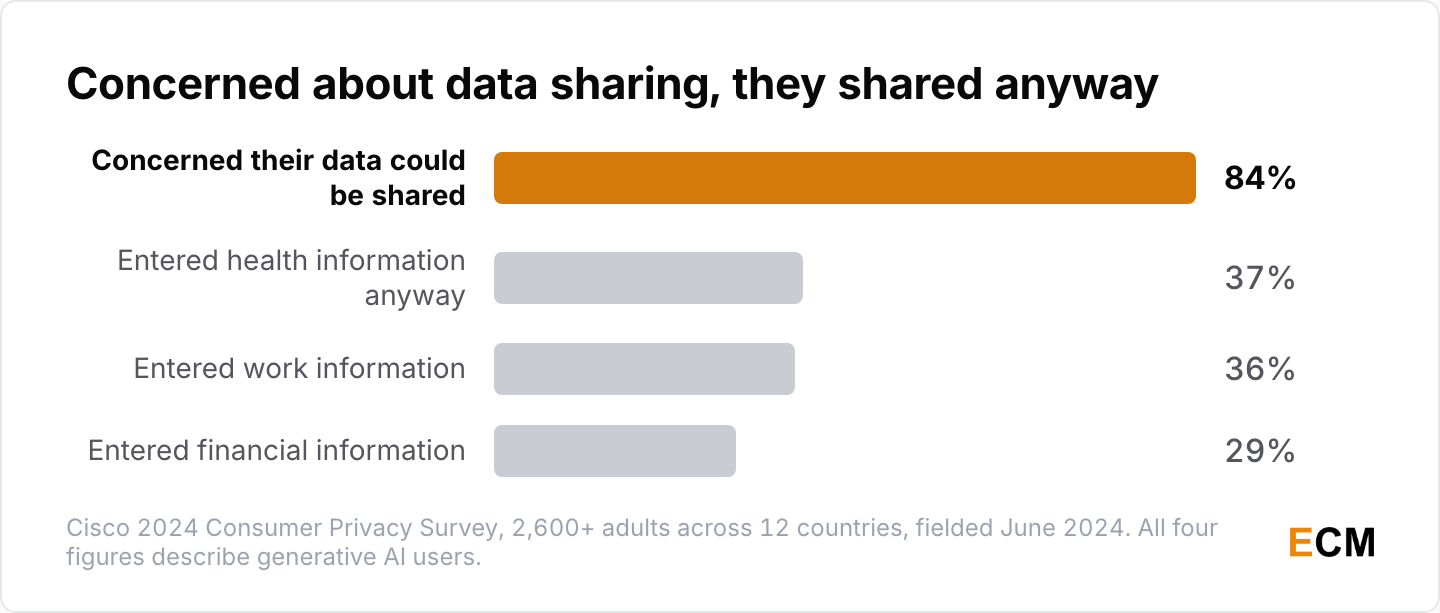
- 84% of generative AI users were concerned their data could be shared, yet 37% entered health information, 36% work information and 29% financial information (Cisco, 2024, 2024).
AI Personalization ROI and Revenue Impact
Measured population-level ROI for AI personalization barely exists. What exists is consultancy forecasting, self-reported results and vendor case studies.
Personalization Revenue Forecasts From BCG
Forward-looking language isn’t optional with any of these, because BCG sells personalization consulting.
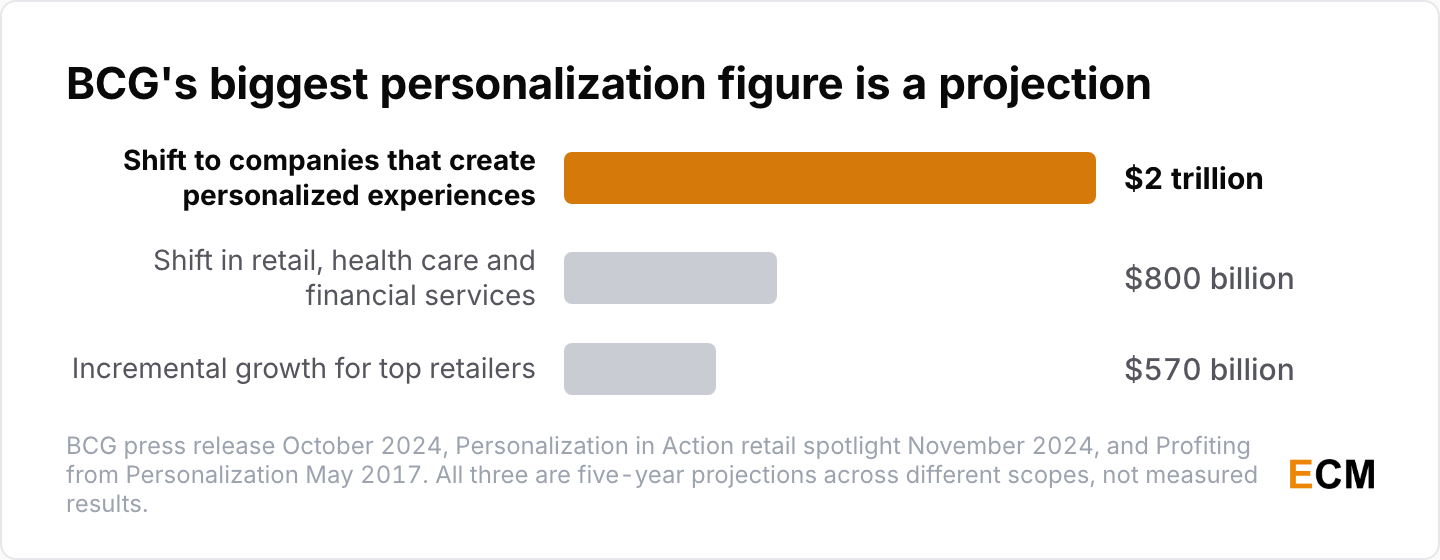
- BCG projects that over the next five years $2 trillion in revenue will shift to companies that know how to create personalized experiences, and that leaders grow revenue roughly 10 percentage points faster a year than laggards (BCG, 2024).
- Top retailers on BCG’s Personalization Index could gain an estimated $570 billion in incremental growth by using first-party data (BCG, Personalization in Action, 2024).
- In 2017, BCG forecast an $800 billion revenue shift over five years to the 15% of companies that get personalization right, in retail, health care and financial services alone, and found brands using advanced digital technology and proprietary data grew revenue 6% to 10%, two to three times faster than those that didn’t (BCG, Profiting from Personalization, 2017).
Reported Results From Personalization Programs
Adobe (3,000 executives and practitioners) and Deloitte Digital asked companies what their own personalization metrics did, which is the closest thing here to an outcome benchmark.
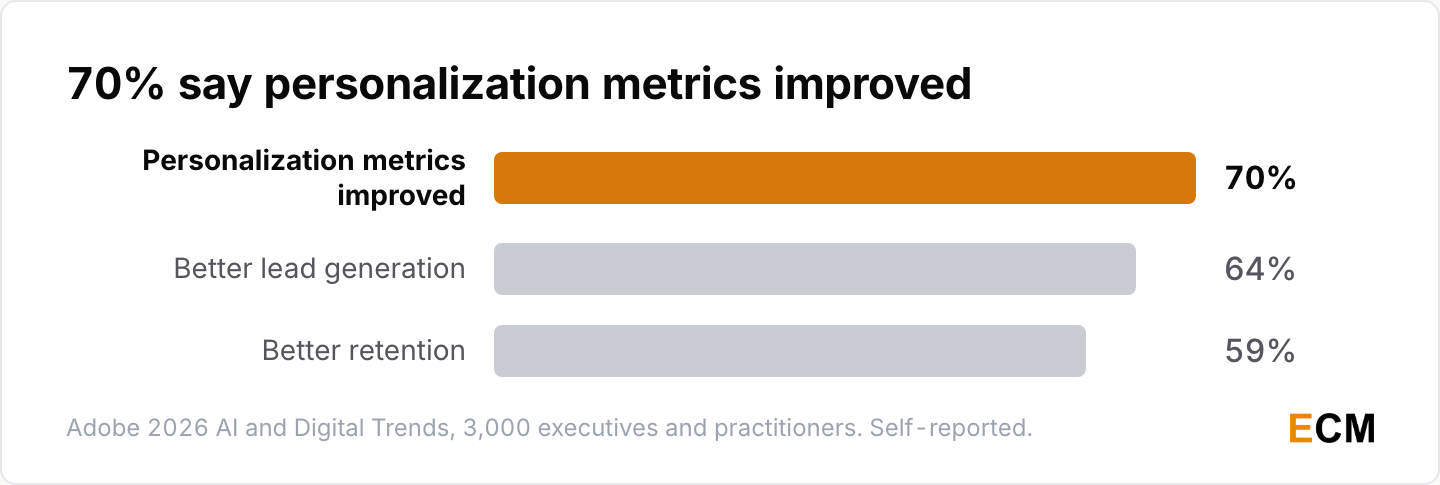
- 70% of organizations say their personalization metrics somewhat or significantly improved over the past three years, 64% report better lead generation and 59% better retention (Adobe, 2026 AI and Digital Trends, 2026).
- High-maturity brands are more likely than low-maturity ones to say personalization improves conversion (38% vs 23%) and customer retention (44% vs 32%) (Deloitte Digital, 2026).
- 36% of high-maturity brands say their personalization investment grew revenue by 15% or more in FY2026, against 16% of low-maturity brands, and they beat FY2025 financial goals by 13.5% on average against 10.1% (Deloitte Digital, 2026).
Customer Data Infrastructure for AI Personalization
Three competing vendors land on the same conclusion: the models are ready and the plumbing isn’t.
AI Infrastructure Readiness Benchmarks
The cloud-readiness gap between generative and agentic AI is 38 points (Adobe 2026, 2026).
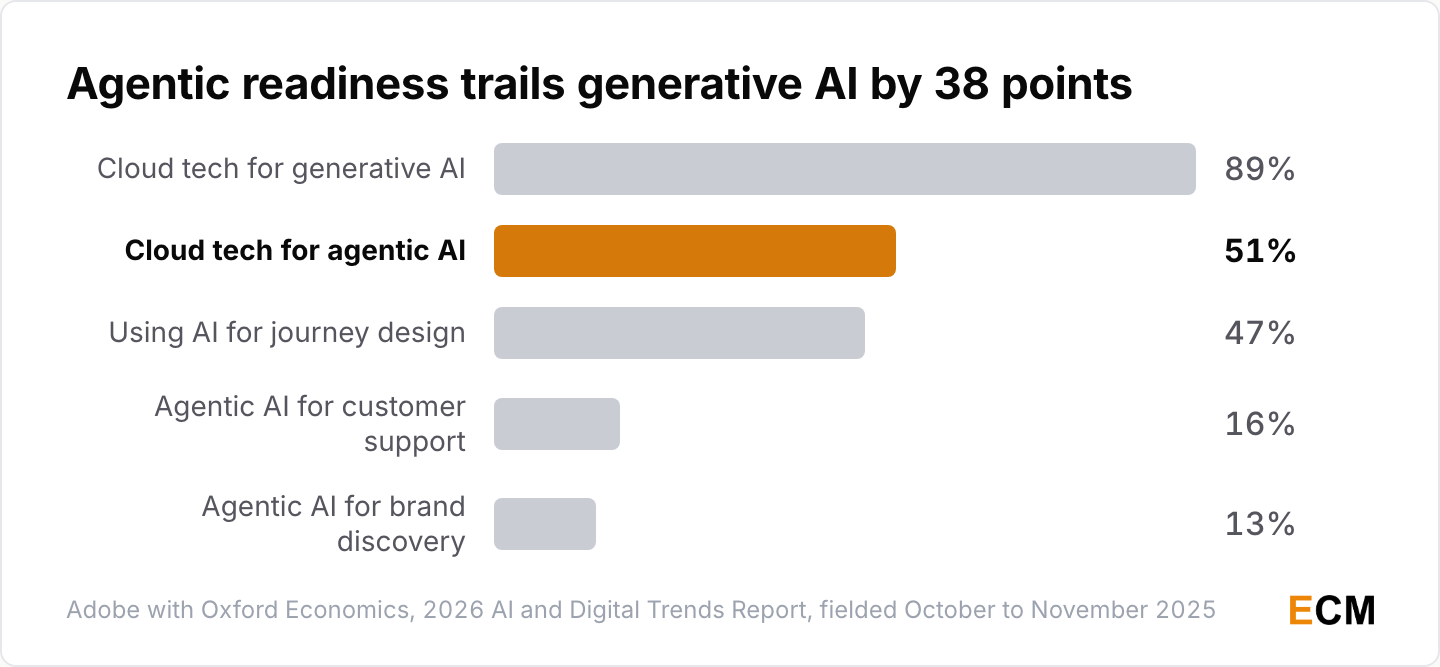
- 89% of organizations have the cloud-based technology to support generative AI, but only 51% have it for agentic AI (Adobe, 2026 AI and Digital Trends, 2026).
- Only 47% use generative or agentic AI for journey design or omnichannel activation (Adobe 2026, 2026).
- 16% have agentic AI embedded organization-wide for customer support, and 13% for brand discovery and search (Adobe 2026, 2026).
- Integration is the top constraint to scaling personalization, cited by 44% of brands (Deloitte Digital, 2026).
Customer Data Platform Adoption Rates
Twilio Segment’s State of Personalization Report surveyed 521 business leaders across 12 countries on what they actually run underneath personalization (Twilio Segment, 2024).
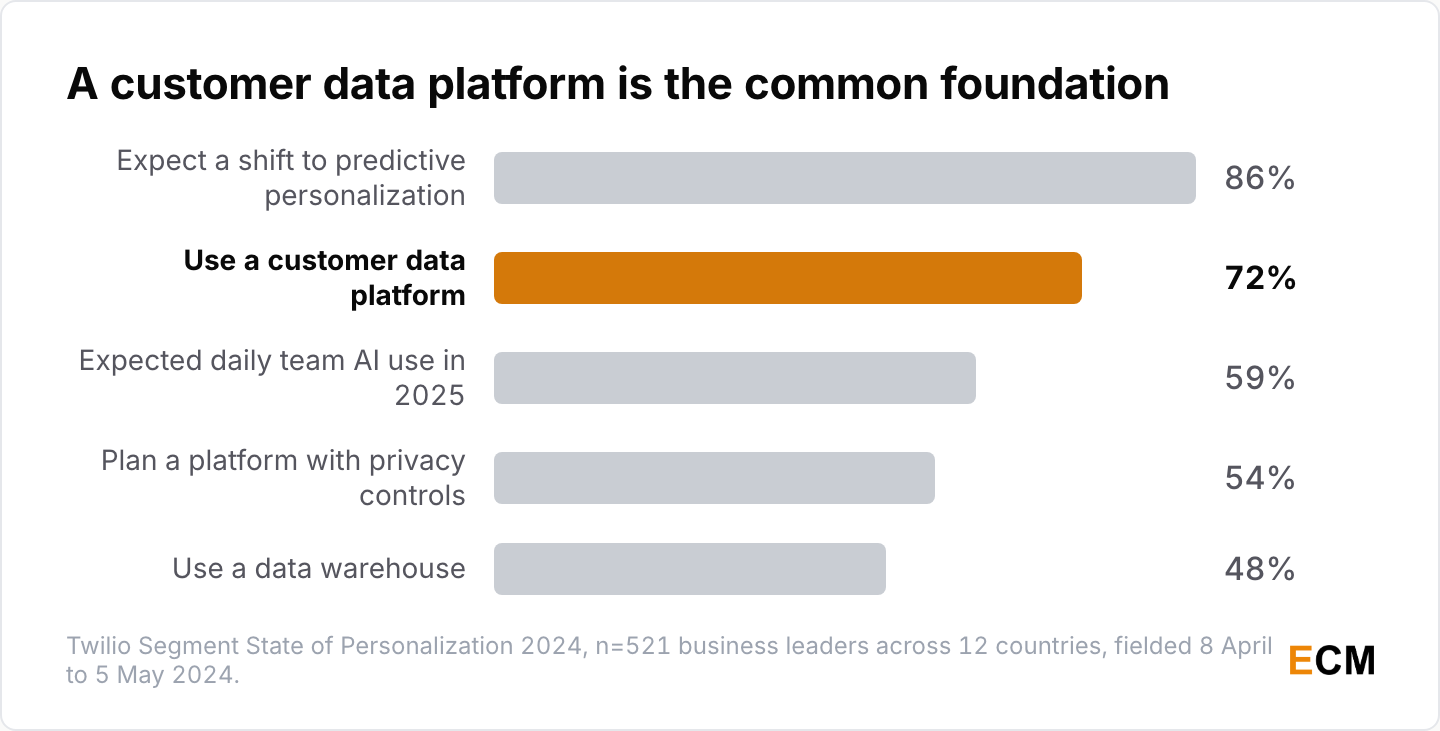
- 72% of companies use a customer data platform for personalization, and 48% use a data warehouse (Twilio Segment, State of Personalization 2024, 2024).
- 86% of business leaders expect a significant shift from reactive to predictive personalization in their industry, and by 2025, 59% expected their teams to use AI daily and 91% at least weekly (Twilio Segment, 2024).
- 89% of leaders predict ethical AI use will be a competitive advantage, while 54% of brands plan to implement a data platform with robust privacy controls (Twilio Segment, 2024). I read that 35-point gap between belief and plan as the clearest signal in the report.
- 92% of surveyed businesses reported using AI-driven personalization to drive growth in Twilio’s fourth annual edition, a release that also describes many businesses as still experimenting with AI (Twilio, State of Personalization 2023, 2023).
AI Personalization Statistics by Marketing Channel
Channel data is where marketing personalization stops being abstract. A marketer can tell you whether email is personalized far more reliably than whether “the customer journey” is.
Which Channels Get Personalized First
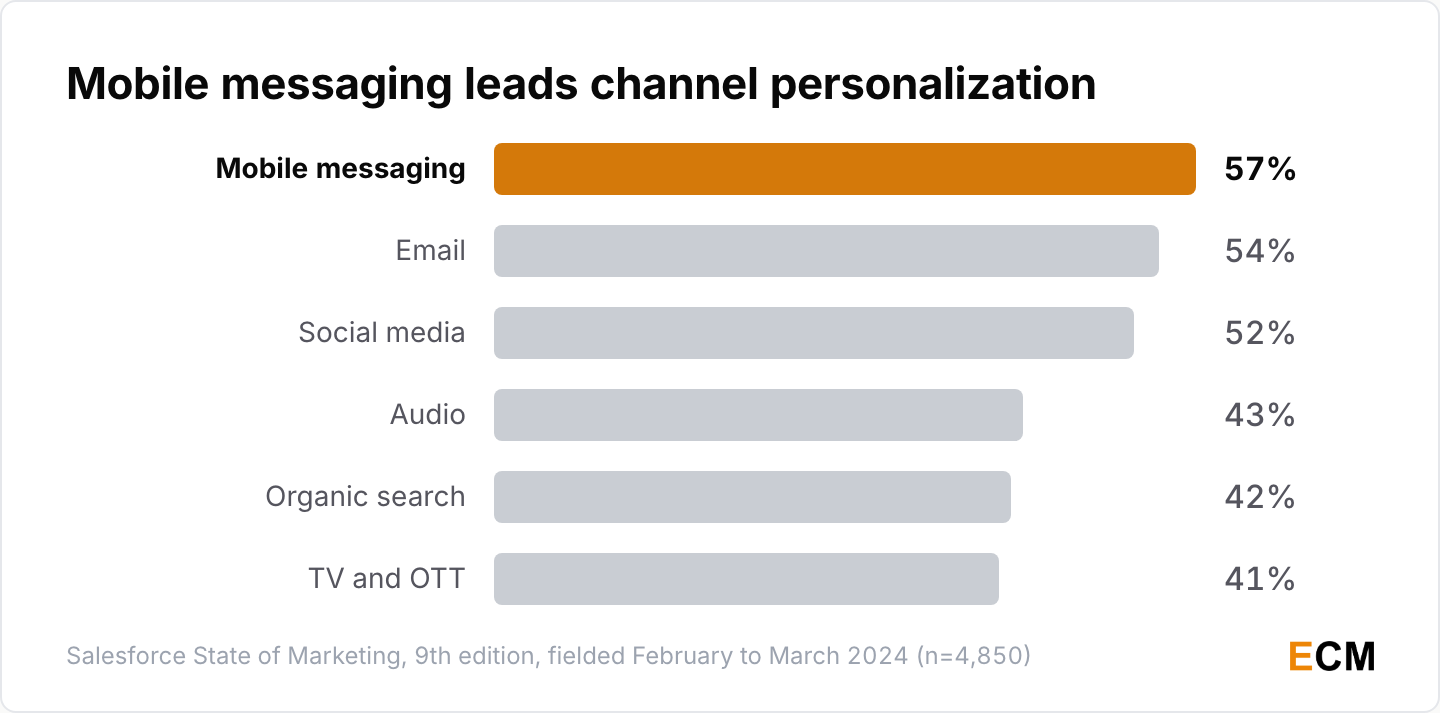
Mobile messaging leads, and audio, search and connected TV trail it by 14 to 16 points (Salesforce, 9th edition, 2024).
- Marketers can fully personalize across five channels on average; high performers manage six and underperformers three (Salesforce, 9th edition, 2024).
- Mobile messaging is the most personalized channel at 57%, followed by email at 54% and social media at 52% (Salesforce, 9th edition, 2024).
- Audio sits at 43%, organic search at 42% and TV or OTT at 41% (Salesforce, 9th edition, 2024).
Email Personalization and AI Adoption
Email is where content personalization actually ships, and where production speed is easiest to measure.
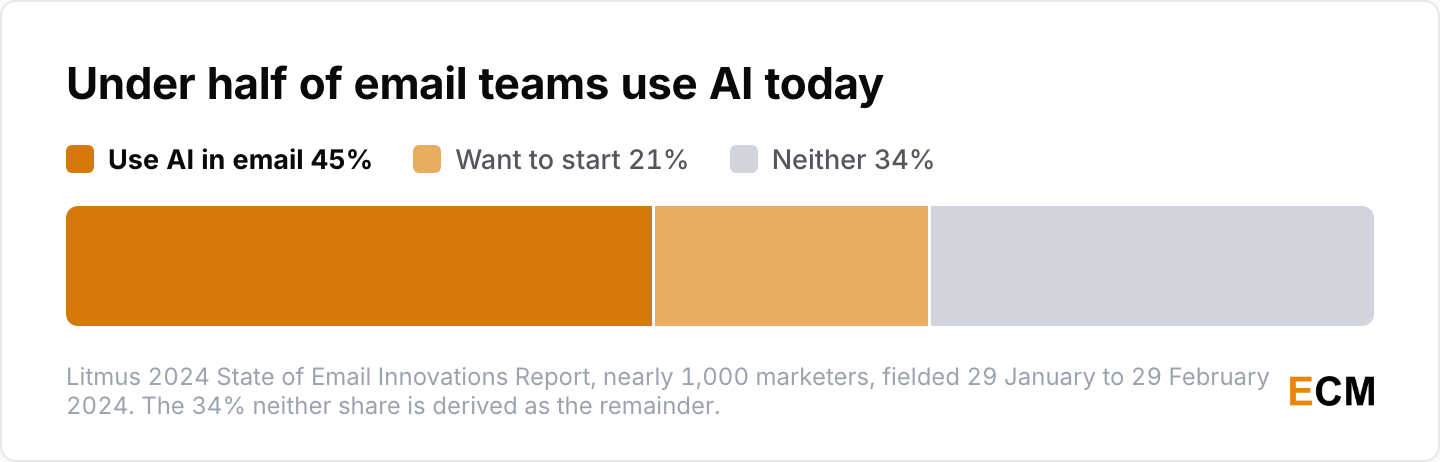
- 45% of teams use AI in email marketing and a further 21% want to start, which leaves 34% doing neither, yet 72% of marketers don’t know their email ROI (Litmus, 2024 State of Email Innovations, 2024). I’d read any email personalization ROI claim against that.
- In 2024, 62% of email teams took two weeks or more to produce and deploy one email. By 2026, 78% take three days or less (Litmus, State of Email 2026, 2026). Production speed is catching up, so the data layer is now the tighter limit.
- 67% of consumers receive too many emails, rising to 81% among baby boomers (Litmus, 2024).
More channel benchmarks sit in the email marketing statistics roundup and the content marketing statistics page.
Klaviyo Customer Growth Statistics
Klaviyo has been public since September 2023, so its customer counts come from SEC filings, and its upmarket cohort is outgrowing the base.
- Klaviyo served over 193,000 customers as of 31 December 2025, up from 167,000 a year earlier (Klaviyo, Form 10-K FY2025, 2026).
- 3,912 customers generated over $50,000 of annual recurring revenue at the end of 2025, up 37% from 2,850 (Klaviyo 10-K, 2026).
Klaviyo Revenue Growth and Profitability
Growth is slowing while losses shrink, the trade most public SaaS companies are making right now.
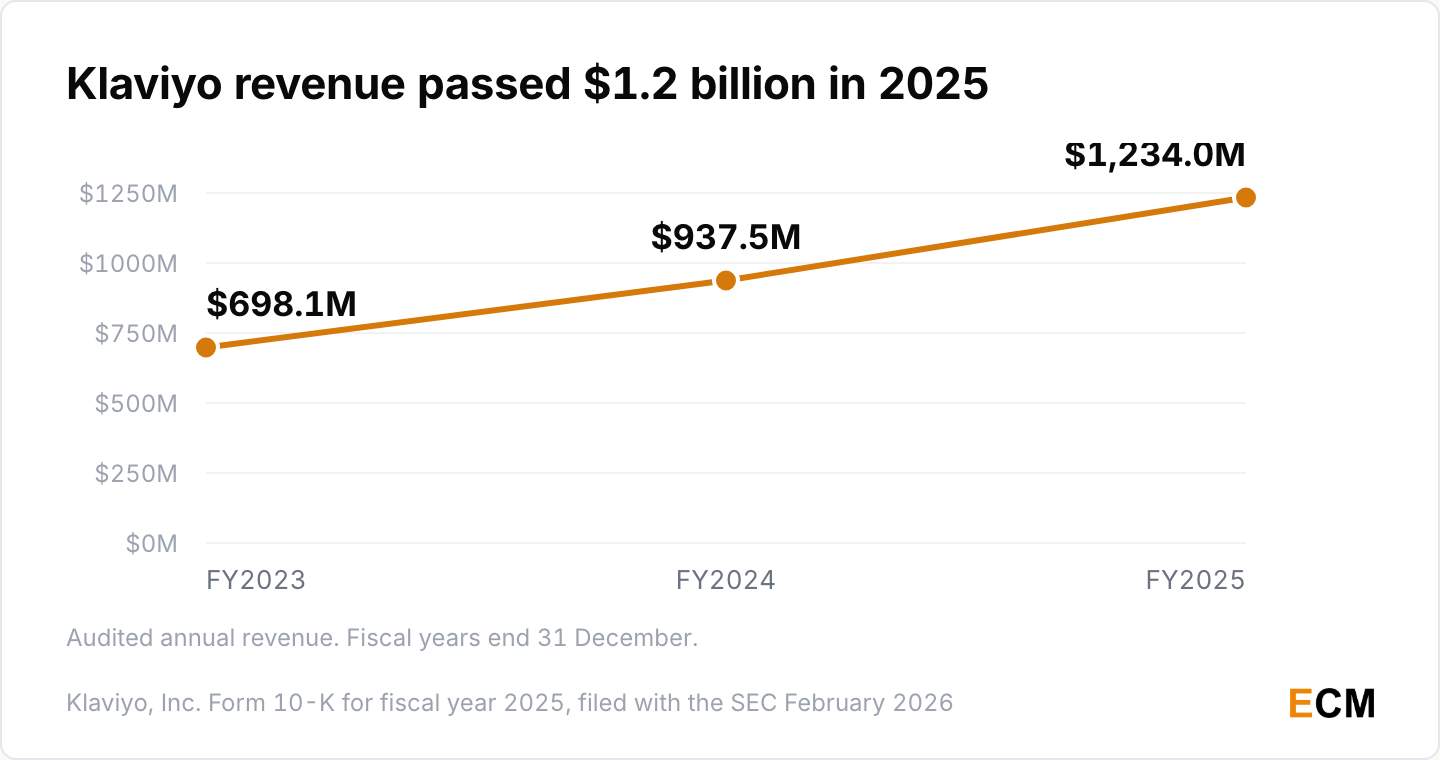
- Revenue grew 31.6%, from $937.5 million in 2024 to $1,234.0 million in 2025, after rising 34.3% from $698.1 million in 2023 (Klaviyo 10-K, 2026).
- Net losses narrowed from $46.1 million in 2024 to $31.8 million in 2025, while gross profit grew 28.7%, from $716.2 million to $921.5 million, a touch slower than revenue (Klaviyo 10-K, 2026).
Platform growth proves businesses are buying personalization infrastructure. It doesn’t prove the personalization works. My Klaviyo review covers what the product does and doesn’t do for a content team.
Frequently Asked Questions
What Is AI Personalization and How Does It Work?
AI personalization uses artificial intelligence, mostly machine learning, to tailor content, product recommendations and customer interactions to each person’s behavior and purchase history. It covers predictive models that segment customers, real-time recommendation engines and generative AI that writes the copy. That spread is why adoption figures run from 13% using agentic AI to 75% “dabbling” (Salesforce, 10th edition, 2026). Check what a survey counted before setting its number beside another.
Do 71% of Consumers Really Expect Personalized Interactions?
Yes, as a 2021 figure. McKinsey wrote that “71 percent of consumers expect companies to deliver personalized interactions” in November 2021 (McKinsey, 2021). The article gives no sample size or fielding date, and later McKinsey pieces repeat it without a new consumer panel. For a current number, Deloitte Digital found 52% of US consumers more likely to buy from brands that personalize (Deloitte Digital, 2026).
How Does AI Personalization Affect Customer Satisfaction and Loyalty?
Survey respondents most often report retention gains. Adobe found 59% of organizations report better retention from personalization (Adobe 2026, 2026), and high-maturity brands in Deloitte Digital’s study report retention gains more often than low-maturity ones, 44% against 32% (Deloitte Digital, 2026). The risk runs the other way too: more than 75% of consumers won’t buy from an organization they don’t trust with their data (Cisco, 2024).
What Is Hyper-Personalization?
Hyper-personalization means tailoring each interaction to one person in real time, using live behavioral data instead of fixed segments. It’s where the industry says it’s heading: 86% of business leaders expect a shift from reactive to predictive personalization (Twilio Segment, 2024). The catch is data, since only 31% of marketers are fully satisfied with how they unify customer data (Salesforce, 9th edition, 2024).
How Can Marketers Use AI for Personalized Content?
Start where personalization already ships: email, mobile messaging and social. 49% of marketers already use AI to tailor content (HubSpot 2026, 2026), and 45% of email teams use AI today (Litmus, 2024). Production used to be the time sink: 62% of email teams took two weeks or more to ship one email in 2024, while 78% now take three days or less (Litmus, State of Email 2026, 2026). I’d still point AI at drafting variants first.
What Are Examples of AI Personalization in Different Industries?
Retail leads the forecasts: BCG estimates top retailers could gain $570 billion in incremental growth from first-party data (BCG, 2024), and its Personalization Index covers 200 brands across seven sectors (BCG, 2025). In ecommerce email, Klaviyo’s 193,000 customers show how widely brands buy personalization-capable platforms (Klaviyo 10-K, 2026). Customer support is earlier, with 16% of organizations running agentic AI there (Adobe 2026, 2026).
What Are the Best Practices for AI Personalization?
Fund it as a program, fix the data and share the work across teams. 43% of high-maturity brands fund personalization as a multiyear strategic investment, against 16% of low-maturity peers (Deloitte Digital, 2026). Brands with extensive cross-functional collaboration are more than twice as likely to report loyalty or lifetime-value gains, 54% against 23% (Deloitte Digital, 2026). Name the sponsor when you cite any of these reports, since every vendor here sells into the personalization stack.
Should I Cite the BCG $2 Trillion Personalization Figure?
Yes, as a forecast. BCG’s October 2024 release says $2 trillion in revenue will shift over the next five years to companies that create personalized experiences (BCG, 2024). It’s a projection, not a measured result, so write “BCG projects,” never “personalization generated,” and mention that BCG sells personalization consulting.
Written by
Editorial Staff
The Editorial Staff represents the writers, editors, and content creators who have worked (or work) at Elite Content Marketer. The experimenter-in-chief behind the team is Chintan Zalani, who has close to a decade of experience trying to make sense of the content marketing industry. Started in 2019, Elite Content Marketer is on a mission to help creators build sustainable businesses.
Related Articles
Marketing Data
Creator Economy Statistics 2026: 60 Facts + $250B Market
60 creator economy statistics: a $250B market (2023), $37B projected US creator ad spend, 10.1M US independent creators, earnings, AI and burnout.
Oct 24, 2026Read more →
Marketing Data
Affiliate Marketing Statistics 2026: 60 Facts + $13.6B Spend
60 affiliate marketing statistics: $13.62B in US spend in 2024, 9.4% of US e-commerce sales, a 15X UK return and what affiliates really earn.
Oct 23, 2026Read more →
Marketing Data
Black Friday Statistics 2026: 57 Facts + $11.8B in Sales
57 Black Friday statistics: $11.8B in US online sales in 2025, 202.9M US weekend shoppers, and 84% of shoppers suspect inflated pre-sale prices.
Oct 22, 2026Read more →