The single most useful number I found while building this page is 88.46%.
94 Generative Engine Optimization Statistics (2026)
That’s the share of URLs ChatGPT cites that come from its ordinary web search retrieval, according to Ahrefs’ analysis of 1.4 million prompts. It means generative engine optimization isn’t a separate discipline sitting alongside search. It’s a second gate that opens only after the first one does. If a page can’t be retrieved by a search index, it’s not in the running to be cited at all.
Below are 94 generative engine optimization statistics for 2026, each one checked against the closest thing to a primary publication that exists for it. Where a figure had drifted between the original study and the version circulating on marketing sites, I went back to the source and used what the source actually says. Where a study was only ever released through a trade publication, the citation says so.
A warning about this topic in particular. Almost every large-scale citation dataset in this space is published by a company selling AI visibility tooling. That doesn’t make the numbers wrong, and in most cases these vendors run the only measurement infrastructure that exists. It does mean the sample is whatever that vendor happens to track. Every figure below names its publisher so you can weigh it yourself, and the Sources and Methodology section lists the claims that didn’t survive checking.
Key Takeaways
- GEO doesn’t replace search ranking, it depends on it. 88.46% of ChatGPT’s cited URLs come from its search retrieval path, and pages ranking first in Google are cited 3.5 times more often than pages outside the top 20.
- Position on the page decides more than most people think. 44.2% of ChatGPT citations come from the first 30% of a document, and pages whose headline directly answers the query are cited 41% of the time against 29% for weak matches.
- Most of what gets cited isn’t yours and never will be. Only 32.3% of ChatGPT’s top 1,000 cited pages are ones a marketer could realistically pitch. Wikipedia is 29.7% of that thousand on its own.
- AI visibility is unstable by design. Only 30% of brands stay visible from one AI answer to the next, and just 20% survive five consecutive runs of the same query.
- Some of the tactics people sell hardest have no measurable effect. An llms.txt file showed no citation benefit and pages carrying FAQ schema averaged fewer citations than pages without it, though the same study attributes nearly double the citation likelihood to FAQ sections written into the body.
- Marketers know it and aren’t acting. 63% of marketers say their company invests no time, budget or staff in GEO, while 67% expect AI search visibility to be very or extremely important within two years.
Top Generative Engine Optimization Statistics for 2026
If you carry five numbers out of this page, carry these.
The Numbers Worth Quoting
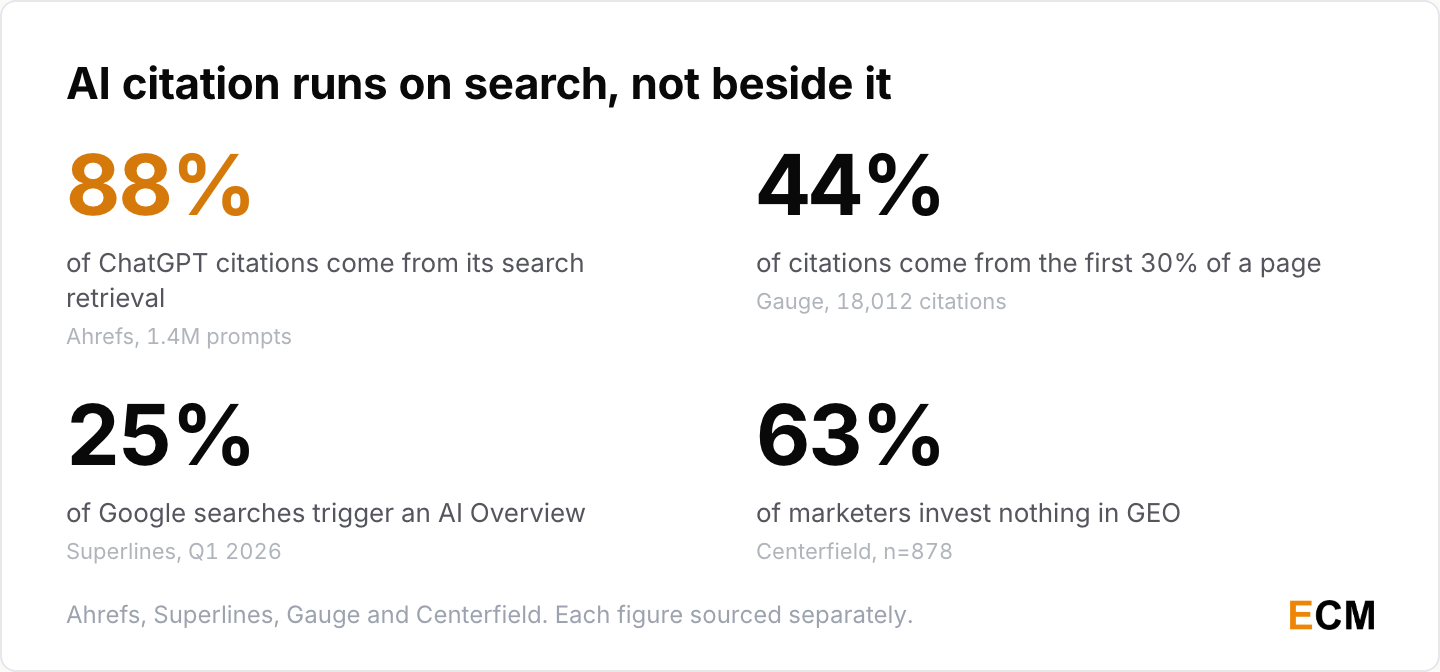
1. 25.11% of Google searches now trigger an AI Overview, a 57% increase on Q4 2025 (Superlines, State of GEO Q1 2026).
2. 88.46% of the URLs ChatGPT cites come from its “search” retrieval type, meaning a page has to be findable in search before it can be cited (Ahrefs, 1.4 million prompts).
3. 44.2% of ChatGPT citations come from the first 30% of a page’s content (Kevin Indig and Gauge, 18,012 verified citations).
4. Only 32.3% of ChatGPT’s top 1,000 cited pages are pitch-worthy for a marketer. The biggest non-pitchable categories, as shares of the full thousand, are Wikipedia at 29.7%, homepages at 23.8% and app store listings at 6.6% (Ahrefs, September 2025).
5. 63% of marketers say their company isn’t investing time, budget or staff in GEO (Centerfield survey of 878 US marketers, reported by Search Engine Land, August 2025, margin of error 3.3%).
How Much Of Search Is Now An AI Answer
The honest answer is that it depends heavily on the query, and the industry averages hide most of the story.
AI Overview Coverage By Industry
6. AI Overviews appear on roughly 63% of healthcare queries, 32% of B2B technology queries and 23% of ecommerce queries (BrightEdge Generative Parser).
7. AI Overviews appear 195% more often when a Featured Snippet is already present for the query (BrightEdge).
8. ChatGPT accounts for 87.4% of total AI referral traffic (Superlines, citing Conductor Q1 2026 benchmarks).
9. OpenAI’s search referral traffic grew 44% month over month and Perplexity’s grew 71% in November 2024, the period when this traffic first became measurable (BrightEdge).
Stat 6 is the one I’d put in front of anyone about to reorganize a content strategy around AI Overviews. If you sell B2B software, a third of your queries carry one. If you publish health content, nearly two thirds do. Those are different businesses facing different problems.
What People Actually Use AI Tools For
10. Weekly use of generative AI tools nearly doubled from 18% to 34% year on year across six countries (Reuters Institute, Generative AI and News Report 2025, roughly 2,000 respondents per country).
11. Only 7% of people use AI chatbots for news in a given week, rising to 15% among under-25s (Reuters Institute, Digital News Report 2025, averaged across 48 markets).
12. Averaged across markets, just 4% say they accessed ChatGPT for news in the last week (Reuters Institute, Digital News Report 2025, full report PDF).
Stats 10 to 12 are the gap that most GEO commentary skips. General AI use is doubling. AI use for a specific information job, in this case news, is still in single digits. Both things are true, and quoting the first as though it were the second is the most common error in this category.
The B2B Buying Shift
13. Half of B2B software buyers now start their search with an AI chatbot instead of a traditional Google search (G2 buyer survey, August 2025).
14. 74% of those buyers are turning to ChatGPT specifically (G2, August 2025).
15. 89% of B2B buyers used generative AI in at least one phase of their purchasing process (Forrester Buyers’ Journey Survey 2024).
16. 87% of those buyers said generative AI helped create a better business outcome for their organization (Forrester, 2024).
17. In a buying process Forrester describes as reshaped by generative AI, more than 60% of business buyers now use a trial to evaluate a solution, rising to 78% among buyers making purchases of $10 million or more (Forrester, The State of Business Buying 2026).
18. The typical B2B buying decision now includes 13 internal stakeholders and nine external influencers (Forrester, The State of Business Buying 2026, January 2026).
How AI Engines Choose What To Cite
This is the part of the topic where real research exists, and where the findings are consistent enough across independent vendors to act on.
Search Ranking Still Gates The Citation Pool
19. Pages ranking first in Google were cited by ChatGPT 3.5 times more often than pages outside Google’s top 20, with a 43.2% citation rate (AirOps, 15,000 prompts across 548,534 pages).
20. 55.8% of cited pages ranked in the top 20 for at least one query, whether the original prompt or a fan-out (AirOps).
21. Reddit supplies 67.8% of the URLs ChatGPT retrieves and then doesn’t cite, and is cited only 1.93% of the time (Ahrefs).
22. Citation overlap between AI assistants and Google and Bing’s top 10 stands at 11% on average (Ahrefs, 15,000 long-tail prompts).
23. Only 12% of links cited by ChatGPT, Gemini and Copilot appear in Google’s top 10 for the same prompt. Perplexity is the outlier at 28.6% (Ahrefs).
Stats 19 and 22 look like a contradiction and aren’t. Ranking makes you far more likely to be cited, and most citations still land somewhere other than the top 10. Both follow from the fan-out behavior in stats 59 to 61: the engine runs its own queries, and your page competes on those instead of the one the user typed.
Position And Section Length
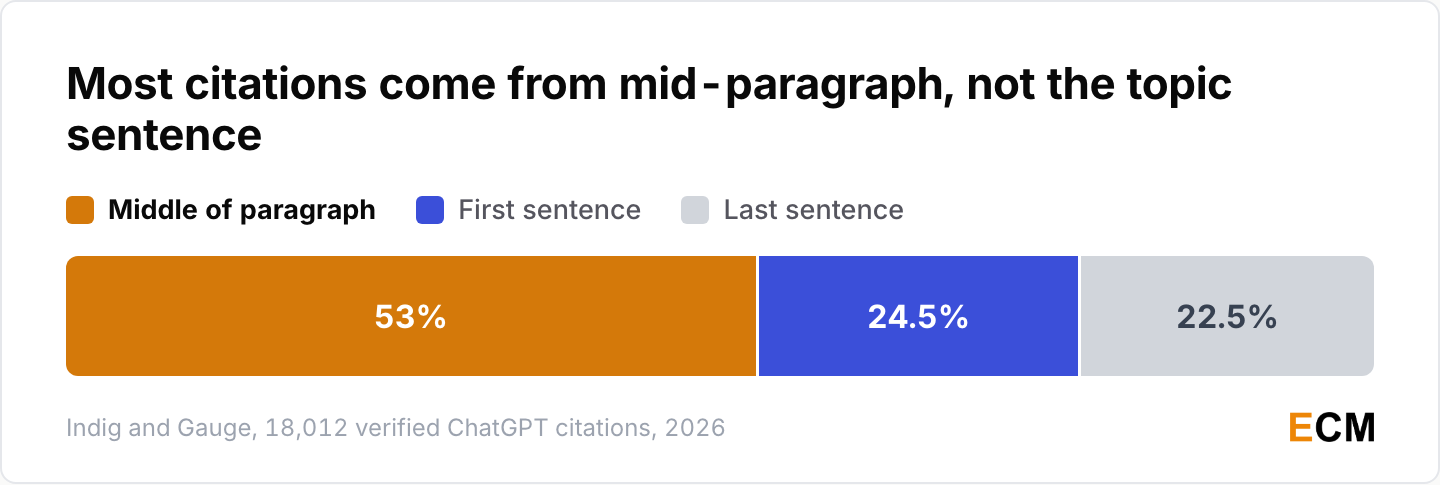
24. Within paragraphs, 53% of citations come from the middle, 24.5% from first sentences and 22.5% from last sentences (Indig and Gauge).
25. Cited passages were nearly twice as likely to use definitive language such as “X is” or “X refers to”, and twice as likely to include a question mark (Indig and Gauge, 11,022 citations analyzed for linguistic traits).
26. Pages with headlines that directly answer the query are cited 41% of the time, against 29% for loosely related headlines (AirOps with Kevin Indig, 16,851 queries across 353,799 pages).
27. Pages with 50% or more title-to-query overlap have a 20.1% citation rate against 9.3% for pages under 10% overlap, a 2.2 times lift (AirOps).
28. Sections of 120 to 180 words between headings receive roughly 70% more citations than pages with sections under 50 words (SE Ranking, 129,000 domains).
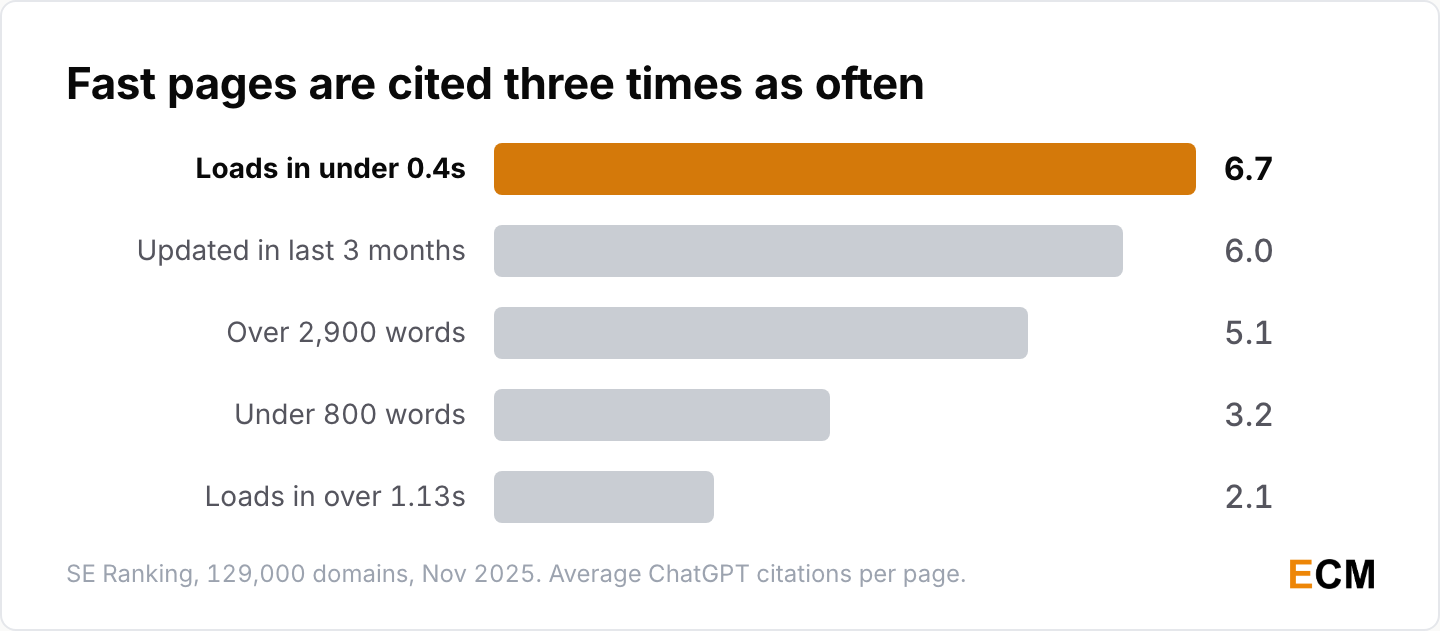
29. Articles over 2,900 words average 5.1 citations against 3.2 for articles under 800 words (SE Ranking).
Stats 3 and 24 to 27 are the most directly actionable findings on this page. Answer the question in the headline, answer it again in the opening third of the body, and write in sections long enough to stand alone as an answer. That’s most of GEO.
Authority, Speed And Freshness
30. Sites with over 32,000 referring domains are 3.5 times more likely to be cited by ChatGPT than sites with up to 200 referring domains (SE Ranking).
31. Sites with over 350,000 referring domains receive 8.4 citations on average (SE Ranking).
32. Domains with a trust score above 90 earn almost four times more citations than domains scoring below 43 (SE Ranking).
33. Pages with First Contentful Paint under 0.4 seconds average 6.7 citations, while pages over 1.13 seconds drop to 2.1 (SE Ranking).
34. Content updated in the past three months averages 6 citations against 3.6 for outdated pages (SE Ranking).
35. More than 70% of all pages cited by AI have been updated within the past 12 months (AirOps, The 2026 State of AI Search).
36. About 83% of commercial citations come from pages updated within the last year, and more than 60% from pages refreshed within six months (AirOps).
I’d treat stat 33 with more caution than the others in this cluster. It’s a correlation from a predictive model, and fast pages tend to belong to well-resourced sites that are also more authoritative. The freshness numbers in stats 34 to 36 are the ones I’d actually plan around, because two independent datasets point the same way.
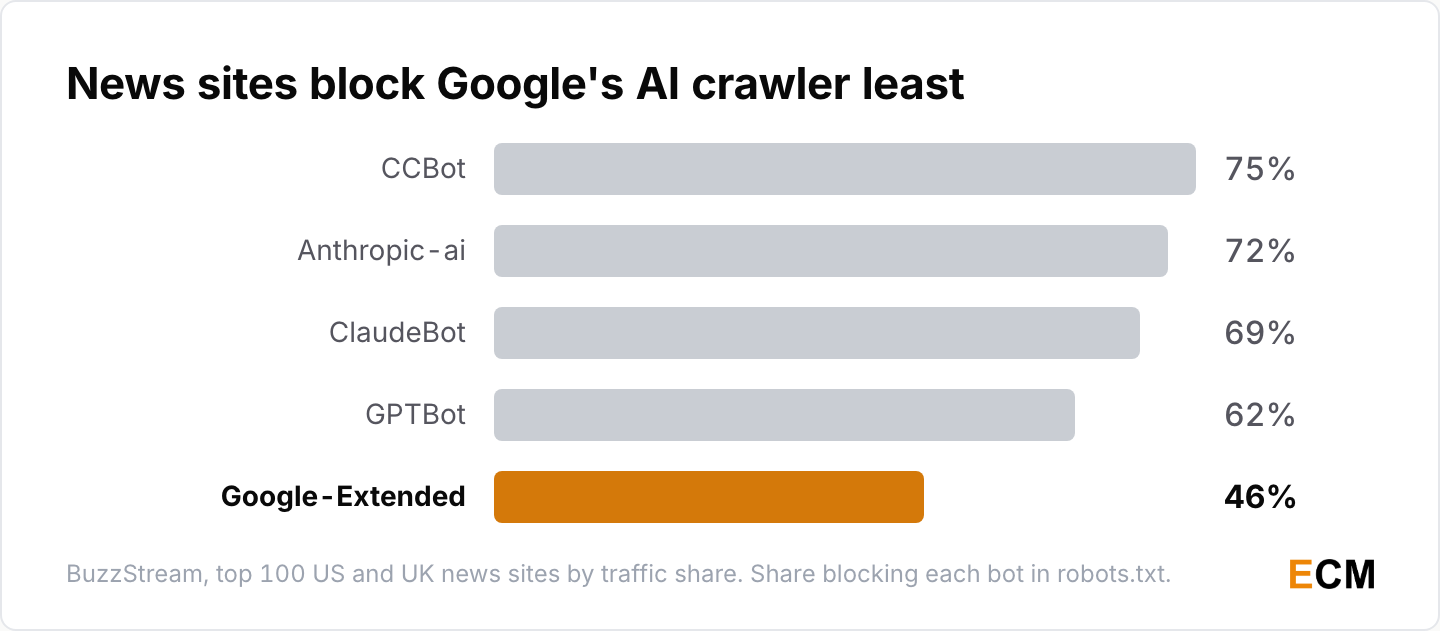
What Works, And What The Evidence Says Does Not
This section splits the tactics that show an effect in the research from the ones that don’t, which is not the split most GEO advice implies.
What Shows No Benefit
37. The presence of an llms.txt file showed no measurable citation benefit and slightly reduced the model’s predictive accuracy (SE Ranking).
38. Pages with FAQ schema average 3.6 citations, while pages without it reach 4.2 (SE Ranking).
39. Keyword stuffing performed 10% worse than the baseline in GEO-BENCH testing (Aggarwal et al., Princeton, IIT Delhi, Georgia Tech and Allen Institute for AI, KDD 2024).
What The Evidence Says Does Work
40. Adding statistics and citing sources were the highest-performing methods tested, improving on baseline by 41% on Position-Adjusted Word Count and 28% on Subjective Impression (Aggarwal et al.).
41. GEO methods can boost source visibility in generative engine responses by up to 40% (Aggarwal et al., GEO-BENCH, roughly 10,000 queries across nine domains, tested against 2023 and 2024-era engines).
42. On Perplexity specifically, the best-performing methods improved on baseline by 22% on Position-Adjusted Word Count and 37% on Subjective Impression (Aggarwal et al.).
43. Content quality and depth scored a perfect 10 on ChatGPT, Gemini and Claude, and 9 on Perplexity, making it the single most influential factor tested (Goodie AI AEO Periodic Table, 6,000 randomized prompts over six weeks).
Stats 37 and 38 deserve to be quoted more than they are. Both llms.txt files and FAQ schema are actively sold as GEO tactics, and the largest public study of citation factors found no benefit from either. The format itself is a separate question. The same study reports that the presence of FAQ sections in the main content nearly doubles a page’s chance of being cited, and that its model treats their absence as a negative signal, even though the raw averages for FAQ pages run the other way. SE Ranking’s own reading is that FAQ sections cluster on small support and product pages that earn few citations regardless. So the markup does nothing; the format is at worst neutral.
Third-Party Coverage Beats Your Own Site
44. Brands are 6.5 times more likely to be mentioned through third-party sources than through their own domains (AirOps, 21,311 brand mentions across more than 500 commercial-intent queries).
45. Domains with profiles on Trustpilot, G2, Capterra, Sitejabber or Yelp have a three times higher chance of being cited by ChatGPT (SE Ranking).
46. Domains with millions of brand mentions on Quora and Reddit have roughly four times higher citation likelihood (SE Ranking).
Which Domains Get Cited, And How Fast That Changes
Platform Citation Share
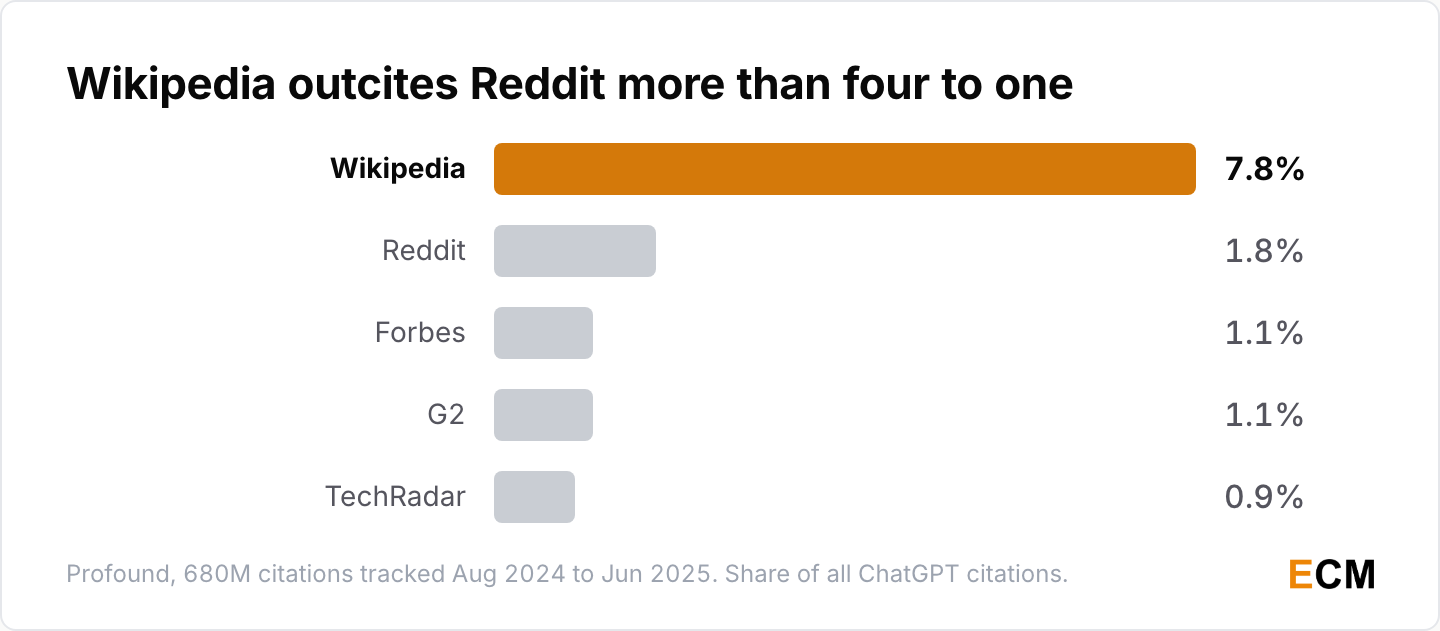
47. Wikipedia is ChatGPT’s most cited source at 7.8% of total citations (Profound, 680 million citations tracked from August 2024 to June 2025).
48. Wikipedia accounts for 47.9% of citations among ChatGPT’s top 10 most-cited sources (Profound).
49. On ChatGPT, Reddit takes 1.8% of citations, Forbes 1.1%, G2 1.1% and TechRadar 0.9% (Profound).
50. On Perplexity, Reddit accounts for 6.6% of all citations, roughly 3.7 times its share on ChatGPT (Profound).
51. Google’s AI Overviews and AI Mode reach 86% semantic similarity in their answers while sharing only 13.7% of cited sources (Ahrefs, 730,000 response pairs).
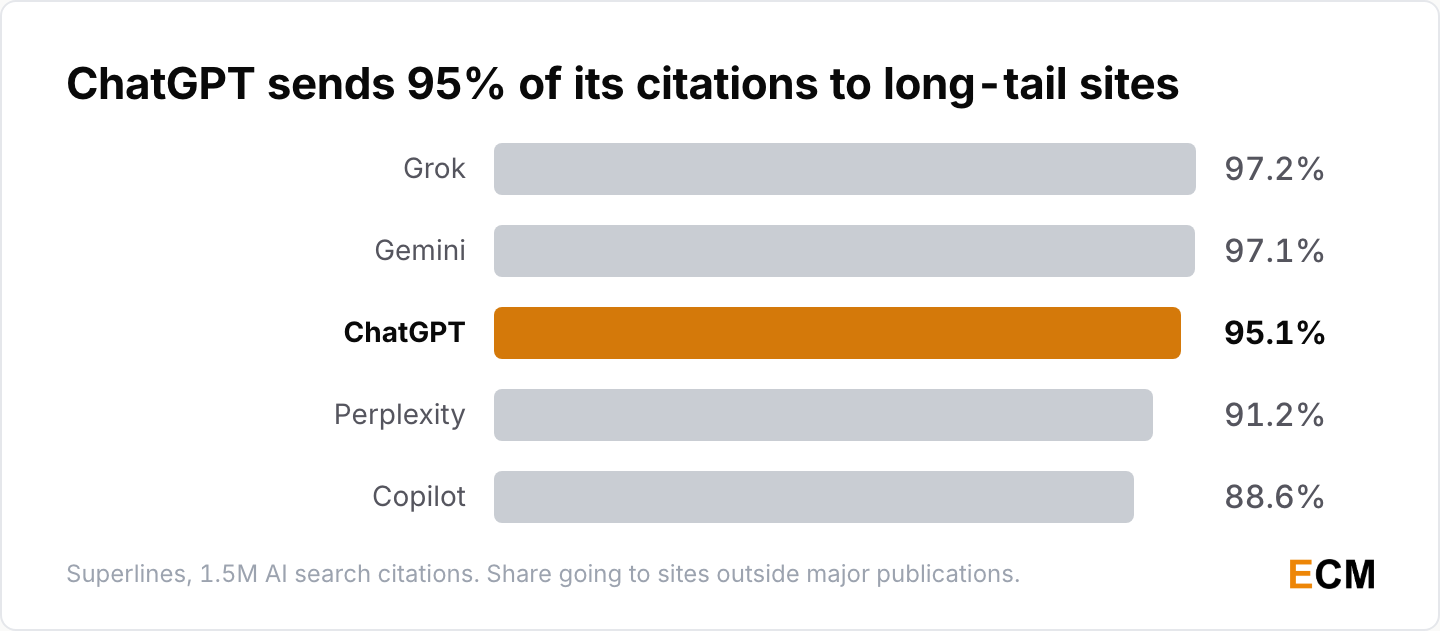
52. Between 85% and 97% of AI citations go to long-tail sources rather than major publications. Grok is highest at 97.21%, ChatGPT sits at 95.07% and Copilot is lowest at 88.61% (Superlines, 1.5 million citations).
53. Perplexity cites Reddit 6.1 times more often than YouTube and Grok 2.3 times more, while Google’s AI Overview shows near parity between the two (Superlines, 62 tracked brands).
Stat 51 is the one that changed how I think about measurement. Two Google products answering the same question arrive at nearly the same answer while agreeing on barely one source in seven. Tracking “AI visibility” as a single number across engines flattens a difference that large into noise.
Sudden Shifts In Source Preference
54. ChatGPT cited Reddit in close to 60% of prompt responses in early August 2025, before collapsing to around 10% by mid-September (Semrush, 230,000 prompts tracked weekly over 13 weeks).
55. Over the same window, Wikipedia dropped from appearing in roughly 55% of ChatGPT responses to less than 20% (Semrush).
56. YouTube’s share of social citations rose from 18.9% to 39.2% between August and December 2025, while Reddit’s fell from 44.2% to 20.3% (Goodie AI, cited by Superlines, 6.1 million citations across ChatGPT, Gemini and Perplexity).
Answer-Level Volatility And Query Fan-Out
57. Only 30% of brands stay visible from one AI answer to the next (AirOps, The 2026 State of AI Search).
58. Just 20% of brands remain present across five consecutive runs of the same query (AirOps).
59. ChatGPT generates two or more fan-out follow-up searches on 89.6% of queries (AirOps, 15,000 original prompts).
60. 95% of those fan-out queries have zero monthly search volume by traditional keyword metrics (AirOps).
61. 32.9% of cited pages appear only in fan-out SERPs and never in the original prompt’s SERP (AirOps).
Stats 57 and 58 are why a single AI visibility screenshot is worth almost nothing. If four brands in five drop out over five runs of the same prompt, one check tells you almost nothing. Measure repeatedly or don’t measure.
Where AI Search Gets Attribution Wrong
Citation Accuracy
62. Across eight AI search engines tested with 200 verbatim publisher quotes each, more than 60% of responses contained incorrect citations (Tow Center for Digital Journalism, Columbia Journalism Review, March 2025).
63. ChatGPT Search returned partially or entirely incorrect sourcing on 153 of 200 quotes, and acknowledged it couldn’t answer only seven times (Tow Center, November 2024).
Blocking Crawlers Does Not Stop Citation
64. 79% of top US and UK news sites block at least one AI training bot in robots.txt (BuzzStream, top 100 sites by traffic share).
65. 71% also block at least one AI retrieval or live-search bot (BuzzStream).
66. CCBot is the most blocked crawler at 75%, followed by Anthropic-ai at 72%, ClaudeBot at 69% and GPTBot at 62%. Google-Extended is the least blocked at 46% (BuzzStream).
67. Around 75% of sites blocking OpenAI or Google AI bots still appeared in AI citations (BuzzStream, 4 million citations across 3,600 prompts measured with Citation Labs’ XOFU tool, April 2026).
68. Roughly 70% of ChatGPT citations came from sites blocking ChatGPT-User or OAI-SearchBot (BuzzStream).
Stats 67 and 68 are the most counterintuitive finding on this page, and I wouldn’t build a robots.txt policy on them alone. Blocking a crawler clearly doesn’t remove a site from AI answers, but the mechanism is unresolved. Syndication, Common Crawl archives and search-index snippets can all route content around a block, and BuzzStream can’t fully separate them.
The GEO And AEO Industry By The Numbers
Category Growth
69. G2’s answer engine optimization category grew from seven products at its March 2025 launch to over 150 solutions within 10 months, growth of more than 2,000% (G2, January 2026).
70. As of April 2026, G2 listed 248 products in the AEO category (G2).
71. G2’s first AEO Grid Report, published in December 2025, featured just nine products (G2).
That 2,000% is real arithmetic on a base of seven, which is the least interesting way to read it. The count going from nine graded products in December to 248 listings four months later is the number I’d quote.
Funding
72. Profound raised a $96M Series C at a $1B valuation in February 2026, bringing total funding to $155M (Fortune).
73. Profound serves more than 700 enterprise customers including 10% of the Fortune 500, with fewer than 120 employees (Fortune).
74. At its June 2025 Series A, Profound was processing more than 100 million AI search queries a month across 18 countries and six languages (Profound via PR Newswire).
75. Profound’s $35M Series B, led by Sequoia in August 2025, brought total funding to $58.5M (Fortune).
76. Peec AI raised a $21M Series A led by Singular in November 2025, tripling its valuation above $100M on more than $4M ARR after 10 months and 1,300 customers (TechCrunch), taking total funding to $29M (Peec AI).
77. Two more GEO platforms raised Series A rounds a month apart in mid-2025: Scrunch AI took $15M led by Decibel in July, and Bluefish AI took $20M led by NEA and Salesforce Ventures in August.
78. Daydream raised a $15M Series A led by WndrCo in April 2026, bringing total funding to $21M (PR Newswire).
Incumbent Revenue
79. Semrush grew its AI product ARR from $4M to $38M in a single year, measured at 31 December 2025 (Semrush Q4 and FY2025 results).
80. Semrush reported FY2025 revenue of $443.6M, up 18% year on year, with ARR of $471.4M and approximately 108,000 paying customers across 145 countries (Semrush Form 10-K).
81. Adobe agreed to acquire Semrush for $1.9B at $12 per share in an all-cash deal announced 19 November 2025 (Adobe).
Stat 79 is the number I find most persuasive in this section, because it comes out of a public company’s SEC filing rather than a vendor blog. Every market-sizing figure below is a model. A public company reporting that one product line went from $4M to $38M in twelve months is a measurement.
Market Sizing
82. Market Intelo values the global GEO market at $848M in 2025, projecting $19.8B by 2034 at a 50.5% compound annual growth rate (Market Intelo).
83. Dimension Market Research’s current model differs substantially, putting the market at $1,089.3M in 2026 and $17,148.6M by 2034 at a 40.6% CAGR (Dimension Market Research).
84. North America held roughly 42.5% of the 2025 market at $360.4M, with AI visibility analytics the largest service segment at 34.2% and SaaS platforms 60% of deployments (Market Intelo).
Stats 82 and 83 are two analyst houses describing the same market with a $2.7B gap at the same end date and a 10-point difference in growth rate. Neither is measured, and Market Intelo’s own model doesn’t reconcile: $848M growing to $19.8B over nine years is about 42% a year, not the 50.5% it prints. The two houses print growth rates 10 points apart, but once Market Intelo’s own numbers are recomputed the real gap is closer to a point. I include them because people ask for a market size, and the honest version of that answer is a range with the disagreement showing.
What Marketers Are Actually Doing About It
The Investment Gap
85. GEO receives 9% of marketing resources on average, against 24% for SEO and 36% for social (Centerfield, reported by Search Engine Land, 878 US marketers).
86. 33% of marketers rate their understanding of GEO as good or expert, against 72% for SEO (Centerfield, reported by Search Engine Land).
87. 93% of marketers cite barriers to GEO implementation, led by budget at 40% and limited expertise or competing priorities at 36% (Centerfield, reported by Search Engine Land).
Stated Intent
88. 41% expect their company to dedicate more resources to GEO in the next year (Centerfield, reported by Search Engine Land).
89. 67% believe AI search visibility will be very or extremely important within two years (Centerfield, reported by Search Engine Land).
90. 54% of US marketers plan to fully implement their GEO strategy within three to six months (Scribewise via eMarketer, 205 professional-services marketing leaders, fielded 18 to 29 September 2025).
91. 68% of organizations are actively changing their strategies for AI search (BrightEdge, more than 750 marketers, October 2025).
92. 54% have tasked their SEO and digital marketing teams to lead AI search initiatives, more than all other departments combined (BrightEdge).
93. AI chatbots including ChatGPT, Perplexity, Gemini and Claude are the top area where marketers plan to increase 2026 investment, named by 37.7% (HubSpot, more than 1,500 marketers). 61% say marketing is experiencing its biggest disruption in 20 years (HubSpot).
94. 74% of marketers rate AI as critically or very important to success over the next 12 months, while 62% name lack of education and training as the top barrier (Marketing AI Institute, 2025 State of Marketing AI Report, almost 1,900 respondents).
Put stats 5, 85 and 90 together and you get the real state of GEO in 2026. Nearly two thirds of companies spend nothing on it, it gets under two fifths of the resourcing that SEO does, and more than half of marketers say they will have it fully implemented within six months. The last of those isn’t going to happen, and the gap between the first two and the third is where the opportunity sits. If you want the underlying search numbers that GEO now sits on top of, the SEO statistics and website statistics pages carry them.
Frequently Asked Questions
Does Generative Engine Optimization Replace SEO?
No, and the data is unusually clear on this. 88.46% of the URLs ChatGPT cites come from its search retrieval path, pages ranking first in Google are cited 3.5 times more often than pages outside the top 20, and 55.8% of cited pages ranked in the top 20 for at least one query. Search ranking is the entry condition for the citation pool. GEO is what you do after you have earned that, not instead of it.
How Do AI Engines Actually Choose Sources?
Retrieval first, then relevance at the passage level. The engine runs its own searches, often several: ChatGPT fires two or more fan-out queries on 89.6% of prompts, and 95% of those have no traditional search volume. It then pulls specific passages. 44.2% of citations come from the first 30% of a page, 53% come from the middle of paragraphs rather than the topic sentence, and pages whose headline directly answers the query are cited 41% of the time against 29% for weak matches.
Is An llms.txt File Worth Adding?
The evidence says no. In SE Ranking’s study of 129,000 domains, the presence of an llms.txt file showed no measurable citation benefit and slightly reduced the predictive accuracy of the model. FAQ schema fared no better: pages carrying it averaged 3.6 citations against 4.2 for pages without. The format is a separate question. The same study reports that FAQ sections in the main content nearly double a page’s chance of being cited, with the caveat that raw averages for FAQ pages run the other way because those sections cluster on small support pages. The markup is the part that shows no effect.
How Long Does GEO Take To Show Results?
Nobody has published a defensible answer, and the volatility numbers explain why. Only 30% of brands stay visible from one AI answer to the next and just 20% survive five consecutive runs of the same query, so a single before-and-after check can’t distinguish a real change from noise. Any timeline claim you see, including Profound’s claim that early adopters see a 25% to 40% lift in AI share of voice within 60 days, comes without published methodology.
Should I Block AI Crawlers?
Blocking doesn’t appear to remove you from AI answers. Around 75% of sites blocking OpenAI or Google AI bots still appeared in AI citations, and roughly 70% of ChatGPT citations came from sites blocking ChatGPT-User or OAI-SearchBot. That’s a robust finding across 4 million citations, but the mechanism is unresolved, so treat it as a reason not to expect blocking to work rather than a recommendation either way.
Which AI Platform Should I Optimize For First?
ChatGPT, on volume. It accounts for 87.4% of AI referral traffic. Be aware that optimizing for one doesn’t carry over cleanly: Google’s own AI Overviews and AI Mode reach 86% semantic similarity while sharing only 13.7% of cited sources, and average citation overlap between AI assistants and Google and Bing’s top 10 is 11%.
How Big Is The GEO Software Market?
Between $848M in 2025 and $1.09B in 2026 depending on which analyst you ask, growing to somewhere between $17.1B and $19.8B by 2034. Both figures are models rather than measurements, and they disagree by $2.7B on where the market lands. The audited number worth more than either is Semrush’s: AI product ARR went from $4M to $38M in one year.
Sources And Methodology
Every statistic above was checked in September 2026 against the closest available publication of the underlying research, and the citation points at the page that actually carries the number rather than at the page a dossier recorded. Several studies here have no standalone primary publication and were released through a trade outlet instead: the Centerfield survey exists only in Search Engine Land’s coverage, the Scribewise survey only in eMarketer’s, and the Profound and Peec AI funding figures are fullest in Fortune and TechCrunch. Those citations name the research organization in the prose and link the outlet that published the numbers. Search Engine Land is owned by Semrush, which also appears in this article as a research source and as a company whose revenue is reported here.
Vendor-published research dominates this topic and is flagged in the text throughout. Ahrefs, Semrush and SE Ranking sell SEO tooling. Profound, AirOps, Superlines and Goodie AI sell AI visibility platforms. BrightEdge sells enterprise search software, G2 monetizes the software category whose growth it reports, and BuzzStream sells digital PR tools. Each has a commercial interest in the direction of the number it publishes. These figures appear because they represent the only measurement at that scale, not because the incentives are clean. The genuinely disinterested sources on this page are the Reuters Institute, the Tow Center at Columbia Journalism Review and the KDD 2024 GEO-BENCH paper. Semrush’s SEC filings are audited and carry legal penalties for misstatement, which makes them reliable, but Semrush is not a neutral party in this market.
Sample boundaries matter more than usual. Every citation dataset here reflects the queries its vendor happens to track, which skews commercial and English-language. The Reuters Institute figures are self-reported survey responses. The Centerfield, Scribewise, BrightEdge, HubSpot and Marketing AI Institute surveys are all self-selected samples of marketers, and the Scribewise sample of 205 US professional-services respondents is small enough that its 54% should be read as directional.
Several claims were corrected during verification rather than repeated:
- Perplexity’s citation overlap with Google’s top 10 is 28.6%, not the roughly 33% that circulates. Ahrefs describes it as “nearly 1 in 3”.
- The August-to-December 2025 shift in YouTube and Reddit citation share is Goodie AI research covering 6.1 million citations. It is frequently attributed to Superlines, which republished it.
- Semrush had approximately 108,000 paying customers at the end of FY2025 per its Form 10-K, not the 117,000 that appears on several aggregator sites.
- The market-sizing figures of $848M in 2025 and $19.8B by 2034 are Market Intelo’s model. Dimension Market Research, to which they are often attributed, currently publishes a different model entirely.
- The AirOps volatility and freshness figures come from its 2026 State of AI Search report, not the AI search hub index page that aggregators link.
Several widely repeated claims were excluded because no primary source survived checking:
- “Only 11% of domains are cited by both ChatGPT and Google AI Overviews”, attributed to Profound’s 680 million citation study. The cited page contains no cross-platform overlap statistic at all, and where the figure circulates it is paired with Perplexity rather than AI Overviews.
- “AI Overview content changes for the same query around 70% of the time, replacing 45% to 50% of citations.” Neither AirOps page carrying the surrounding research contains this figure.
- A claimed doubling of AI use for news from 3% to 6% in the Reuters Institute Digital News Report 2025. The full report text contains no such figure. The published numbers are 7% weekly use of AI chatbots for news and 4% for ChatGPT specifically, both averaged across 48 markets.
- Forrester’s reported 83% of purchases including generative AI features, a doubling of average purchase price, and a 30% extension of decision timelines. The underlying Forrester report is paywalled and only the buying-group doubling could be confirmed on an accessible page.
- “Pages updated within 60 days are 1.9 times more likely to appear in AI answers”, attributed to BrightEdge. The figure does not appear in any BrightEdge publication.
- Superlines’ statement that the GEO tools market has attracted more than $31M in venture funding. The rounds on this page that carry a figure come to about $202M, and the running totals these companies report come to about $240M, so the aggregate is either stale or scoped far more narrowly than it reads.
- The Growth Memo analysis behind stats 3, 24 and 25 is subscriber-only. The citation points at the original publication, and the figures were confirmed against Search Engine Land’s February 2026 write-up of the same study.
- The Semrush AI Visibility Toolkit list price. The pricing page geo-prices by visitor location and a US dollar figure could not be confirmed directly.
- Evertune’s $15M Series A led by Felicis in August 2025. The round checks out against the company’s GlobeNewswire release, but that page could not be retrieved at the time of writing, so it is left out of the numbered figures rather than cited to a link nobody can open.
Where a source publishes continuously updated pages, the retrieval date is September 2026. The G2 category counts, market-sizing models and pricing pages in particular are revised in place without changing their URLs, so any of those figures should be re-checked against the source before being quoted elsewhere.

Written by
Chintan Zalani
Hey, I’m Chintan, a creator and the founder of Elite Content Marketer. I make a living writing from cafes, traveling to mountains, and hopping across cities. Join me on this site to learn how you can make a living as a sustainable creator.
View Profile →Related Articles
Marketing Data
AI Hallucination Rate 2026: 60+ Sourced Statistics
The real AI hallucination rate in 2026, across 64 sourced statistics: OpenAI’s o3 scores 5.7% on FActScore with browsing on and 24.2% with it off.
Sep 9, 2026Read more →
Marketing Data
AI Content Detection Statistics 2026: 90 Sourced Numbers
90 AI content detection statistics for 2026, each traced to its source: AI’s share of new articles stalled at 49.94%, detectors still miss most of it.
Sep 9, 2026Read more →
Marketing Data
71 YouTube Statistics for Creators and Marketers 2026
71 YouTube statistics for 2026, every number traced to its source: YouTube passed $60 billion in revenue and took 13.8% of all U.S. TV viewing time.
Sep 8, 2026Read more →