94% of B2B buyers used LLMs while buying, and they now contact sellers 61% of the way through the journey, down from 69% (6sense, 2025). These B2B buyer statistics cover research habits, buying committees, AI use and why vendors win.
60 B2B Buyer Statistics for 2026: 94% Use AI
 Written by Editorial Staff
Key Takeaways
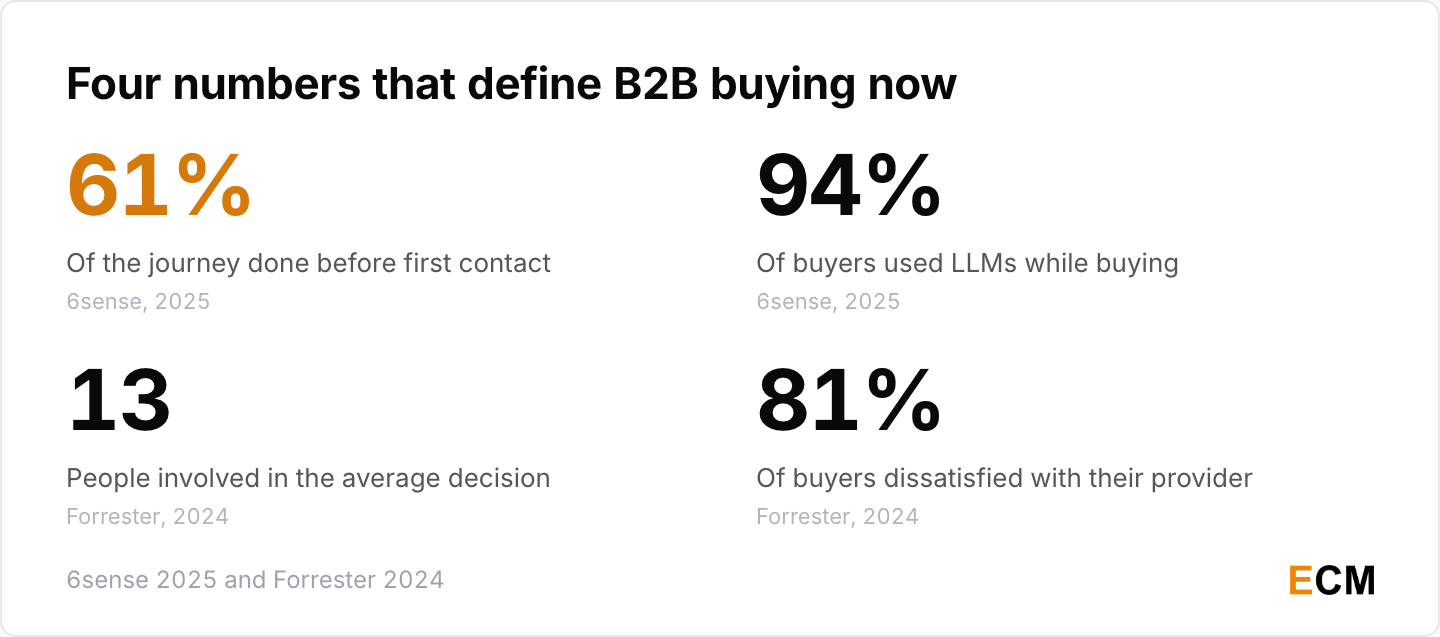
- Buyers reach sellers 61% of the way through the journey, and 94% of them used LLMs somewhere in the process (6sense, 2025).
- The first vendor buyers spoke with went on to win 77.0% of the time in the initial study (6sense, 2025).
- On average, 13 people inside a company are involved in a B2B buying decision (Forrester, 2024).
- 86% of B2B purchases stall during the buying process, and 81% of buyers are dissatisfied with the provider they chose (Forrester, 2024).
- Generative AI chatbots were the top influence on software shortlists at 17.1%, against 8.8% for vendor salespeople (G2, 2025).
- 74% of B2B buying teams show unhealthy conflict during the decision (Gartner, 2025).
- 56% of tech buyers talked to a product user before buying, while vendors guessed 34% (TrustRadius, 2024).
B2B Buying Journey Statistics Before Sales Gets a Call
Most of the B2B buying journey still happens before a seller hears about it, which is the stretch content can reach. My content marketing statistics roundup covers the other side of that work.
How Far Buyers Get Before First Contact
Buyers are calling sellers earlier than they did, but they still arrive with most of the thinking done.
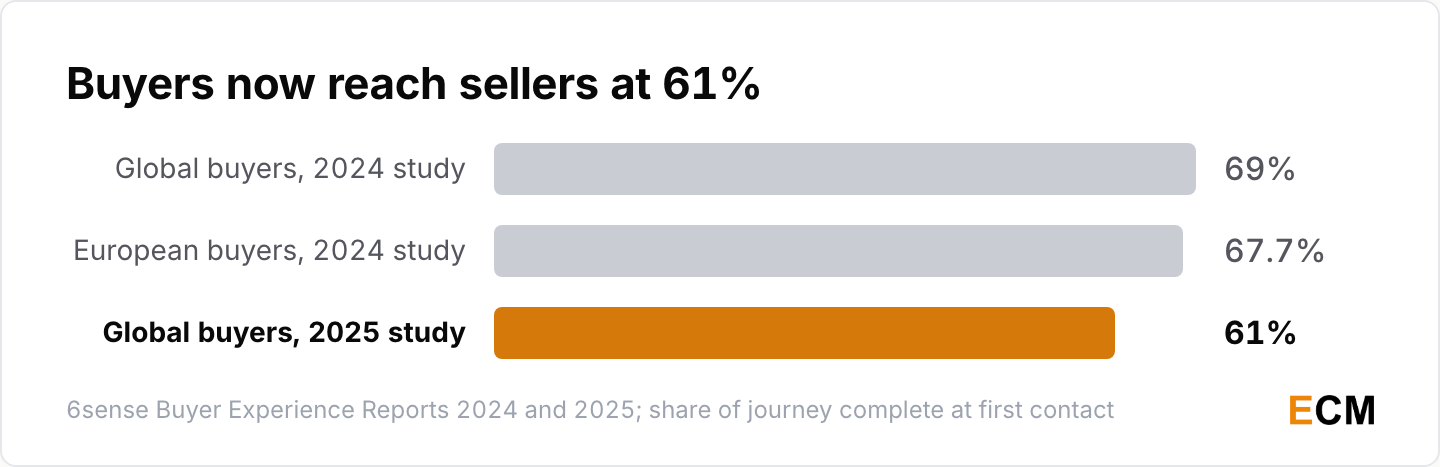
- The point of first contact moved from 69% of the journey to 61% between the 2024 and 2025 studies, so buyers now engage sellers earlier in the journey (6sense, 2025).
- In the 2024 global study of 2,509 buyers, 69% of the purchase process happened before buyers engaged sellers, and 85% had set their purchase requirements first (6sense, 2024).
- European buyers were 67.7% through the process at first contact, and 88.8% had largely or completely set requirements before reaching out (6sense, 2024).
- Most buyers want each phase to be all or mostly self-service: 83% for discovery, 81% for research and 76% for evaluation (G2, 2024).
Buyers Pick a Favorite Before the First Call
The order of the shortlist usually predicts the winner. I’d treat the first sales call as a confirmation meeting, not a pitch.
- 94% of buyers ranked their shortlist by preference before talking to sellers, and 79% said they, not the vendor, started the first conversation (6sense, 2025).
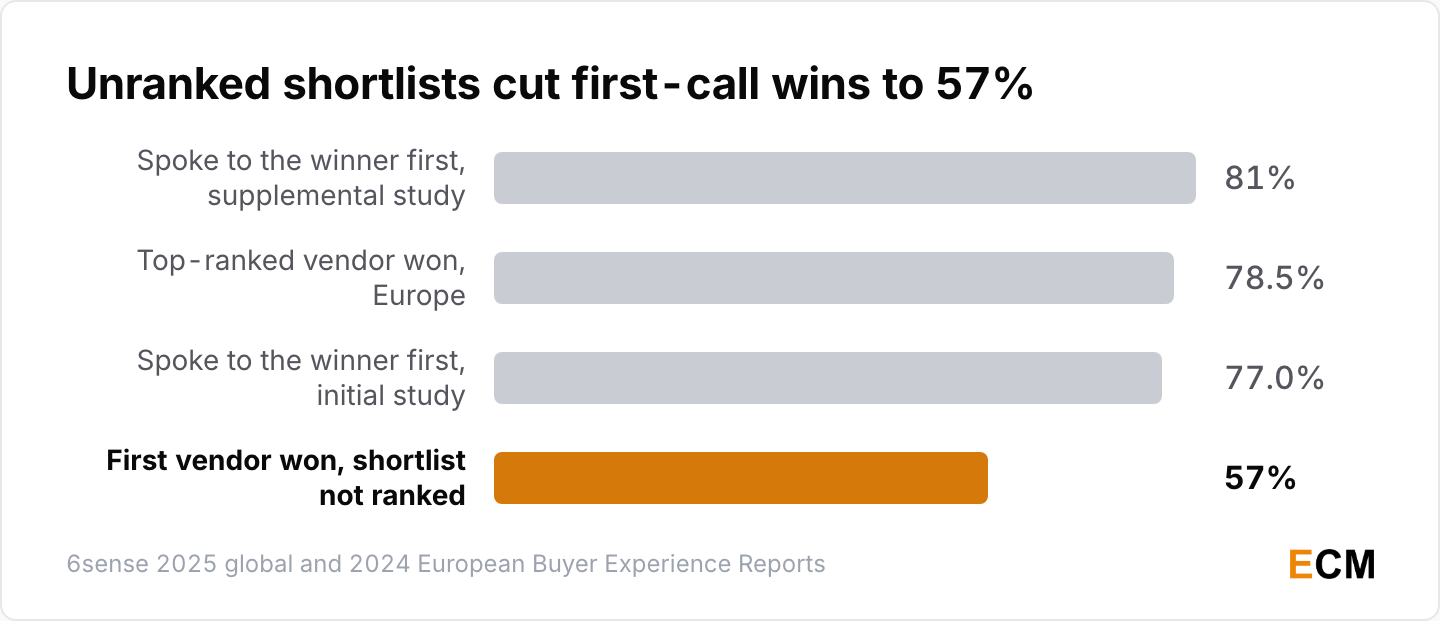
- The first vendor buyers spoke with was the winner 77.0% of the time in the initial study and 81% in a supplemental one, but only 57% when the shortlist wasn’t ranked first (6sense, 2025).
- In Europe, the vendor ranked first at first contact won 78.5% of the time, and buyers started first contact 83% of the time (6sense, 2024).
- 81% of buyers chose a preferred vendor before speaking with sales (6sense, 2024), and 71% of tech buyers went with their first choice while 12% switched (TrustRadius, 2024).
Shortlists Are Getting Shorter
Fewer slots means getting onto the list early matters more than the final pitch.
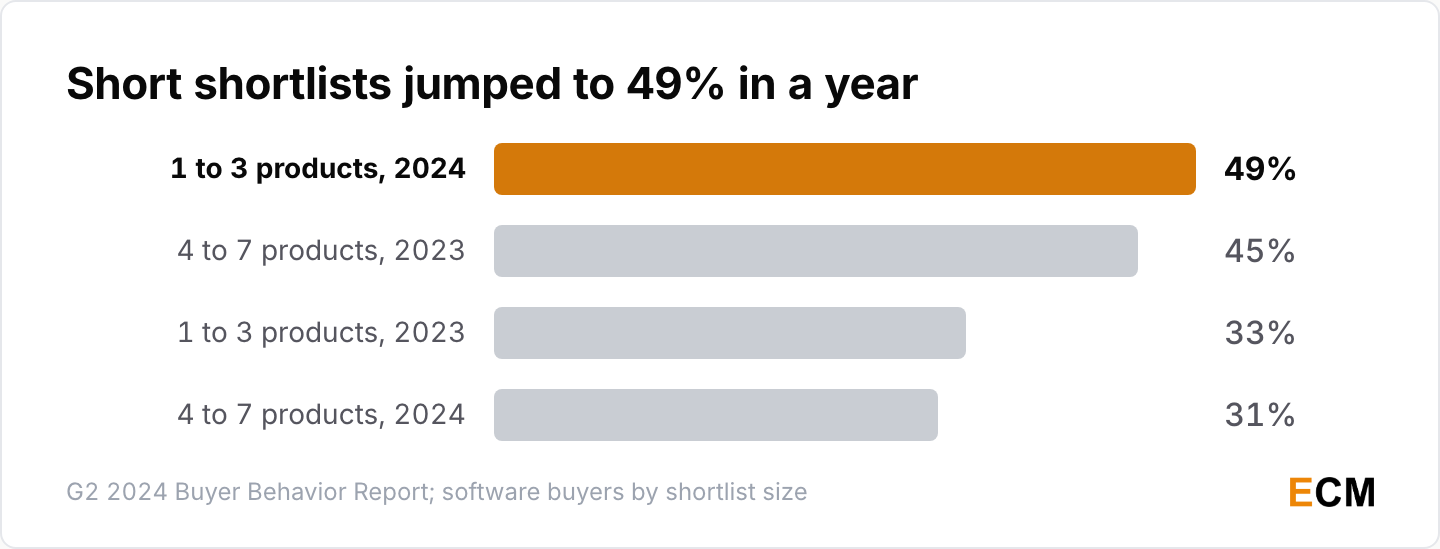
- 49% of software buyers had one to three products on their shortlist in 2024, up from 33% in 2023, while shortlists of four to seven products fell from 45% to 31% (G2, 2024).
- Buyers fill 3.6 shortlist spots on day one, evaluate 5.1 vendors on average, and choose a winner from that day-one list 95% of the time (6sense, 2025).
How Long B2B Buying Cycles Take
Cycle length depends on who is measuring. 6sense tracks the whole journey, while TrustRadius asks how long the purchase took.
- The average B2B buying cycle fell from 11.3 months in 2024 to 10.1 months in 2025, and 49% of buyers said economic uncertainty shortened their cycle (6sense, 2025).
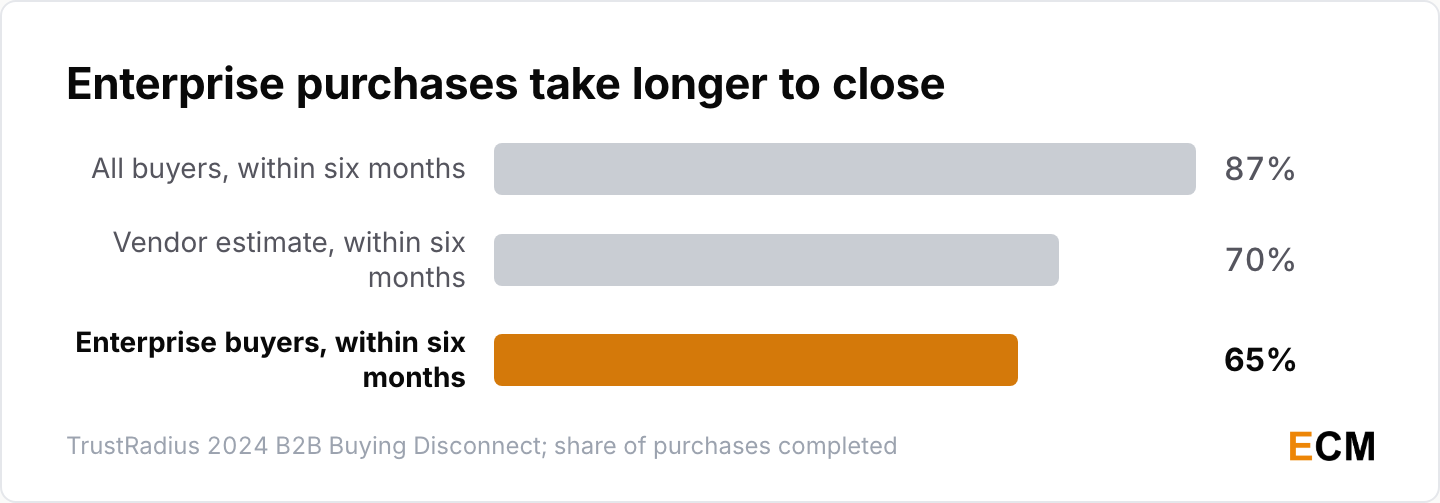
- 87% of tech buyers completed their purchase within six months, falling to 65% for enterprise buyers, who reached 87% by 12 months (TrustRadius, 2024).
- Vendors saw it slower: they reported 70% of purchases completed within six months and 89% by ten months (TrustRadius, 2024).
How Many People Sit on a B2B Buying Committee
Forrester finds buying groups growing, and that is the real reason content has to work for several readers at once. The count changes a lot depending on the kind of purchase.
Average Buying Group Size by Source
Group size depends on who is counting and what is being bought.
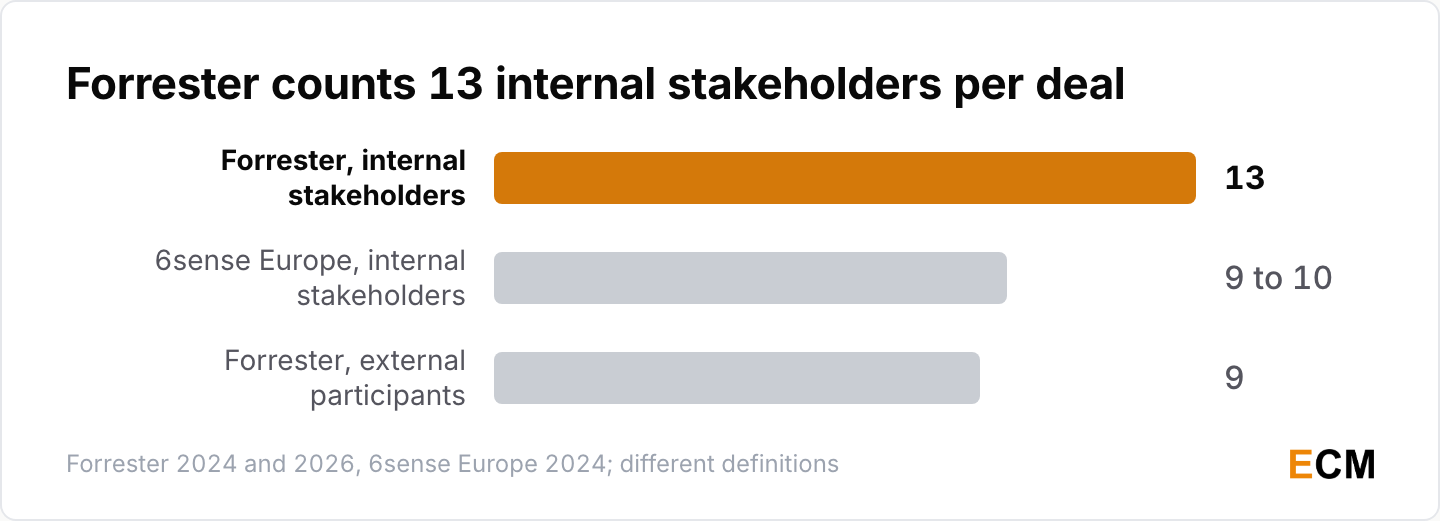
- 13 people inside an organization are involved in the average buying decision, and 89% of purchases involve two or more departments (Forrester, 2024).
- Forrester’s 2026 buying study counts 13 internal stakeholders and 9 external participants per purchase, and the group doubles in size when the product includes generative AI features (Forrester via Digital Commerce 360, 2026).
- Gartner says buying groups range from 5 to 16 people across as many as four functions (Gartner, 2025).
- European buying groups average 9 to 10 internal stakeholders (6sense, 2024), while 96% of tech buying groups have five or fewer members and 53% include someone from the C-suite (TrustRadius, 2024).
Who Makes the Final Purchase Decision
Procurement now joins from the start, and finance often holds the final say.
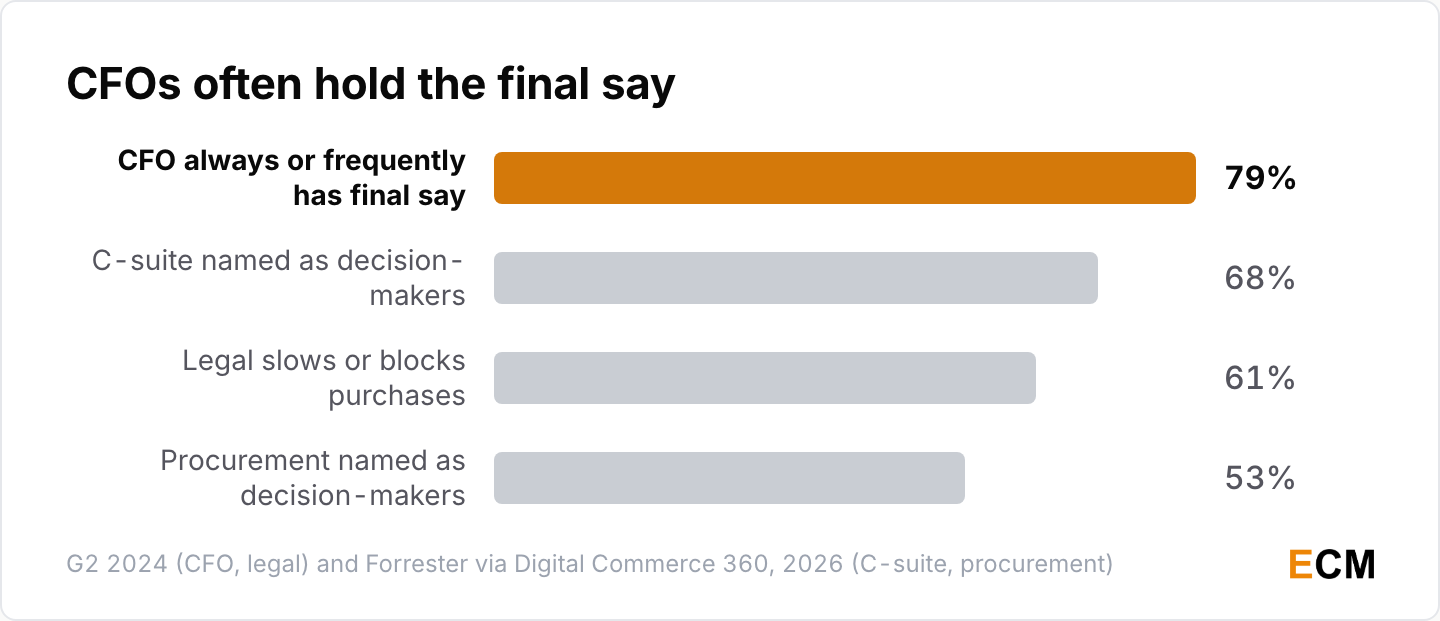
- 79% of software buyers say the CFO always or frequently holds final decision-making power, 61% say legal slows or blocks purchases, and 41% name a C-suite leader or the CFO as the person ultimately responsible for sign-off (G2, 2024).
- 68% of respondents named C-suite leaders as decision-makers, and 53% named procurement, which now joins from the earliest stages (Forrester via Digital Commerce 360, 2026).
Conflict and Consensus Inside Buying Groups
Most buying teams hit conflict, and the ones that reach agreement report better deals. The payoff for content that helps a group agree is large.
- 74% of B2B buyer teams showed unhealthy conflict during the decision, in a survey of 632 buyers run in August and September 2024 (Gartner, 2025).
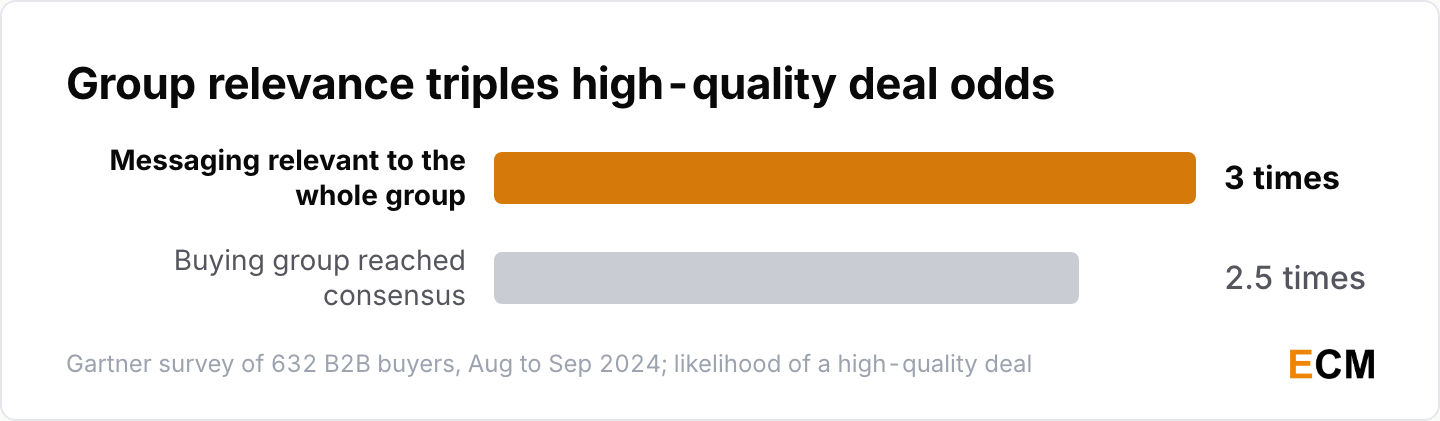
- Buying groups that reach consensus are 2.5 times more likely to report a high-quality deal, and buyers who get messaging relevant to the whole group are 3 times more likely (Gartner, 2025).
- Among buyers with six or more internal participants, 94% said the larger group delivered clear benefits, and fewer than half cited slower decisions as a significant drawback (Forrester via Digital Commerce 360, 2026).
How B2B Buyers Use Generative AI in Purchasing
AI is now part of nearly every buying journey, but the headline adoption numbers hide how shallow some of that use still is. The search side of this shift is in my zero-click search statistics.
How Many B2B Buyers Use AI to Research
Adoption is near universal when “use” means any AI at any point. Direct chatbot research is far lower.
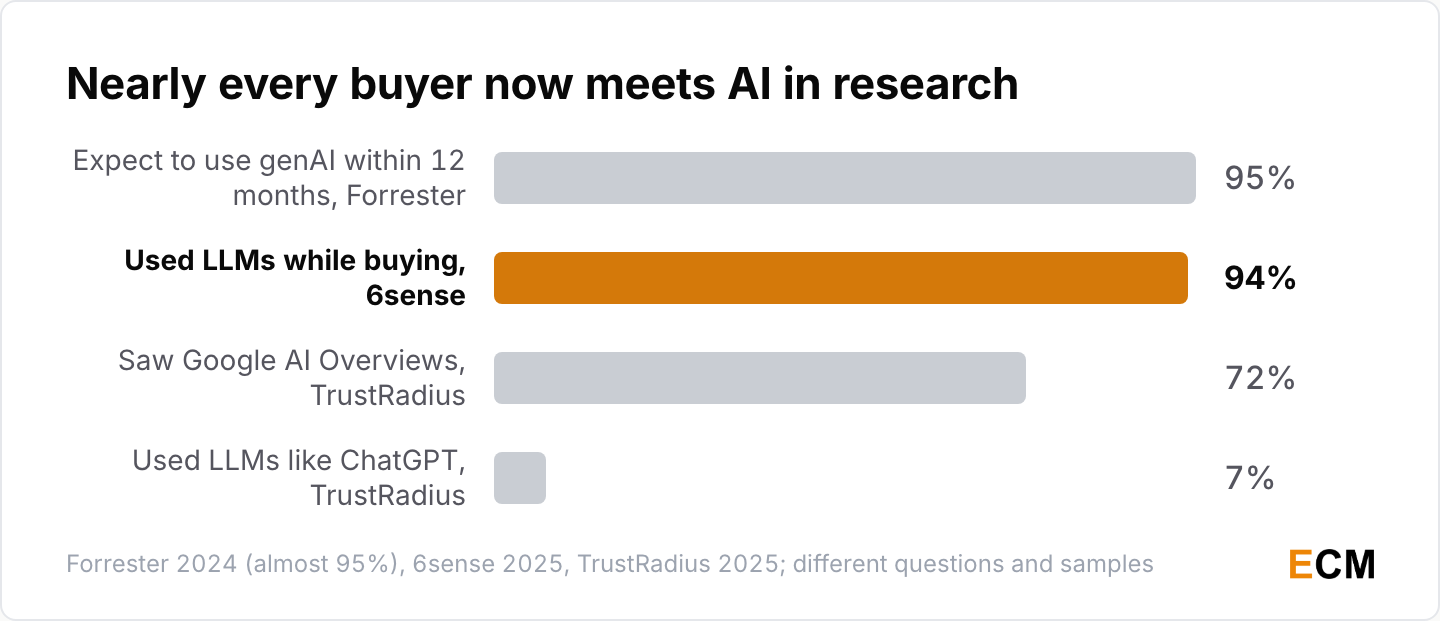
- 94% of buyers used LLMs in their buying process, more toward the middle of the journey than the start (6sense, 2025).
- Almost 95% of buyers said they expected to use generative AI to support their decision and purchase process in the following 12 months (Forrester, 2024).
- 72% of tech buyers ran into Google’s AI Overviews while researching, from 59% in EMEA to 73% in the US and 84% in APAC, but only 7% used LLMs like ChatGPT as part of their buying process (TrustRadius, 2025).
- Occasional AI use among tech buyers rose from 17% in 2024 to 30% in 2025, and frequent use from 4% to 8% (TrustRadius, 2025).
AI Chatbots Now Shape the Shortlist
This is the number I’d put in front of any B2B marketing team: chatbots already outrank salespeople as a shortlist influence.
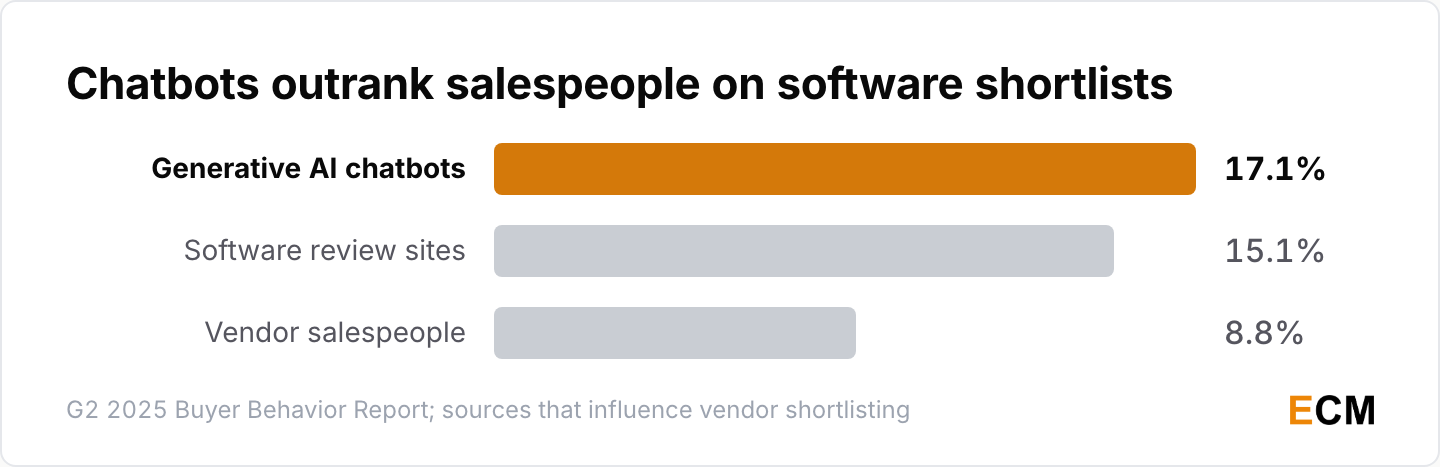
- Generative AI chatbots were the most cited influence on software shortlists at 17.1%, ahead of software review sites at 15.1% and vendor salespeople at 8.8% (G2, 2025).
- 30% of buyers saw generative AI tools as a meaningful interaction at the final commit stage, against 17% who said the same about product experts (Forrester, 2025).
- 90% of tech buyers who saw AI Overviews clicked through to the sources they cited (TrustRadius, 2025).
- 61% of purchase influencers say their organization has or will use a private generative AI engine to support purchasing (Forrester, 2025).
Trust in AI Answers Is Still Shaky
Buyers use AI for speed and then check its work, which is why cited sources matter.
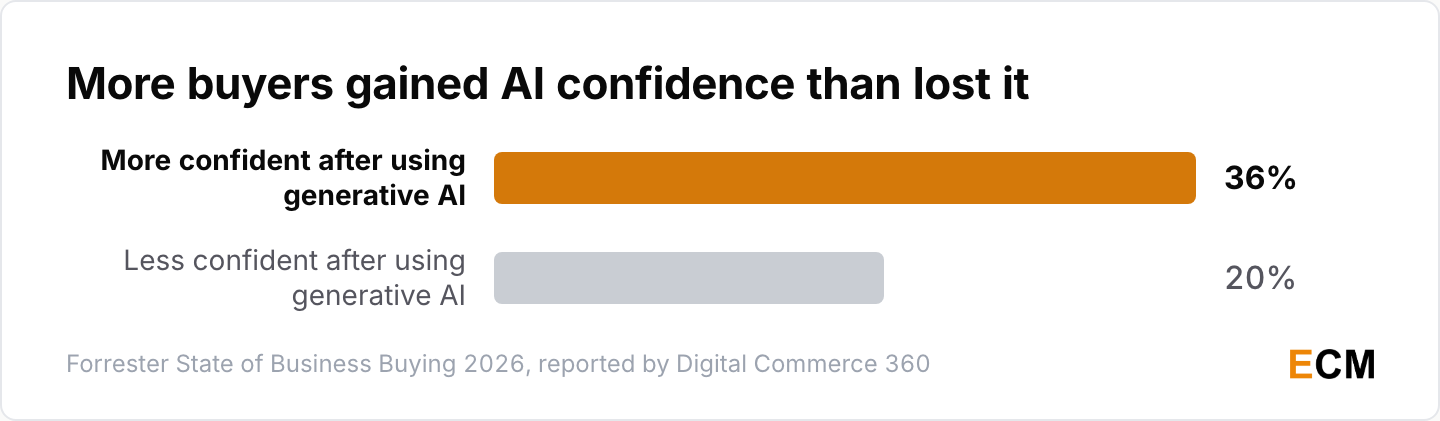
- 36% of buyers said generative AI made them more confident in their decision, while 20% felt less confident after hitting unreliable or inaccurate information (Forrester via Digital Commerce 360, 2026).
- Forrester predicts that ungoverned genAI use in B2B go-to-market tools will cost more than $10 billion in enterprise value in 2026 through stock declines, settlements and fines (Forrester, 2025).
- 80% of tech buyers trust AI-generated content at least some of the time, and 62% of frequent AI users always or very often double-check it (TrustRadius, 2025).
AI Features Send Buyers Back to Sellers
AI inside the product raises questions buyers take to the vendor, and that pulls them into sales conversations sooner.
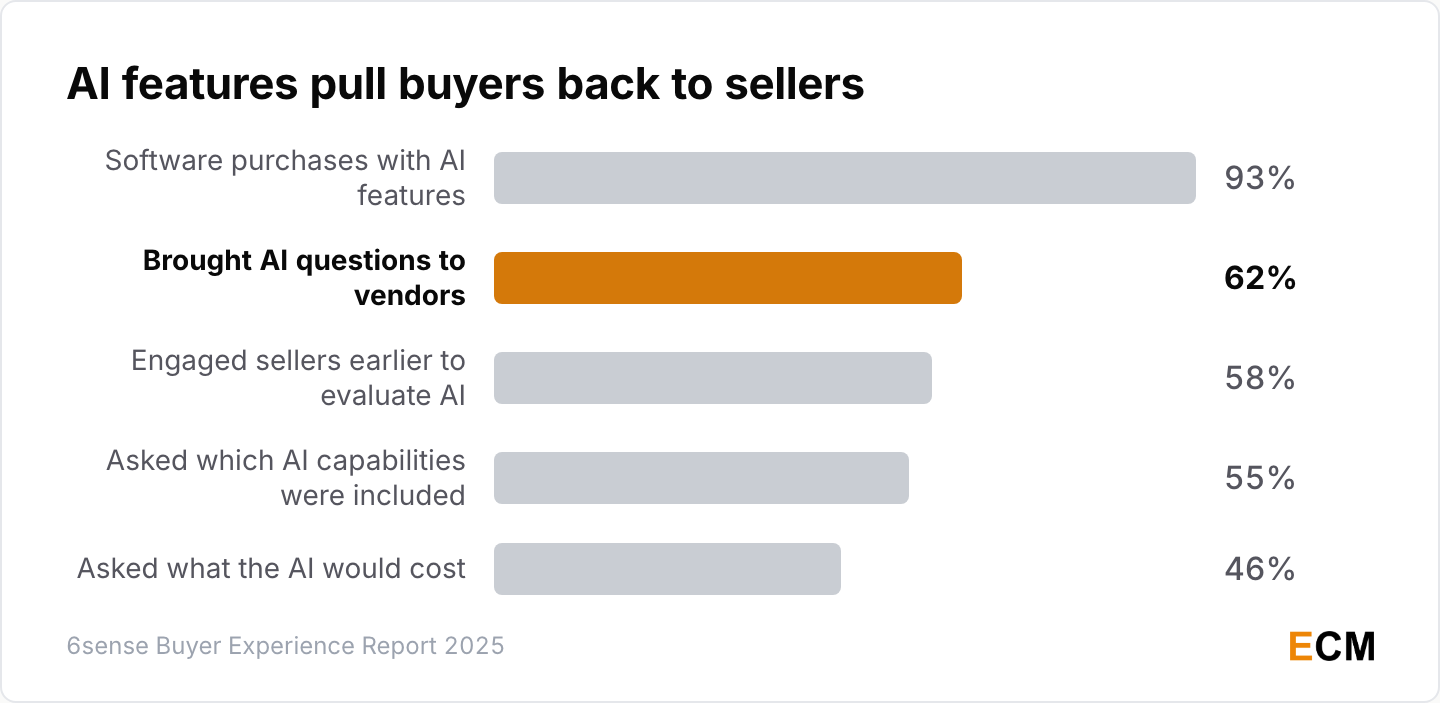
- Nearly 90% of buyers said AI features were part of the solution they bought, with software highest at 93% (6sense, 2025).
- 62% brought AI questions or concerns to vendors, including which capabilities were included (55%) and what they would cost (46%), and 58% engaged sellers earlier to evaluate AI (6sense, 2025).
- Over two-thirds of software buyers would pay a premium for AI if the vendor proves its value, rising to 88% of power users (G2, 2025).
What Content and Channels Influence B2B Buyers
Search, peers and reviews still do more work than analyst reports or sales outreach. My online review statistics go deeper on review data.
Where B2B Buyers Research Vendors
Google is still the first stop for research, and video and review sites come next.
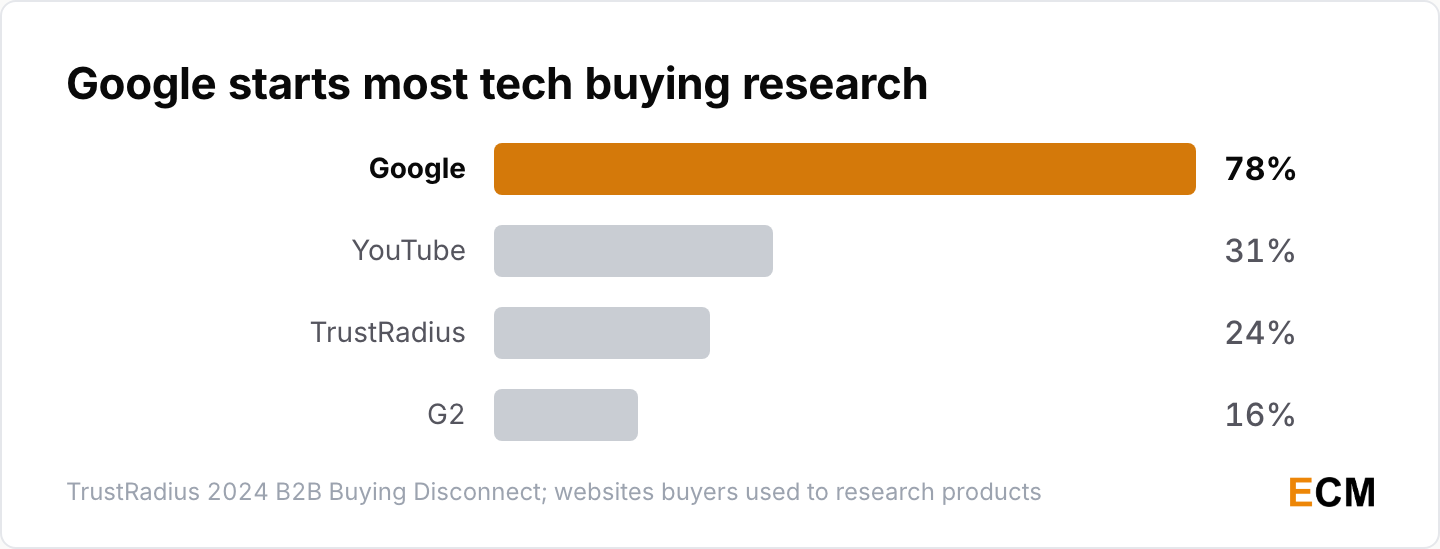
- Tech buyers researched products on Google (78%), YouTube (31%), TrustRadius (24%), G2 (16%) and LinkedIn (16%) (TrustRadius, 2024).
- Public review websites were the most consulted source for 31% of software buyers in 2024, up from 23% in 2023, 18% in 2022 and 13% in 2021 (G2, 2024).
- Buyer use of analyst reports fell to 16%, the lowest in seven years (TrustRadius, 2024).
- More than 50% of younger buyers were expected to rely on external sources, including social media, to make buying decisions in 2025 (Forrester, 2024).
Peer Conversations Vendors Underestimate
Buyers trust people who already use the product. Vendors keep guessing that number too low.
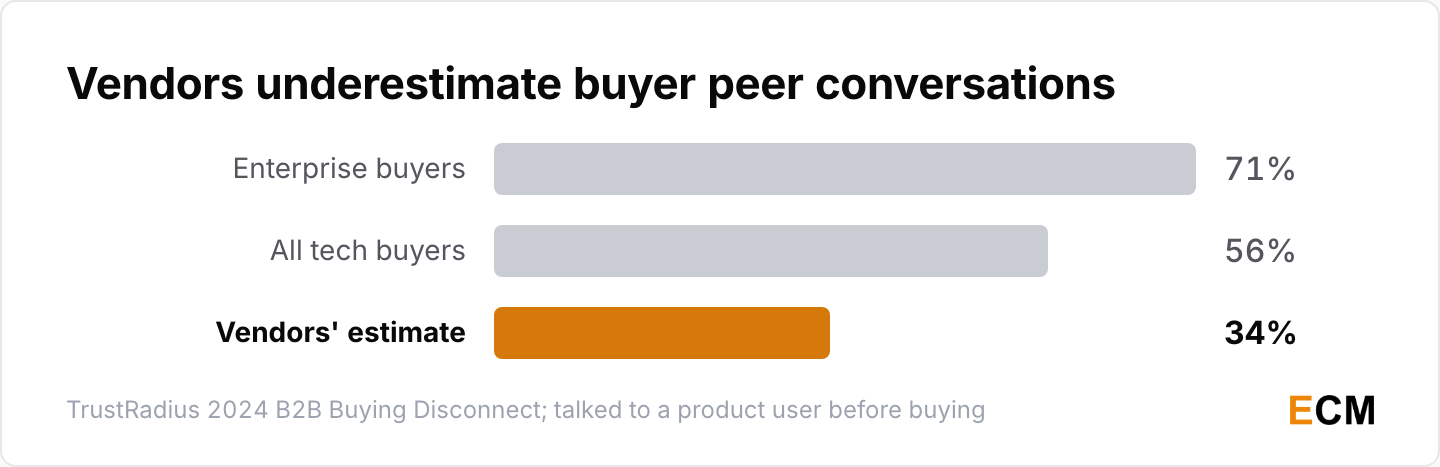
- 56% of tech buyers had a conversation with a product user before buying, 71% for enterprise purchases, while vendors estimated 34% (TrustRadius, 2024).
- 54% of tech buyers used at least one demo, 67% for enterprise purchases, and 71% of demo users called it the most influential resource (TrustRadius, 2024).
- 76% of buyers brought in at least one outside resource such as an analyst, consultant, investor, distributor or reseller; a year earlier, 71% used analysts or consultants, a narrower category (6sense, 2025).
What B2B Buyers Want From Vendor Content
Generic content is the loudest complaint, and it got worse in a single year.
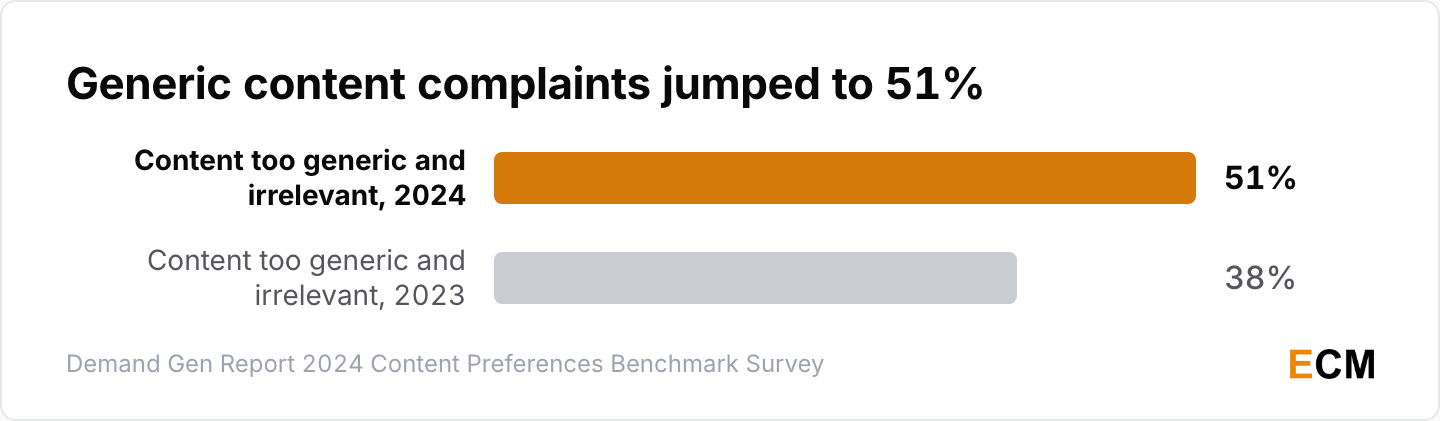
- 51% of buyers said content was too generic and irrelevant to their needs in 2024, up from 38% in 2023, and another 51% said access took too many steps, up from 30% (Demand Gen Report, 2024).
- 89% of respondents downloaded and read assets they found themselves, 72% shared content with their team, and 57% of colleagues who got it read it (Demand Gen Report, 2024).
- Short-form content (67%) and webinars or digital events (65%) were the formats buyers found most valuable in decision-making (Demand Gen Report, 2024).
Why B2B Vendors Win or Lose Deals
Familiarity wins more deals than persuasion. That is the most useful finding for marketers here, yet vendors still spend more on demand generation than brand.
Prior Experience Beats Cold Outreach
Buyers go back to vendors and sellers they already know, so brand work pays off at decision time.
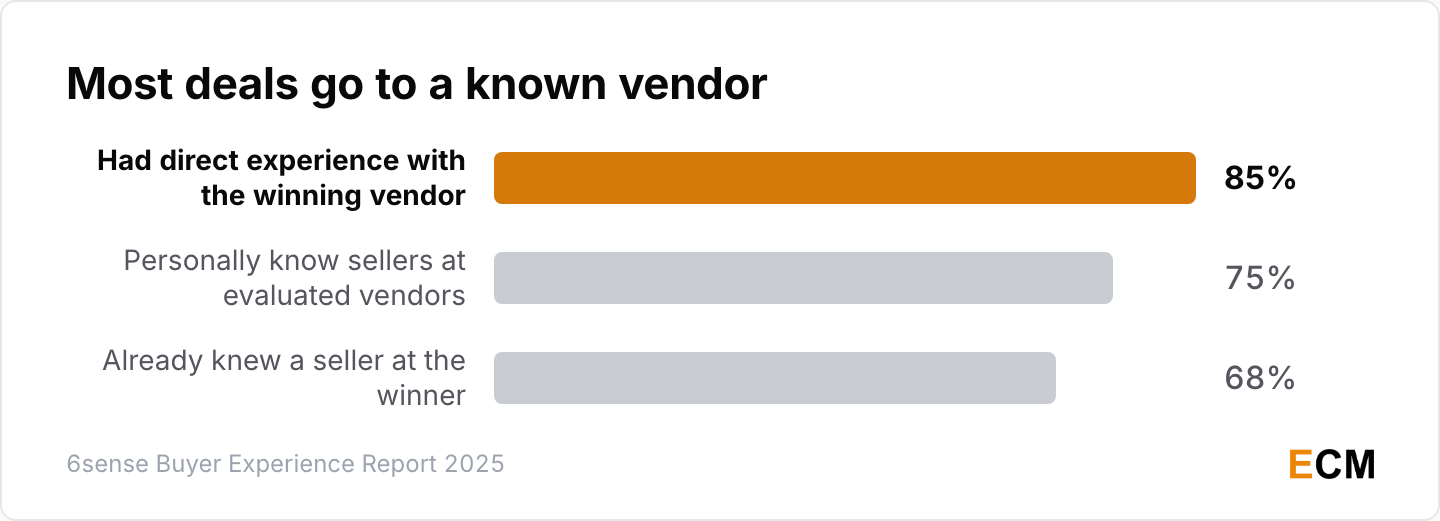
- In 85% of successful purchases, buyers had direct experience with the winning vendor, and they had prior experience with 3.8 of the vendors they evaluated (6sense, 2025).
- 75% of buyers personally know sellers at the vendors they evaluate, and 68% already knew a seller at the eventual winner (6sense, 2025).
- 78% of tech buyers shortlisted products they had heard of before starting research, 86% for enterprise buyers (TrustRadius, 2024).
- Vendors still put an average of 38% of discretionary marketing spend into brand awareness against 53% into demand generation (TrustRadius, 2024).
- Buyers had 16 interactions per person with the winning vendor, one fewer than in 2024 (6sense, 2025).
Stalled Purchases and Dissatisfied Buyers
Most B2B purchases stall, and most buyers end up unhappy with the vendor they picked.
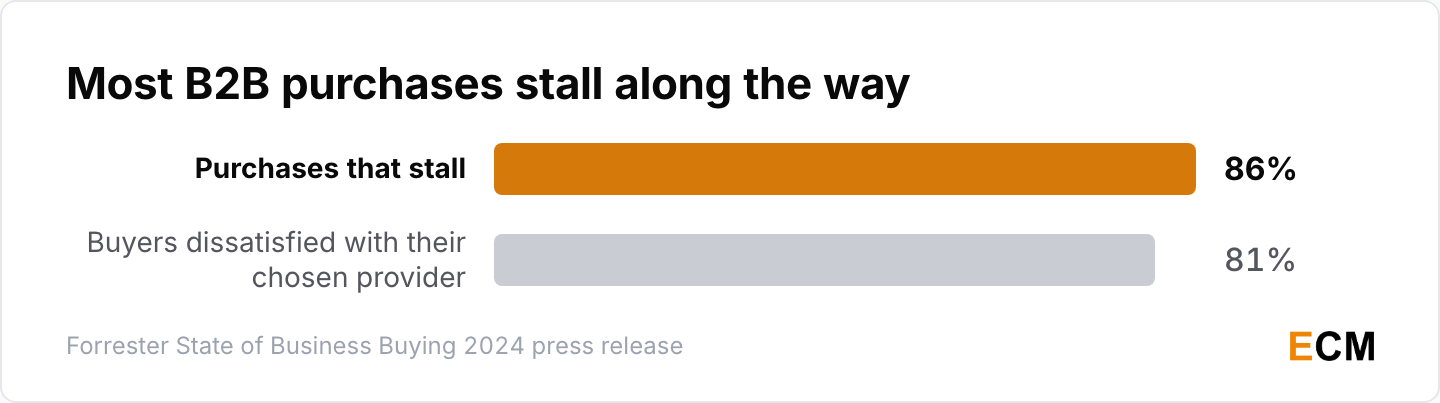
- 86% of B2B purchases stall during the buying process, and 81% of buyers are dissatisfied with their chosen provider (Forrester, 2024).
- 57% of software buyers expect a positive return within three months of purchase, and 11% expect it immediately (G2, 2024).
- 47% of enterprise tech buyers wish ROI were easier to calculate for budget approval, and 51% wish every vendor had transparent pricing (TrustRadius, 2024).
What B2B Selling Will Look Like in 2026
Buyers want proof before they commit, and Forrester expects AI agents to start negotiating on their behalf. The tooling side of that shift is in my martech statistics.
Trials Now Decide the Vendor
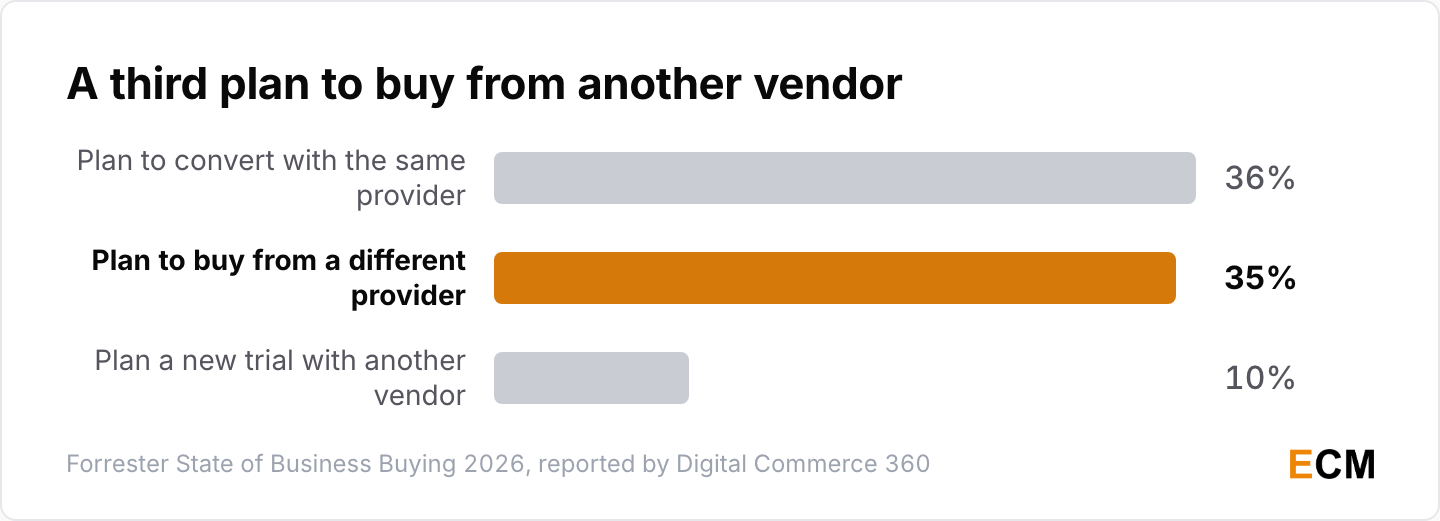
Buyers use trials to compare vendors, and a good share plan to buy elsewhere afterwards.
- More than 60% of buyers ran some form of trial before committing to a full purchase (Forrester via Digital Commerce 360, 2026).
- After a trial, 36% plan to convert with the same provider, 35% plan to buy from a different provider, and 10% plan a new trial with another vendor (Forrester via Digital Commerce 360, 2026).
- Forrester predicted that more than half of large B2B purchases of $1 million or more would go through digital self-serve channels in 2025 (Forrester, 2024).
Budgets, Deal Sizes and Buyer Agents
Spending intent is up, and sellers should expect to negotiate with software on the buyer’s side.
- 57% of software buyers expect their organization to spend more on technology over the next 12 months, 8 points more than in 2024 (G2, 2025).
- The median purchase in 6sense’s survey cost between $200,000 and $300,000 (6sense, 2025), and 12% of software buyers worked on a purchase over $1 million (G2, 2024).
- Forrester expects at least one in five B2B sellers in 2026 to respond to AI buyer agents with counteroffers from their own agents (Forrester, 2025).
Frequently Asked Questions
Is it true that 75% of B2B buyers use social media to make purchasing decisions?
The buyer surveys I rely on don’t show 75%. Tech buyers named YouTube (31%) and LinkedIn (16%) among their research sites, and enterprise buyers used LinkedIn at 30% (TrustRadius, 2024). Forrester expected more than 50% of younger buyers to rely on external sources, social media included, in 2025 (Forrester, 2024).
What is the rule of 7 in B2B?
It’s an old marketing rule of thumb that a prospect needs about seven touches before acting. Real B2B journeys run longer: buyers had 16 interactions per person with the winning vendor and evaluated 5.1 vendors on average (6sense, 2025).
What is the average purchase size from a B2B vendor?
For considered purchases it’s large. The median purchase in 6sense’s 2025 survey cost between $200,000 and $300,000 (6sense, 2025), and 12% of software buyers worked on a deal over $1 million (G2, 2024).
What will B2B selling look like in 2026?
More self-serve, more AI on both sides. Forrester expects at least one in five sellers to respond to AI buyer agents with counteroffers from their own agents in 2026, and 30% of buyers already treat genAI as a meaningful interaction at the final commit stage (Forrester, 2025). More than 60% of buyers trial before buying (Forrester via Digital Commerce 360, 2026).
How many stakeholders are involved in B2B purchasing decisions?
Forrester counts 13 internal stakeholders and 9 external participants per purchase (Forrester via Digital Commerce 360, 2026). Gartner puts the range at 5 to 16 people across up to four functions (Gartner, 2025). Tech buying groups are leaner: 96% have five or fewer members (TrustRadius, 2024).
Who are the typical B2B buyers and decision-makers?
Senior people with finance watching. 68% of respondents named C-suite leaders as decision-makers and 53% named procurement (Forrester via Digital Commerce 360, 2026), and 79% of software buyers say the CFO always or frequently holds final decision-making power (G2, 2024).
What content types and channels influence B2B buyers?
Search first, then peers and short content. Google is a research site for 78% of tech buyers (TrustRadius, 2024), and buyers rate short-form content (67%) and webinars (65%) as the most valuable formats (Demand Gen Report, 2024).
How has the B2B buying journey changed with AI?
Buyers now reach sellers earlier, at 61% of the journey instead of 69%, and 94% use LLMs along the way (6sense, 2025). AI chatbots are the top shortlist influence at 17.1% (G2, 2025). The vendor-side view is in my generative engine optimization statistics.
Written by
Editorial Staff
The Editorial Staff represents the writers, editors, and content creators who have worked (or work) at Elite Content Marketer. The experimenter-in-chief behind the team is Chintan Zalani, who has close to a decade of experience trying to make sense of the content marketing industry. Started in 2019, Elite Content Marketer is on a mission to help creators build sustainable businesses.
Related Articles
Marketing Data
60 Zero-Click Search Statistics for 2026: 68% No Click
60 zero-click search statistics for 2026: 68.01% of US Google searches end with no click, AI Overviews cut position 1 CTR 58%, publishers lost 33%.
Sep 12, 2026Read more →
Marketing Data
62 Martech Statistics 2026: Stack Size to ROI
62 martech statistics for 2026: 15,505 tools tracked, budgets at 7.8% of revenue, 49% of tools in use, and where AI agents fall short.
Sep 12, 2026Read more →
Marketing Data
51 LinkedIn Statistics 2026: Members to Revenue
51 LinkedIn statistics for 2026: 1.3B members, $19.8B in revenue, and 76% of B2B marketers naming it among the most effective thought leadership channels.
Sep 12, 2026Read more →