76% of executives now view agentic AI as more like a coworker than a tool (MIT Sloan Management Review and BCG, November 2025). Every brand voice AI decision below sits downstream of that shift.
60 Brand Voice AI Statistics for 2026: Trust and ROI
 Written by Editorial Staff
Key Takeaways
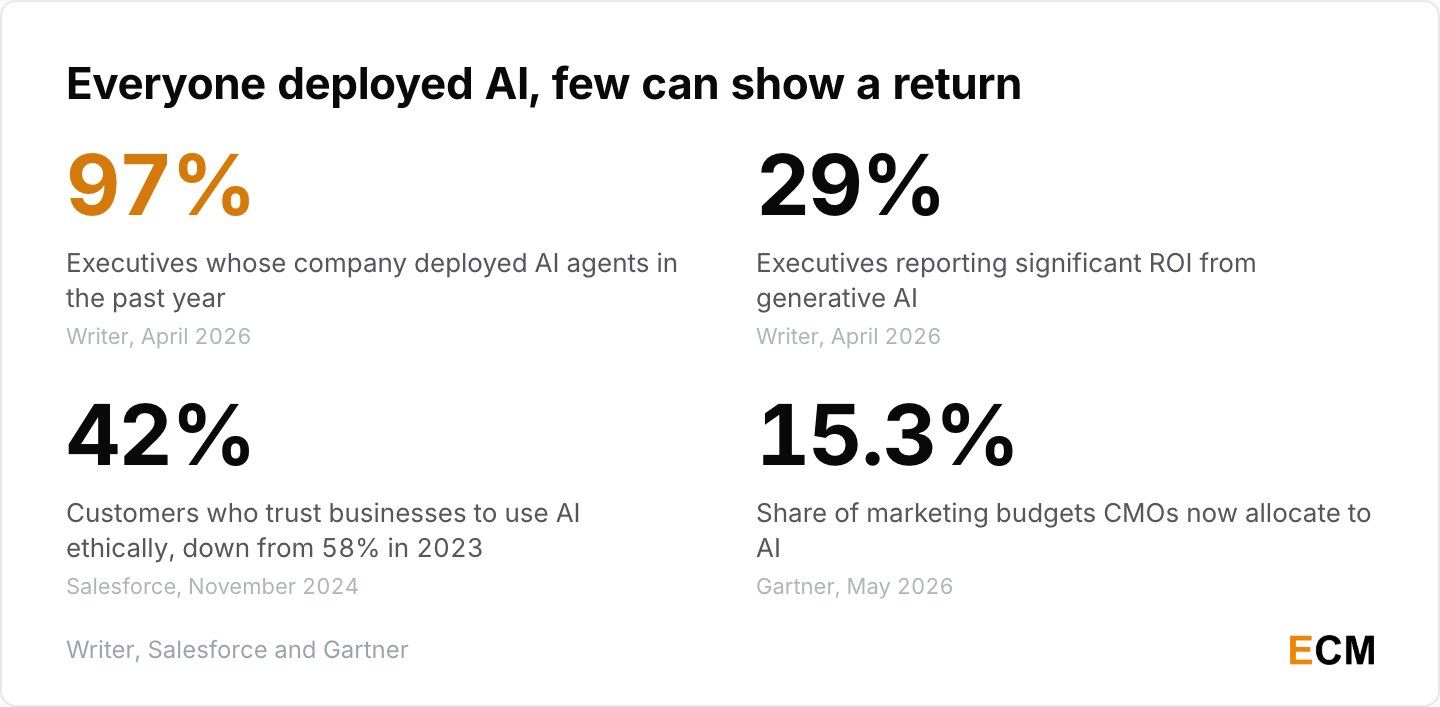
- Deployment is universal, returns aren’t. 97% of executives say their company deployed AI agents in the past year, yet only 29% report significant ROI from generative AI and 23% from agents (Writer, April 2026, 2,400 knowledge workers).
- The job changed shape. 76% of executives now view agentic AI as more like a coworker than a tool, and 35% of companies are already exploring it (MIT Sloan Management Review and BCG, November 2025, 2,102 executives).
- Consumer trust is the constraint. Trust that businesses use AI ethically fell from 58% to 42% in a year (Salesforce, November 2024, 16,585 respondents), and nearly 75% of consumers want to know when they’re talking to an AI agent (Salesforce, October 2024).
- The money moves anyway. CMOs now put 15.3% of marketing budgets into AI while only 30% report mature AI readiness (Gartner, May 2026, 401 marketing leaders).
- Brand tuning is cheap to start. A Firefly custom model trains on 10 to 20 brand images (Adobe, March 2024), and a commissioned Forrester study projects 70% to 80% more asset variants from Adobe’s offerings (Adobe, March 2025).
- The refusal is a real position. Dove pledged never to use AI to represent real women (Unilever, April 2024) and iHeartMedia banned AI voices across its stations (Billboard, November 2025).
- Volume isn’t attention. Around 90,000 fully AI-generated tracks reach Deezer daily, over 50% of uploads, yet they draw 1% to 3% of streams (Deezer, July 2026).
Enterprise AI Adoption And Brand Voice
Adoption is settled. What leadership installed and what marketers actually use in the workflow are still two different numbers.
Agents Are Deployed Almost Everywhere
Deployment stopped being the interesting question somewhere in 2025. The gap now sits between the boardroom and the desk.
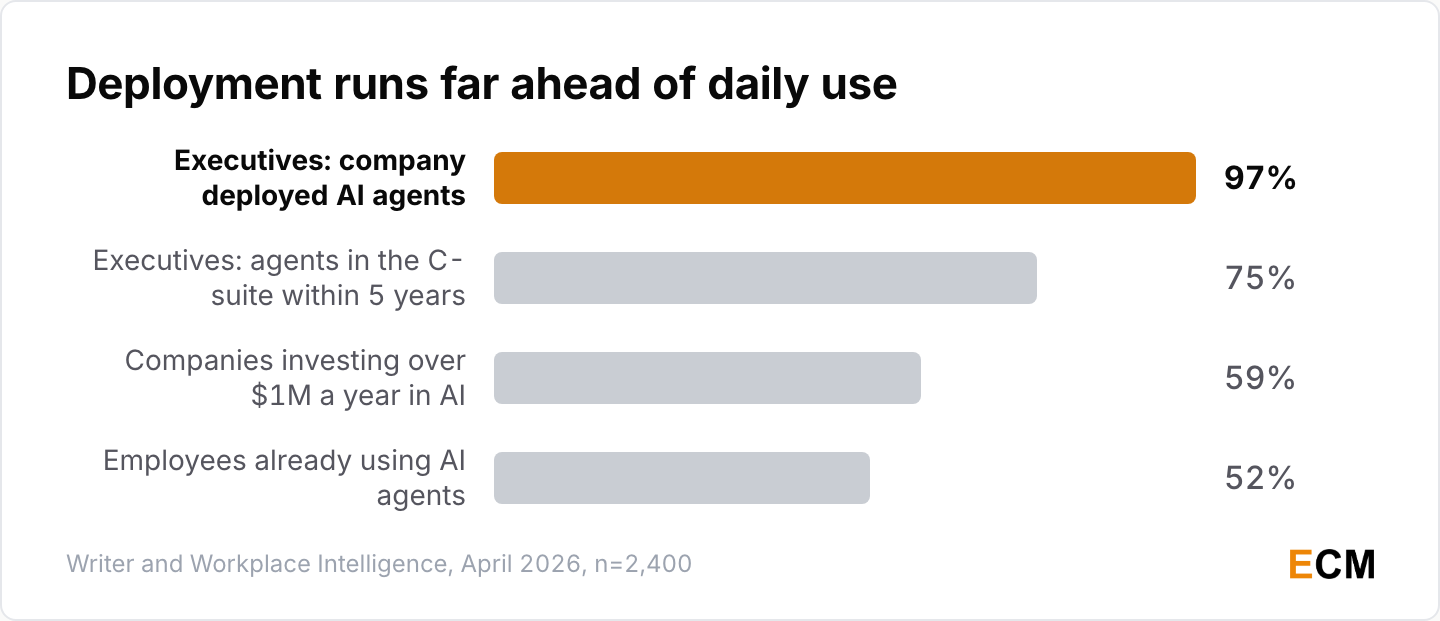
- Executives report near-total deployment while employees lag well behind: 97% of executives say their company deployed AI agents in the past year, against 52% of employees who already use them (Writer, April 2026, 2,400 knowledge workers across six markets, fielded December 2025 to January 2026).
- Spending and expectations both run ahead of use, with 59% of companies investing over $1 million a year in AI and 75% of executives expecting AI agents in their company’s C-suite within five years (Writer, April 2026).
- The agentic wave arrived fast on its own terms: 35% of companies are already exploring agentic AI and another 44% plan to deploy it soon (MIT Sloan Management Review and BCG, November 2025, 2,102 executives across 21 industries and 116 countries).
- The framing shifted with it. 76% of executives view agentic AI as more like a coworker than a tool, which is the moment brand rules stop living in a prompt (MIT Sloan Management Review and BCG, November 2025).
Where The ROI Actually Lands
I’d set expectations here. Almost everyone deployed, and almost nobody can point at a return yet.
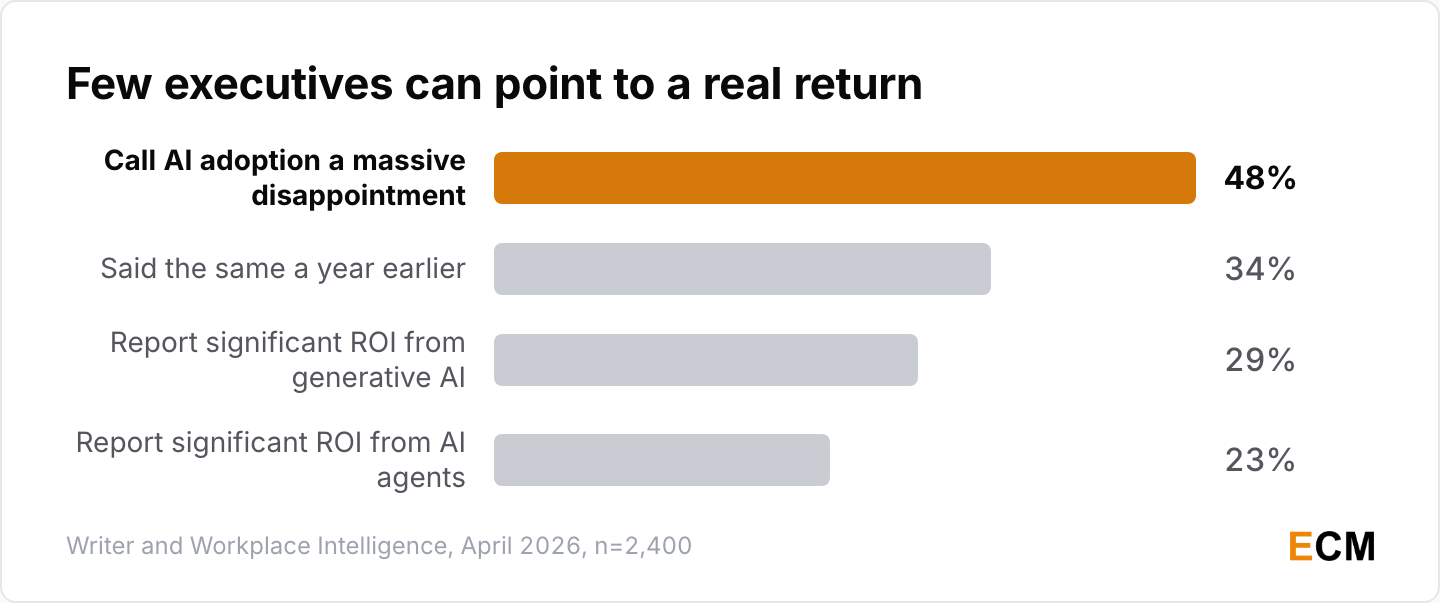
- Returns are thin at the top: 29% of executives report significant ROI from generative AI and 23% from AI agents, while 48% call AI adoption a massive disappointment, up from 34% a year earlier (Writer, April 2026).
- 79% of executives acknowledge struggling with lagging ROI, strategy gaps and internal power struggles, and 75% admit their company’s AI strategy is more for show than actual internal guidance (Writer, April 2026).
- Where CMOs do bank a return it is efficiency, not growth: 49% cite improved time efficiency, 40% cost efficiency and 27% capacity to produce more content (Gartner, May 2025, 402 marketing leaders).
Hours AI Gives Teams Back
Time saved is the one benefit marketers agree on, and it lands very unevenly across the same team.
- Roughly a third of marketing teams save 10 to 14 hours a week with AI, another third save over 15 hours, and just under a third save one to nine (HubSpot, 2026, over 1,500 global marketers).
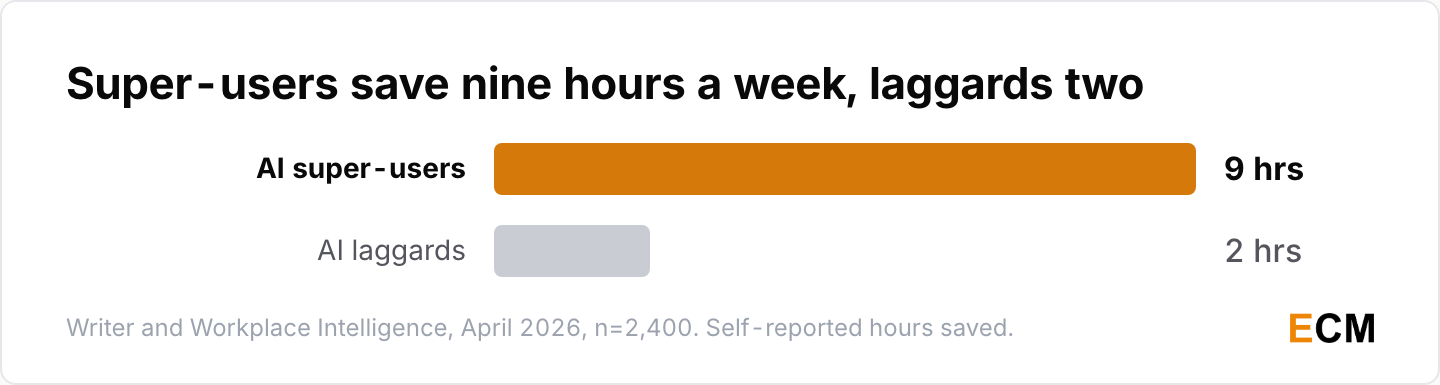
- The spread between operators beats the spread between companies: 87% of leaders say AI super-users are at least five times more productive, and those super-users save nearly 9 hours a week against 2 hours for laggards (Writer, April 2026).
- Marketers don’t read any of this as replacement: 73.4% say they see AI working in conjunction with marketers, assisting them across most job duties (HubSpot, 2026).
Why AI Content Sounds Generic
Three causes of off-brand output show up in the data, and none of them is the model itself.
Channel Sprawl And Voice Drift
More surfaces means more chances to drift off-brand. Channel sprawl is the mechanical cause behind most tone of voice complaints.
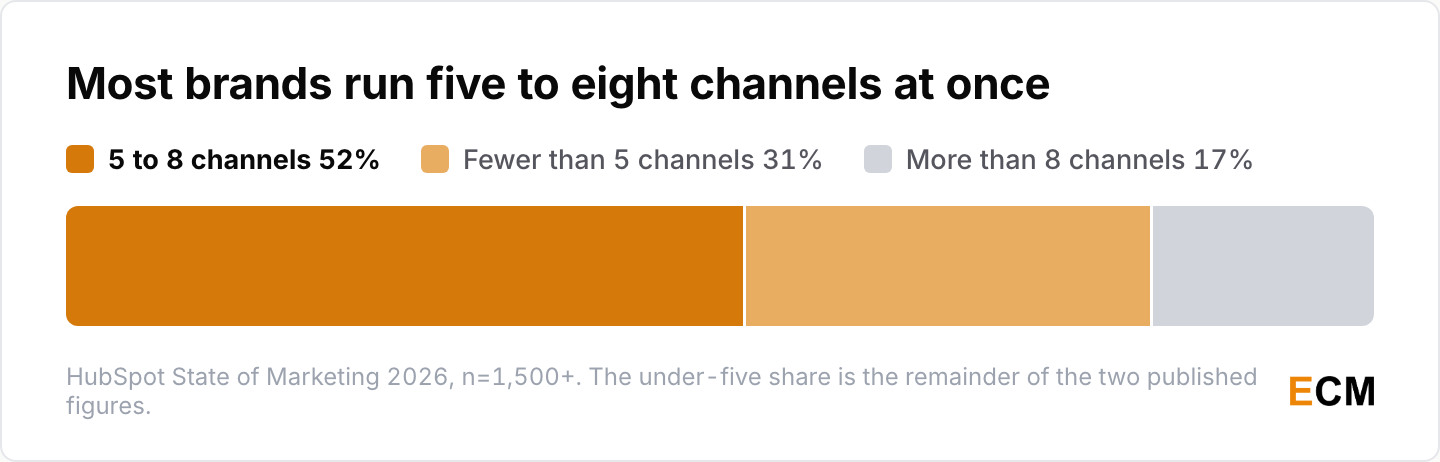
- Most brands are writing for a lot of places at once: 52% run five to eight marketing channels simultaneously and 17% operate more than eight (HubSpot, 2026).
- Customers notice the inconsistency before they notice the quality, with 69% of consumers expecting consistent interactions across departments (Salesforce, October 2024).
Nobody Owns The Output
Generic copy is an ownership problem more than a model problem. Nobody signs off the content creation workflow end to end.
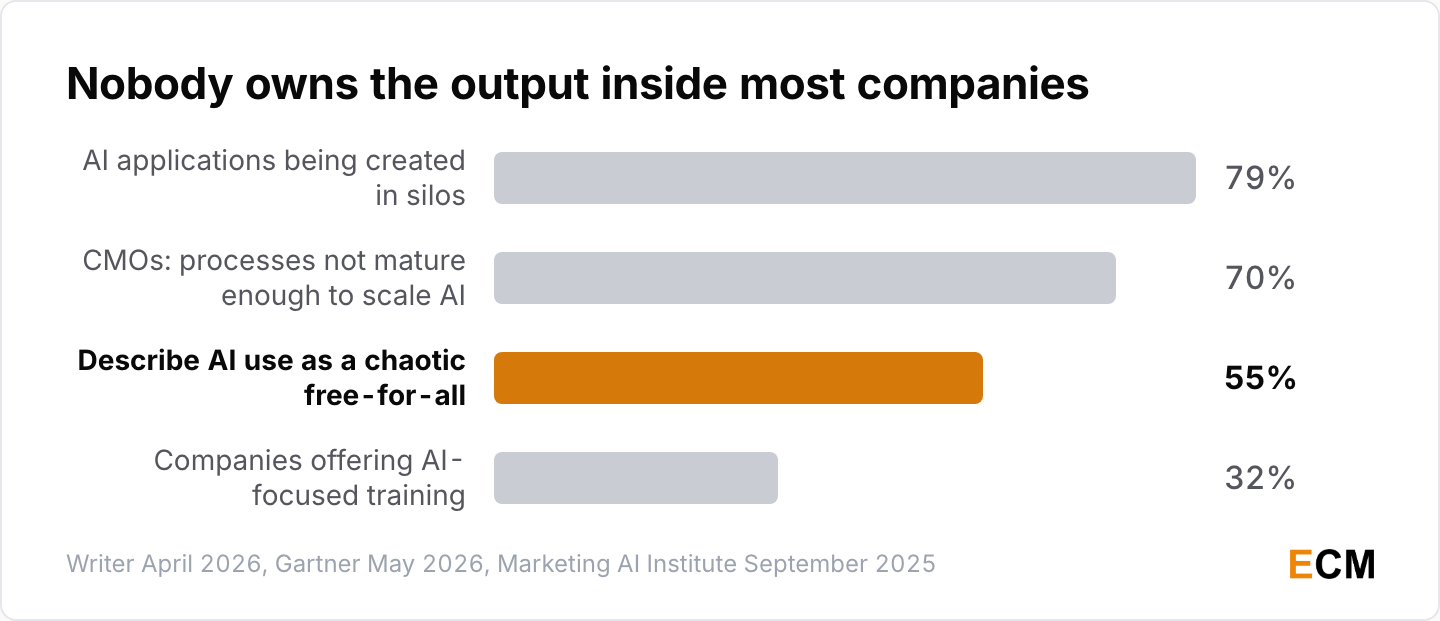
- Inside the enterprise the work is scattered: 55% describe AI use at their company as a chaotic free-for-all and 79% say AI applications are being created in silos (Writer, April 2026).
- Only 32% of marketers say their company offers AI-focused education and training (Marketing AI Institute, September 2025, about 1,900 respondents).
- Process maturity is the admitted bottleneck, with 70% of CMOs saying their internal marketing processes aren’t yet mature enough to implement and scale AI (Gartner, May 2026).
Teams Reach For General Chatbots
Budget flows to general-purpose assistants rather than brand-tuned systems, which is exactly where generic blog posts and landing pages come from.
- The single biggest planned increase in 2026 marketing investment is AI chatbots like ChatGPT, Perplexity, Gemini and Claude, named by 37.7% of marketers (HubSpot, 2026).
- Custom assistants were briefly a mass-market idea: users built over 3 million custom versions of ChatGPT in the two months between the feature launch and the GPT Store opening (OpenAI, January 2024). No newer company figure has been published since.
Brand Tuned AI Tools And Funding
The technical barrier to on-brand generation fell years ago. Watch where the money and the named customers go instead.
How Little Training Data Models Need
You don’t need a corpus to generate on-brand work. You need a decision about which twenty assets carry your unique voice.
- Adobe fine-tunes a Firefly custom model on 10 to 20 brand images (Adobe, March 2024), and states that enterprise content is never used to train its foundational Firefly models (Adobe, 2026).
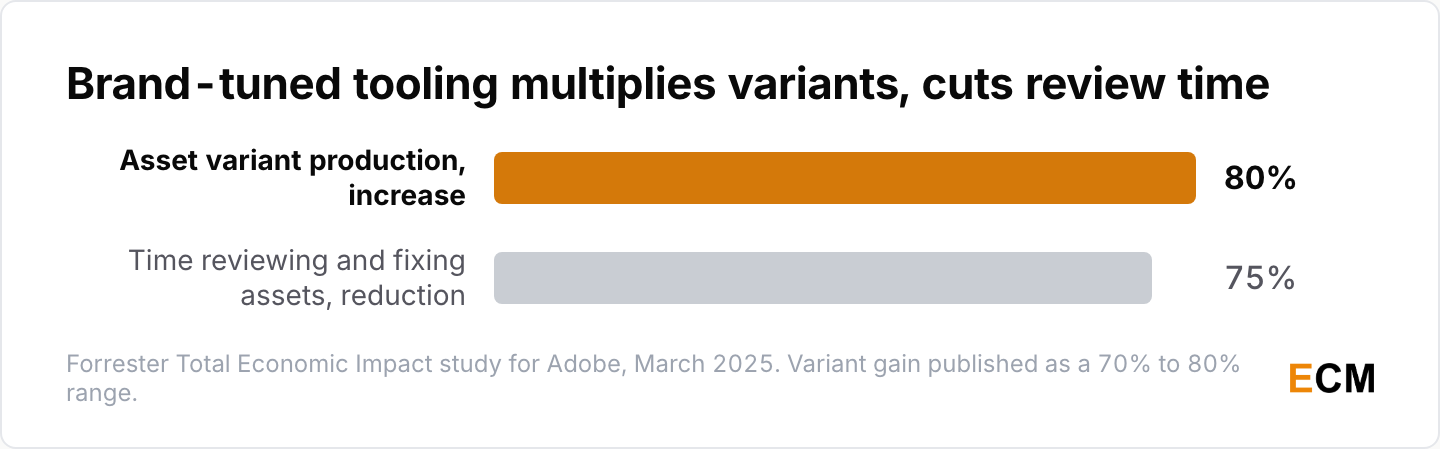
- Forrester’s commissioned Total Economic Impact study of Adobe’s Firefly offerings projects a composite enterprise scaling asset variant production by 70% to 80% while cutting time spent reviewing and fixing assets by as much as 75% over three years (Adobe, March 2025).
- Design systems are becoming an input too. Claude Design reads a team’s codebase and design files during onboarding, then applies that team’s colors, typography and components to every project, running on Claude Opus 4.7 (Anthropic, April 2026).
Money Flowing Into Brand AI
Valuations tell you where investors think brand-controlled generation is heading, which is up and to the enterprise.
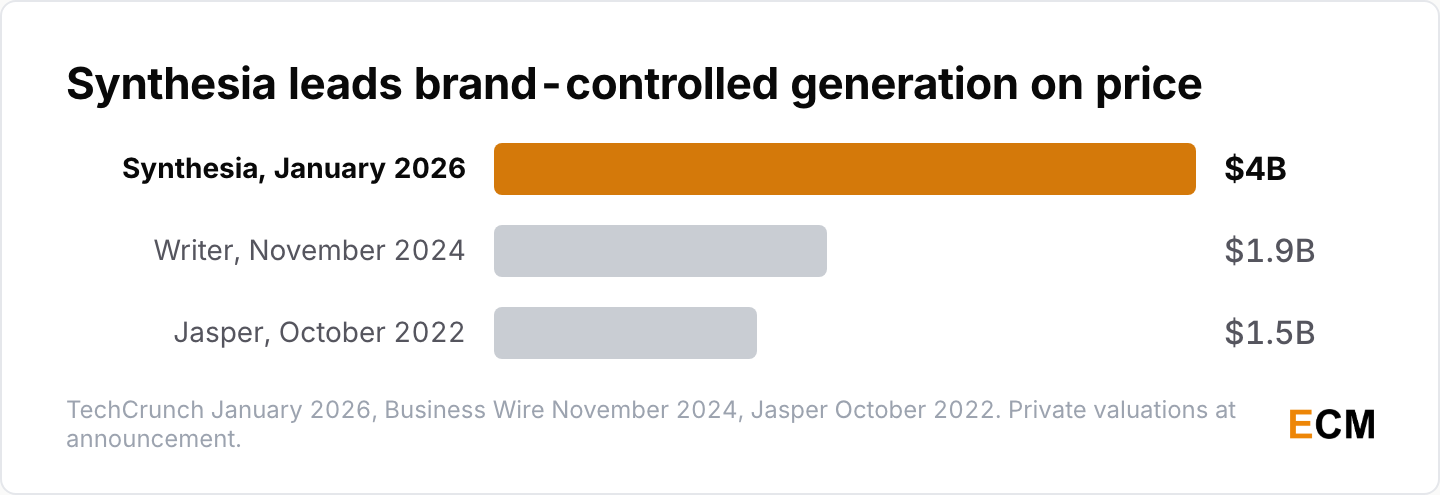
- Synthesia raised a $200 million Series E in January 2026 at a $4 billion valuation, up from $2.1 billion a year earlier, led by GV (TechCrunch, January 2026).
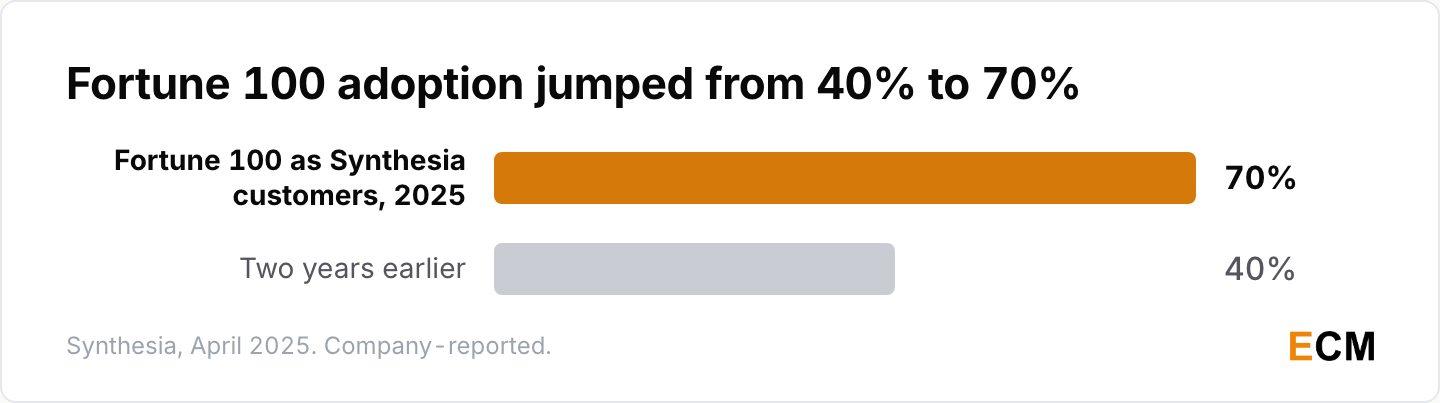
- The revenue behind that price: Synthesia crossed $100 million in ARR in April 2025 and reports more than 70% of the Fortune 100 as customers, up from 40% two years earlier (Synthesia, April 2025).
- Writer raised $200 million at a $1.9 billion valuation in November 2024, naming Accenture, Intuit, L’Oreal, Salesforce, Uber and Vanguard as customers (Business Wire, November 2024).
- Jasper, the first mover on the feature itself, raised a $125 million Series A at a $1.5 billion valuation in October 2022 (Jasper, October 2022) and shipped Jasper Brand Voice the following April (Jasper, April 2023).
Who Is Actually Deploying It
The named adopters are what I’d read here. These are brand-guideline businesses creating content at scale, not technology companies.
- Adobe names Accenture, Dentsu, Henkel, IPG Health, Monks, PepsiCo/Gatorade, Publicis, Stagwell and The Estée Lauder Companies among the businesses and agencies working with Firefly and Custom Models (Adobe, March 2025).
- Synthesia reports more than 65,000 businesses on the platform, and went from 40% of the Fortune 100 as customers to more than 70% in two years (Synthesia, April 2025).
Consumer Trust In AI Content
Disclosure, not quality, is where consumers draw the line on authenticity. Question wording moves every number below, so each carries its own.
What Consumers Want Disclosed
One demand survives every rephrasing: tell me when it is a machine.
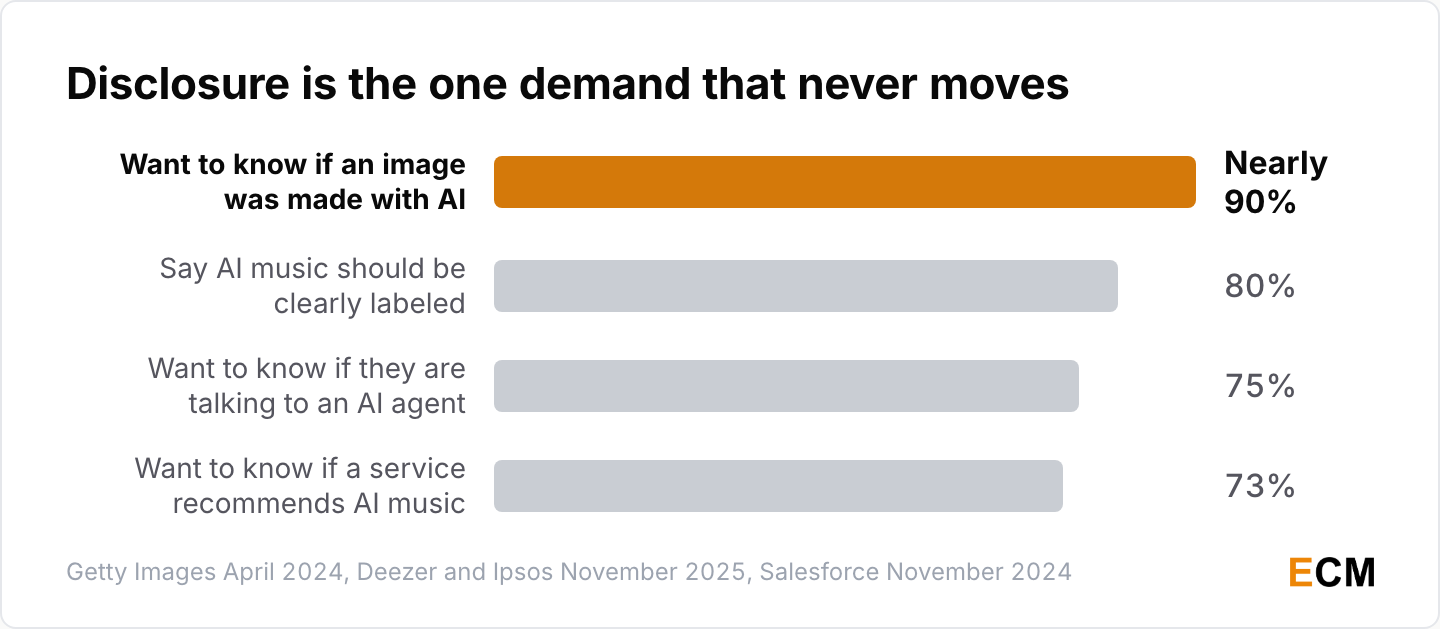
- Nearly 90% of consumers globally want to know whether an image was created using AI (Getty Images, April 2024, over 30,000 adults across 25 countries).
- Nearly 75% of consumers want to know if they’re communicating with an AI agent, 45% are more likely to use one with a clear escalation path and 44% if its logic is explained (Salesforce, October 2024).
- In music the same instinct holds: 80% say fully AI-generated music should be clearly labeled to listeners and 73% want to know if a streaming service is recommending it (Deezer, Ipsos, November 2025, 9,000 people across 8 countries).
- Getty also found people feel less favorably toward brands using AI-generated visuals to create people or products, with healthcare, financial services and travel the sectors where transparency is most expected (Getty Images, April 2024).
Trust In Brands Versus Institutions
Brands start from a better position than they think, and AI is how they spend it down.
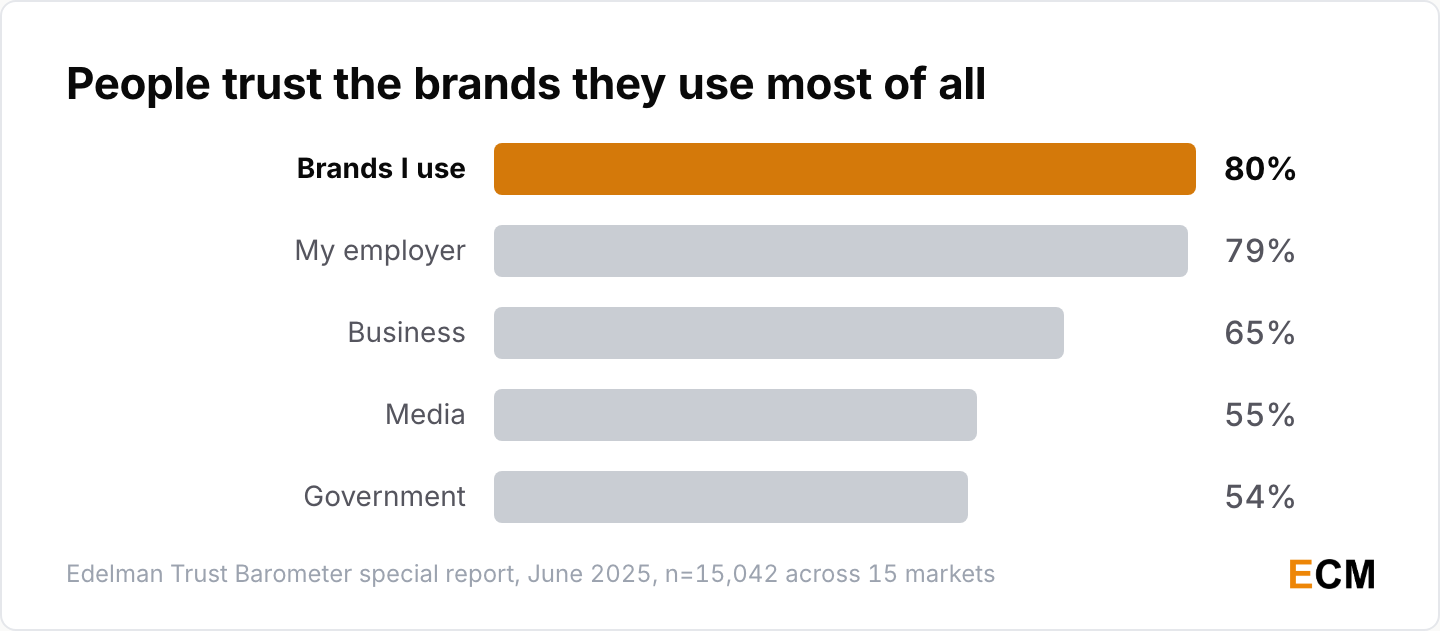
- Brands lead the trust table: 80% of people trust the brands they use, just ahead of their employer at 79% and well clear of business at 65%, media at 55% and government at 54% (Edelman, June 2025).
- That trust is conditional on sounding like a participant in culture: asked which would be more effective at increasing their trust in a brand, 73% picked one that authentically reflects today’s culture over the 27% who picked one that ignores culture and sticks to its products (Edelman, June 2025).
- Trust in the companies behind the AI is going the other way: 72% of consumers trust companies less than they did a year ago and 65% feel companies are reckless with customer data (Salesforce, October 2024).
- The ethics reading is the sharpest fall, and the slide started before the agent era. Trust that businesses use AI ethically dropped from 58% in 2023 to 42% in 2024 (Salesforce, November 2024), after openness to AI had already fallen to 51% of consumers from 65% in 2022 (Salesforce, August 2023).
Generational And Regional Trust Gaps
Where you sell changes the answer more than what you sell does.
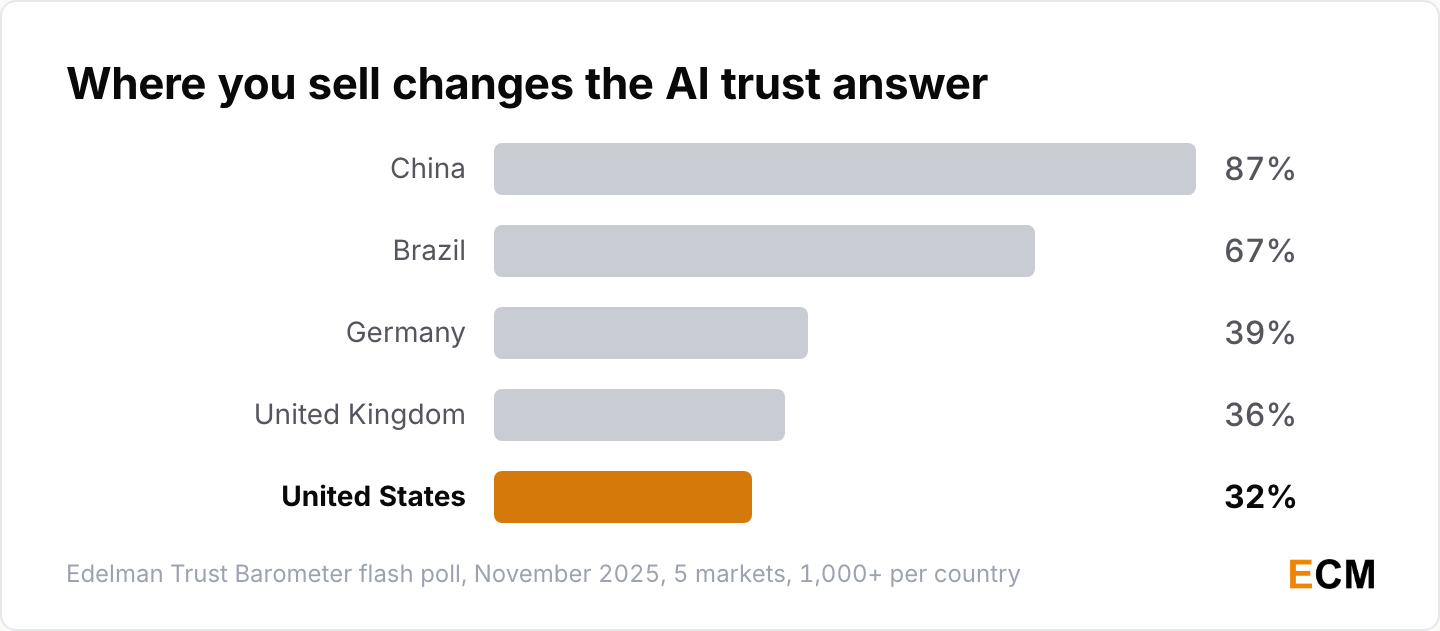
- National trust in AI ranges enormously: China 87%, Brazil 67%, Germany 39%, the UK 36% and the US 32% say they trust artificial intelligence (Edelman, November 2025).
- Age splits the base: 37% of 18 to 30 year olds trust AI companies with their data against 27% of those aged 50 and over (Attest, March 2025, US, UK, Canada and Australia).
- Trust in AI output is climbing slowly from a low base: 43% of consumers would trust information from an AI chatbot or tool, up from 40% a year earlier, rising to 68% among people who already use generative AI, of whom 14% trust it completely (Attest, March 2025).
- An early reading ran far ahead of all of these: 73% of consumers said they trusted content created by generative AI (Capgemini, June 2023, 10,000 consumers in 13 countries). No survey since has reproduced that number.
Brands Publicly Refusing Generative AI
Two companies have made refusal itself the message, and both published the research behind it.
Dove And The Beauty Pledge
Dove went first, and tied the position to a number about harm rather than a number about quality.
- Dove committed in April 2024 to never use AI-generated content to represent real women in its advertising, on the twentieth anniversary of Real Beauty (Unilever, April 2024).
- The research behind it covered 33,000 people across 20 countries and found 1 in 3 women feel pressure to alter their appearance because of what they see online, even when they know the images are fake or AI-generated (Dove, 2024).
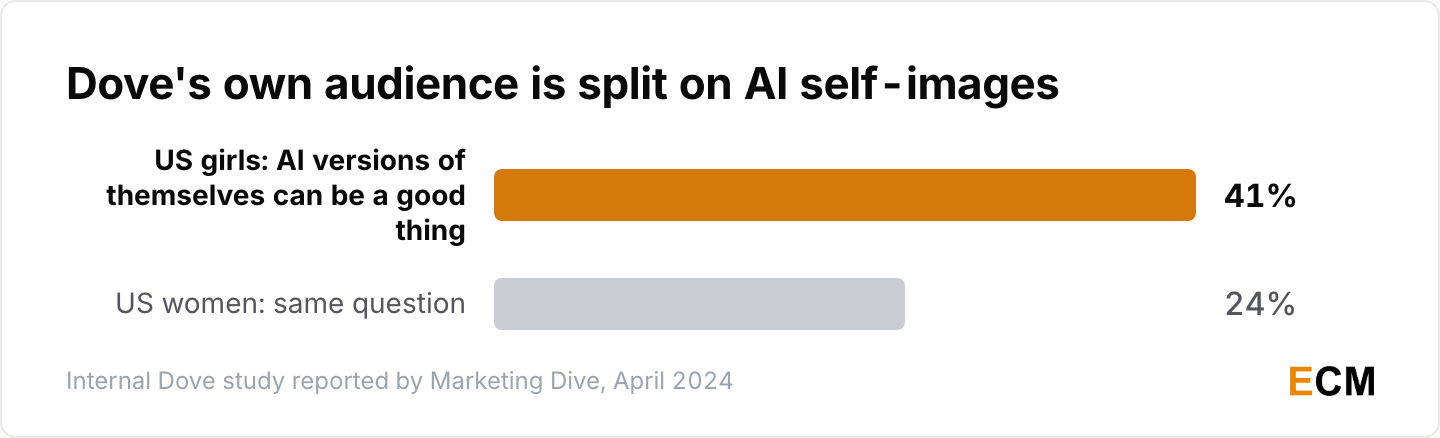
- The position isn’t universally popular inside its own audience. An internal Dove study found 24% of US women and 41% of US girls agreed that using AI to create different versions of themselves can be a good thing (Marketing Dive, April 2024).
iHeartMedia Guaranteed Human Policy
The radio group went further and turned the refusal into an on-air identity, which is a brand voice decision in the most literal sense.
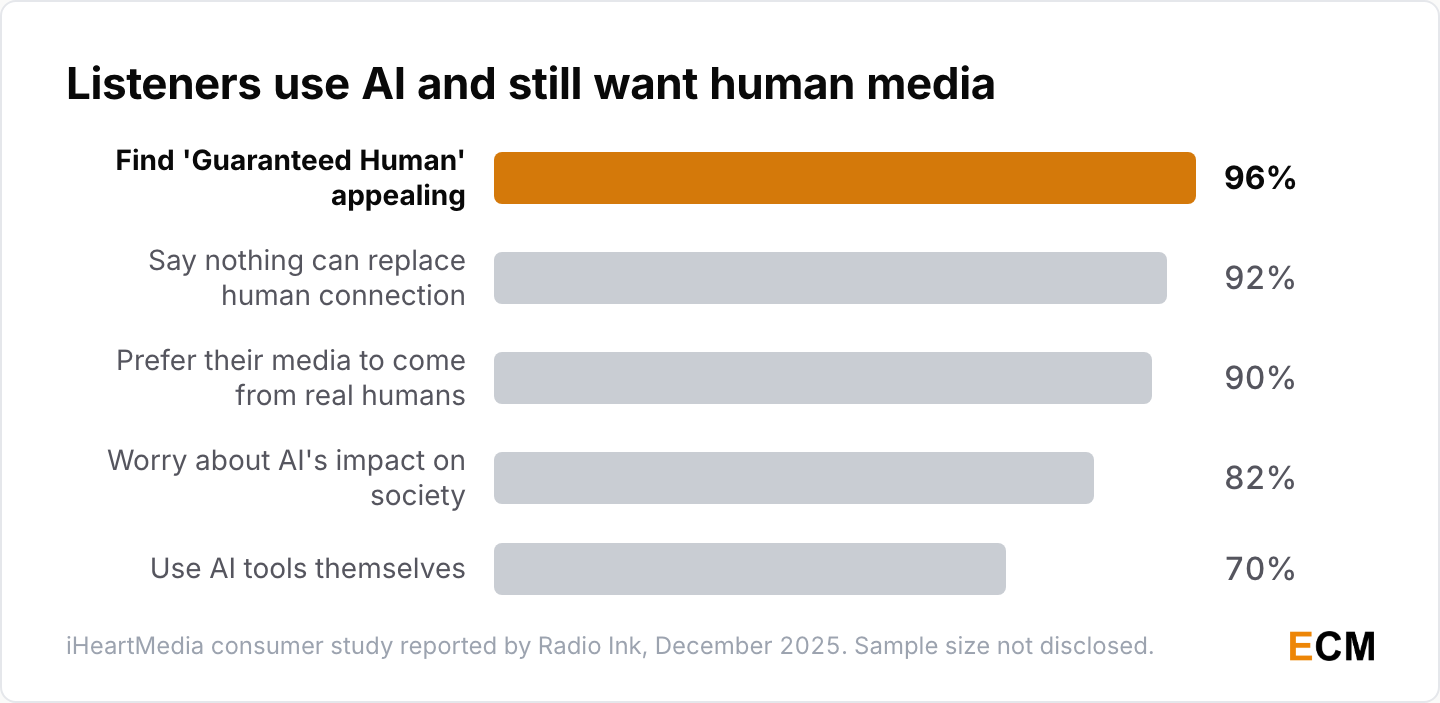
- iHeartMedia banned AI-generated personalities and synthetic vocalists across its portfolio from 24 November 2025, adding a Guaranteed Human line to hourly legal IDs at every station (Billboard, November 2025).
- The consumer research it cited: 70% of consumers use AI tools, but 90% prefer their media to come from real humans and 96% find the Guaranteed Human idea appealing (Radio Ink, December 2025).
- The same research put 92% saying nothing can replace human connection, up from 76% in 2016 (Billboard, November 2025), with 82% worried about AI’s impact on society (iHeartMedia, 2025).
- The ban is narrower than the headline. It doesn’t stop staff using AI behind the scenes for scheduling, analytics, research or editing (Radio Ink, December 2025).
- Not everyone in the industry agrees. Saga Communications uses AI-replicated human voices for imaging across its 113 stations while keeping human air staff (Radio Ink, December 2025).
Listeners Cannot Tell The Difference
The awkward part of the refusal case is that audiences fail the blind test, and the supply side has already tipped.
- In a blind test with two AI songs and one real one, 97% of listeners could not tell fully AI-generated music from human-made music (Deezer, Ipsos, November 2025, 9,000 people across 8 countries).
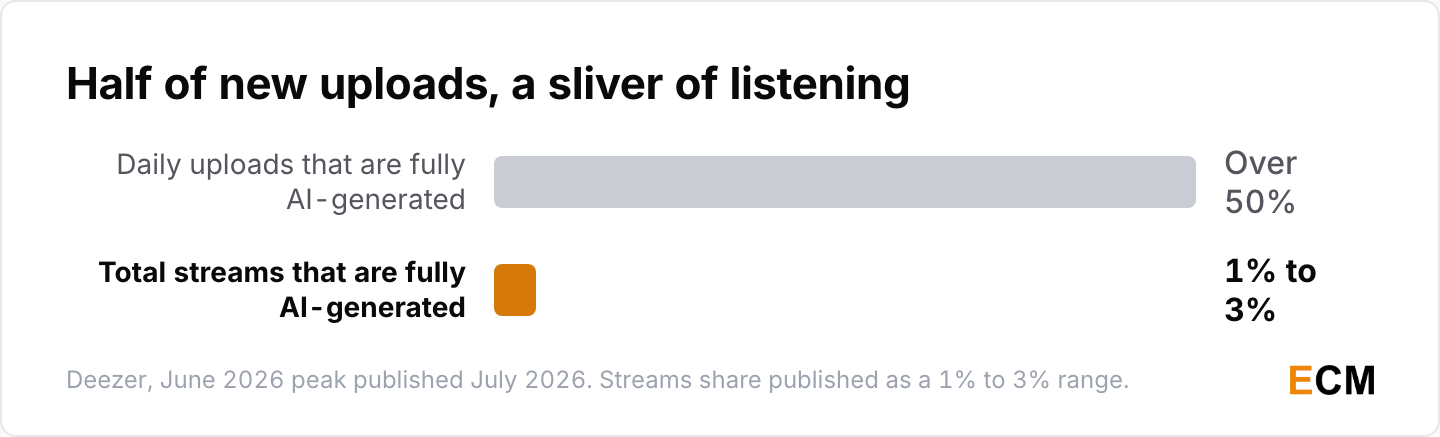
- Supply has already tipped: around 90,000 fully AI-generated tracks reach Deezer every day, more than 50% of all daily uploads at peak in June 2026, after 13.4 million were detected and tagged across 2025 (Deezer, July 2026).
- Attention didn’t follow supply. Fully AI-generated music draws between 1% and 3% of total streams, because detected tracks are kept out of algorithmic recommendations and editorial playlists (Deezer, July 2026).
- Listeners also want it kept apart, with 52% saying fully AI-generated songs should not sit alongside human-made songs in the main charts (Deezer, Ipsos, November 2025).
Governance Gaps Behind AI Velocity
Policy and workflow structure are catching up from a low base, and slower than deployment is moving.
Policy Coverage Lags Adoption
Every governance line is rising and every one of them is still a minority practice.
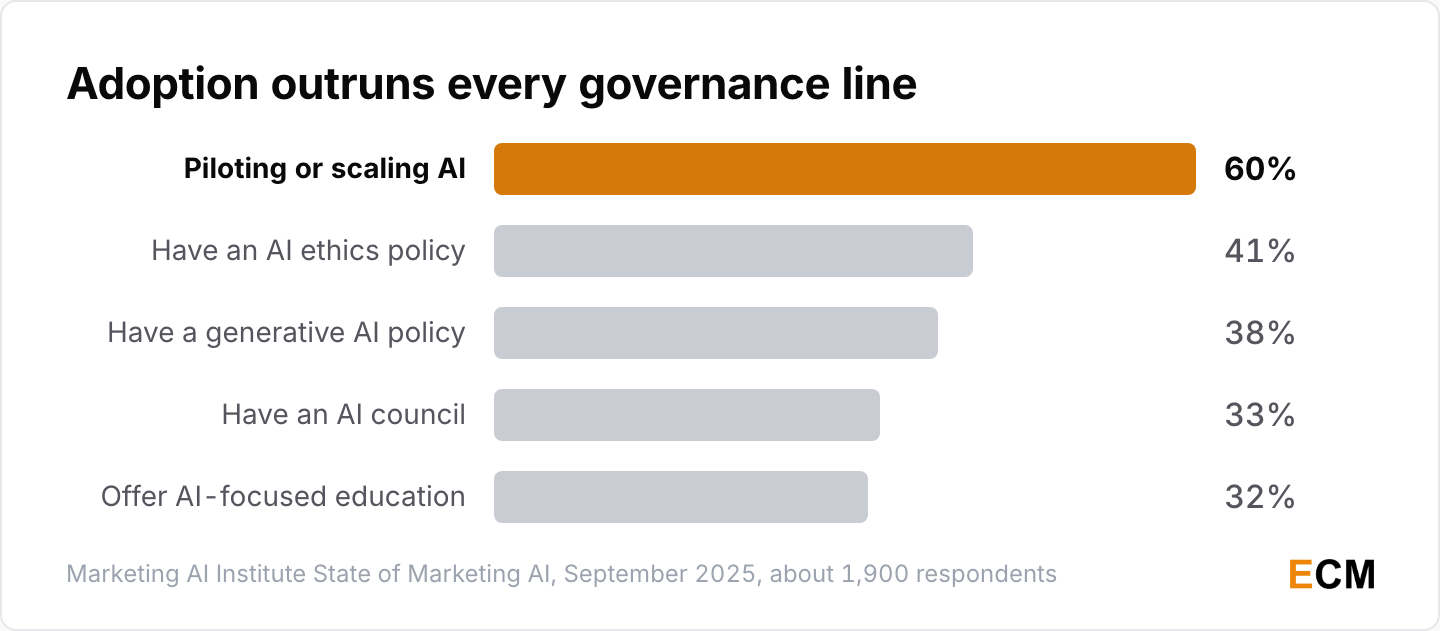
- Governance coverage remains minority practice: 41% of organizations have an AI ethics policy, 38% have a generative AI policy, 33% have an AI council and 32% offer AI-focused education (Marketing AI Institute, September 2025, about 1,900 respondents). Every one of those lines sat lower in the previous edition (Marketing AI Institute, September 2024).
- Meanwhile 60% of teams are piloting or scaling AI, an 18 point jump since 2023 (Marketing AI Institute, September 2025). Governance isn’t keeping pace with that curve, which is the whole of AI content governance as a discipline.
- Buyer confidence in vendors is moving the wrong way: satisfaction with security and data governance in vendors dropped 17 points in a year (Writer, April 2026).
Data Leaks From Unapproved Tools
This is the risk that shows up in incident reports rather than in slide decks.
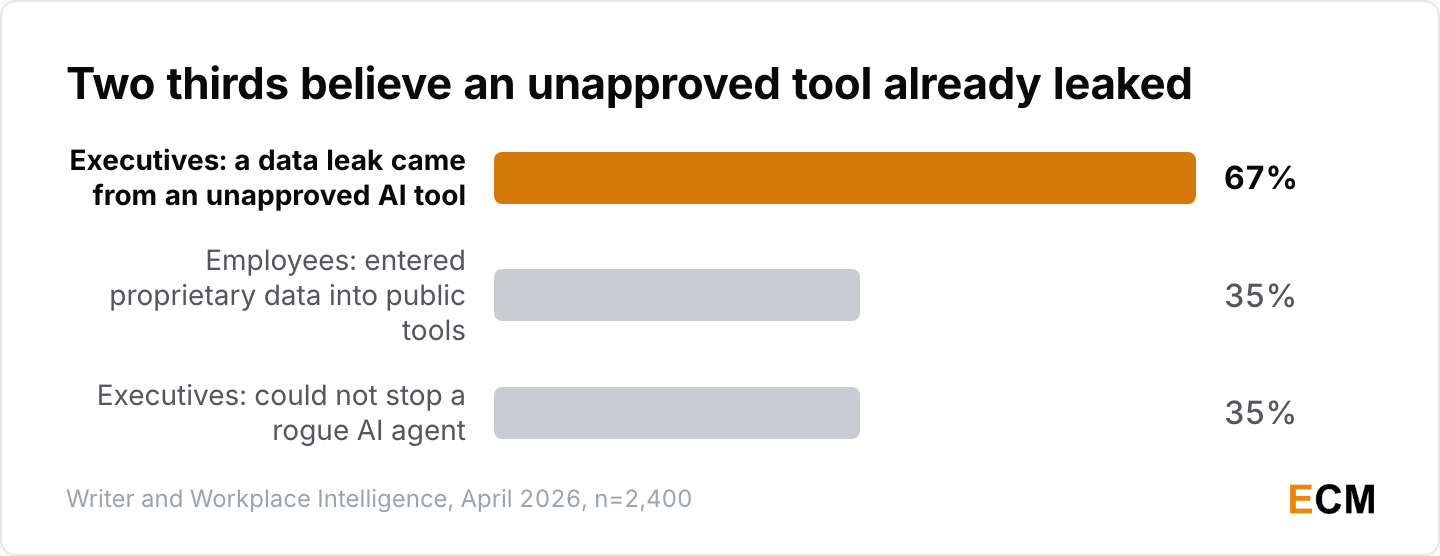
- 67% of executives believe their company has already suffered a data leak or security breach because an employee used an unapproved AI tool (Writer, April 2026).
- 35% of employees admit entering proprietary information into public AI tools, and 35% of executives say they could not immediately pull the plug on a rogue AI agent (Writer, April 2026).
- The authority question is moving faster than the controls. 250% more respondents expect AI to have greater decision-making authority within three years (BCG, November 2025), which is why human in the loop content marketing stopped being optional.
Budgets Flat While AI Absorbs Spend
The money for brand-tuned AI isn’t new money. It comes out of the same flat budget as everything else.
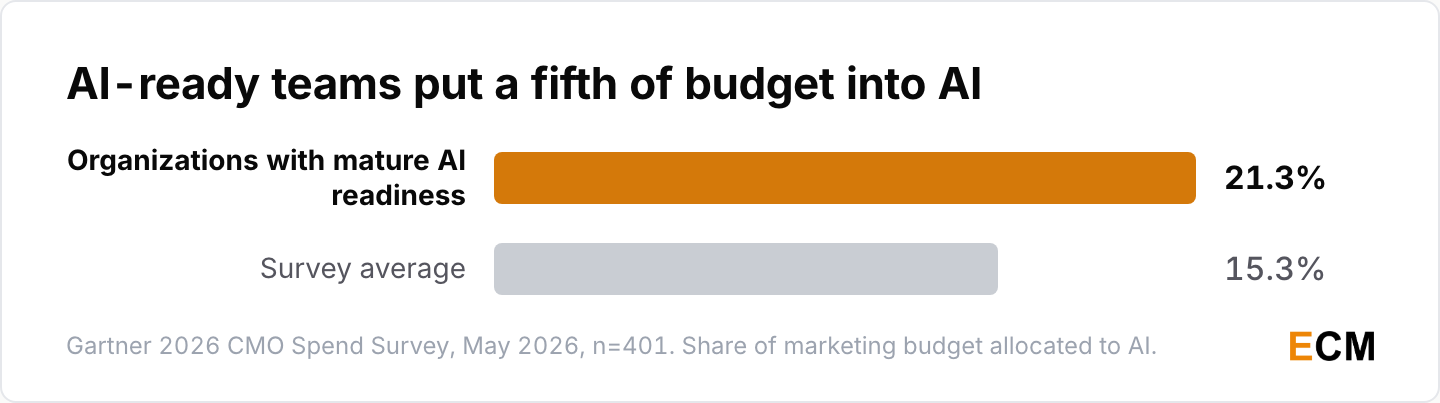
- CMOs allocate an average 15.3% of marketing budgets to AI initiatives, while organizations reporting mature AI readiness allocate 21.3% (Gartner, May 2026, 401 marketing leaders).
- Overall budgets barely moved, rising to 7.8% of company revenue in 2026 from 7.7% in 2025, with AI-ready organizations running at 8.9% (Gartner, May 2026).
- Ambition outruns readiness by a wide margin: 70% of CMOs call becoming an AI leader a critical goal for 2026, but only 30% report mature or fully developed AI readiness, and 56% say they lack the budget to deliver the 2026 strategy (Gartner, May 2026).
- The cuts land on people and partners. 39% of CMOs planned to cut agency budgets and 39% to reduce labor spending, with 22% saying generative AI let them reduce reliance on external agencies for creativity and strategy (Gartner, May 2025, 402 marketing leaders).
Frequently Asked Questions
How do you train AI to sound like your brand?
With fewer assets than you expect. Adobe fine-tunes a Firefly custom model on 10 to 20 brand images (Adobe, March 2024), and Claude Design builds a design system by reading a team’s existing codebase and design files rather than a written brief (Anthropic, April 2026). The hard part is choosing which assets represent you, not gathering volume.
How can AI keep brand voice consistent across channels?
By making tone and style a system input rather than a prompt, so output stays consistent as channels multiply. 52% of brands run five to eight channels at once and 17% run more than eight (HubSpot, 2026), which is more surfaces than a style guide survives. Customers notice: 69% expect consistent interactions across departments (Salesforce, October 2024).
Why does AI-generated content sound generic?
Because most teams are pointing a general-purpose assistant at a brand problem. 37.7% of marketers name AI chatbots as their biggest planned 2026 investment (HubSpot, 2026), while 55% describe internal AI use as a chaotic free-for-all and 79% say applications are built in silos (Writer, April 2026). Unowned output converges on the average.
How do you measure ROI on brand voice AI?
Start with time, because that is where the measurable return sits. 49% of CMOs report ROI through time efficiency and 40% through cost efficiency (Gartner, May 2025). Only 29% of executives report significant ROI from generative AI overall (Writer, April 2026), so a claim of revenue lift needs unusually good evidence.
What mistakes do brands make most with AI content?
Three, in order of cost. Skipping disclosure, when nearly 90% of consumers want to know an image is AI (Getty Images, April 2024). Skipping training, offered by only 32% of companies (Marketing AI Institute, September 2025). And skipping controls, with 67% of executives believing an unapproved tool already leaked data (Writer, April 2026).
Where should humans and AI split the work?
Humans keep judgement, AI takes repetition. 73.4% of marketers say AI assists rather than replaces across most duties (HubSpot, 2026), and the productivity gap is between operators rather than tools, with 87% of leaders saying super-users are at least five times more productive (Writer, April 2026). Skill placement beats tool selection.
What does a brand voice AI framework need to cover?
Four things, and most companies have none of them. An AI ethics policy (41%), a generative AI policy (38%), an AI council (33%) and AI-focused training (32%) (Marketing AI Institute, September 2025). Add disclosure rules, since nearly 75% of consumers want to know when they’re talking to an AI agent (Salesforce, October 2024).
Does AI amplify a brand’s voice or flatten it?
It does whichever the operating model allows. 70% of CMOs say their internal processes aren’t yet mature enough to scale AI (Gartner, May 2026), and a commissioned Forrester study projects 70% to 80% more asset variants where the tooling is brand-tuned (Adobe, March 2025). Same technology, opposite outcomes.
Do consumers trust AI-generated brand content?
It depends entirely on what you ask. Trust that businesses use AI ethically fell from 58% to 42% in a year (Salesforce, November 2024). Trust in AI output moves the other way, with 43% of consumers willing to trust information from an AI tool, up from 40% a year earlier and rising to 68% among people who already use generative AI (Attest, March 2025). Ethics and output are two different questions, and disclosure moves both more than quality does.
What is coming next for brand voice AI?
Agents with authority. 76% of executives already view agentic AI as more like a coworker than a tool and 250% more respondents expect AI to hold greater decision-making authority within three years (BCG, November 2025). 75% of executives expect AI agents in the C-suite within five years (Writer, April 2026). Brand voice rules move out of the prompt and into the system, including how you surface in AI search. For the wider picture, see our content marketing statistics.
Written by
Editorial Staff
The Editorial Staff represents the writers, editors, and content creators who have worked (or work) at Elite Content Marketer. The experimenter-in-chief behind the team is Chintan Zalani, who has close to a decade of experience trying to make sense of the content marketing industry. Started in 2019, Elite Content Marketer is on a mission to help creators build sustainable businesses.
Related Articles
Marketing Data
57 AI Translation Statistics for 2026: 1B Monthly Users
57 AI translation statistics for 2026: 1B monthly Google translation users, a $72.6B language industry, and impactful AI errors in 92% of Somali sections.
Sep 13, 2026Read more →
Marketing Data
58 B2B Content Marketing Statistics for 2026: 95% Use AI
58 B2B content marketing statistics for 2026: 95% of B2B marketers say their organization uses AI, and 61% say their content strategy improved.
Sep 13, 2026Read more →

Marketing Data
60 B2B Buyer Statistics for 2026: 94% Use AI
60 B2B buyer statistics for 2026: 94% of buyers use LLMs, first contact comes 61% into the journey, and 13 people join the average decision.
Sep 12, 2026Read more →